In a unique move to prepare for the upcoming Asian Games in Japan, the Sports Authority of India (SAI) has set up container-based accommodations in Patiala and Bengaluru to acclimatize athletes to non-traditional living conditions.
- The 2026 Asian Games in Japan will feature container and cruise-based accommodations instead of a traditional Athletes' Village.
- SAI has developed specialized container 'simulators' in Patiala and Bengaluru for mental conditioning.
- Athletes are undergoing night stays in these containers to adapt to confined spaces before traveling to Japan.
Preparation for the Asian Games is no longer confined to the training tracks and fields. A new, unconventional challenge has emerged for Indian athletes: their living environment. For the upcoming Asian Games in Aichi-Nagoya, Japan, the traditional 'Athletes' Village' will be absent. Instead, competitors will be housed in containers, cruise ships, and other alternative structures. To mitigate the psychological impact of this shift, the Sports Authority of India (SAI) has launched a proactive simulation program.
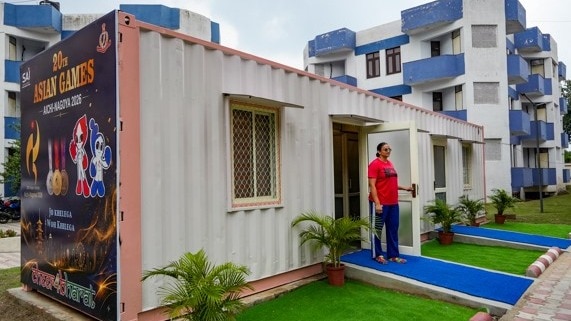
SAI has constructed specialized container rooms at its facilities in Patiala and Bengaluru. The objective is to allow Indian athletes to experience and adapt to the confined, non-traditional living quarters they will encounter in Japan. By spending nights in these containers, athletes are being trained to normalize the environment, ensuring that the novelty of the accommodation does not disrupt their focus or sleep cycles during the actual event.
Why This Matters
BozokMedia analysis shows that elite performance is heavily dictated by environmental stability. Sudden changes in living conditions, such as cramped spaces or unfamiliar amenities, can trigger stress and affect an athlete's circadian rhythm, potentially leading to a decline in performance during critical moments of competition.
The goal is to ensure the athlete's mind remains focused on the game, not the room they are sleeping in.
Two-time Asian Games champion shotputter Tajinderpal Singh Toor, who stands at 6'4", shared his experience, noting that while the space is limited, the containers are equipped with all necessary amenities. Similarly, discus thrower Seema Kaliramana mentioned that while the initial experience was challenging due to the space required for her equipment, her body and mind began to synchronize with the environment by the second day.
The technical design of these containers is highly optimized. Measuring approximately 13 meters in length and 3 meters in width, each unit features two twin-sharing bedrooms, a narrow corridor, split ACs, a small laundry area, and a compact kitchenette equipped with a fridge and sink. The bathrooms are strategically partitioned into separate zones for the washbasin, toilet, and shower to maximize utility in a small footprint.
Interestingly, these containers are not new acquisitions. They were previously repurposed during the COVID-19 pandemic to store weightlifting and athletics equipment at NSNIS Patiala. Now, they serve as 'psychological simulators.' Post-Asian Games, SAI plans to convert these units into permanent guest house accommodations.
Frequently Asked Questions
Question 1: Why aren't athletes staying in a traditional village?
Answer: Due to the specific hosting arrangements in Japan, athletes will be accommodated in containers and cruise ships rather than a standard village.
Question 2: Is this a physical training program?
Answer: No, it is primarily a psychological conditioning program to help athletes adapt to their future living environment.