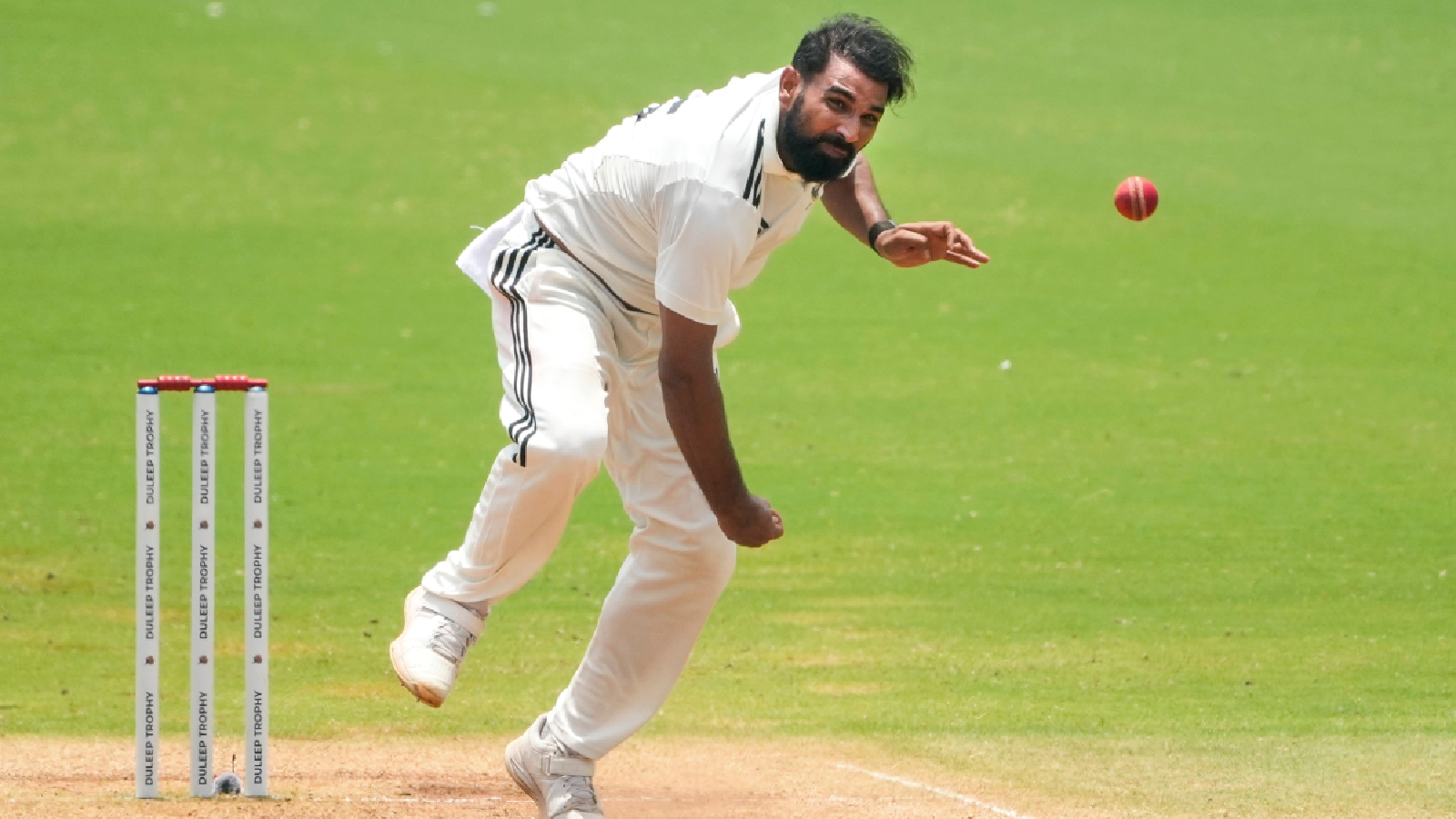
Mohammed Shami delivered a clinical bowling performance in the Duleep Trophy final, providing a stark contrast to Mohammed Siraj's struggles. Shami's precision and tactical execution on a flat Chepauk pitch underscored the gap in control between the two pacers.
- Mohammed Shami took 2/17 in 11 overs, showcasing elite control on a flat Chennai deck.
- Shami and Mukesh Kumar utilized short bursts and meticulous ball maintenance to induce reverse swing.
- Mohammed Siraj struggled with consistency and length, contrasting sharply with Shami's disciplined approach.
In a high-stakes encounter during the Duleep Trophy 2026-27 final, veteran pacer Mohammed Shami provided a textbook demonstration of seam bowling on Day 3. While the South Zone batters attempted to grind out a response to East Zone's massive total of 708, Shami’s spell of 11-4-17-2 served as a masterclass in patience and precision on a challenging red-soil pitch at Chepauk.
The conditions in Chennai were grueling, with temperatures soaring in the mid-30s and oppressive humidity. To combat this, Shami and Mukesh Kumar adopted a strategic approach, bowling in short, high-intensity bursts of two to four overs. This tactical decision ensured they maintained maximum effort on every delivery, avoiding the cramps and fatigue that often plague bowlers in such climates.
Why This Matters
BozokMedia analysis shows that this performance is not merely about wickets, but about the technical disparity between an established master and a struggling peer. While Mohammed Siraj wasted early seam-friendly conditions on Day 1 with wayward lengths, Shami's ability to hit the seam consistently proves that technical discipline outweighs raw pace on flat Indian tracks. This serves as a critical lesson for the younger generation of Indian fast bowlers.
Shami's success was rooted in the basics: landing the ball hard on the seam and meticulously maintaining the ball's condition. By repeatedly polishing one side and applying sweat, Shami and Mukesh managed to extract reverse swing on a surface where the ball typically scuffs up quickly. This attention to detail was the catalyst for the dismissal of Shaik Rasheed, who was trapped lbw by a delivery that nipped back sharply.
The ability to adapt to flat decks through meticulous ball maintenance and disciplined lines is what separates a good bowler from a world-class match-winner.
The partnership between Shami and Mukesh Kumar effectively choked the South Zone scoring rate. After the early wickets of Ricky Bhui and N Jagadeesan, Devdutt Padikkal and Rasheed attempted to stabilize the innings. However, Shami's second spell dismantled the resistance, leading to a collapse that left South Zone trailing by 466 runs by the end of the day.
The contrast was most evident when comparing Shami's economy and strike rate to Siraj's recent form. Siraj, who has been off-color since the Sri Lanka Tests, witnessed firsthand how to operate on a pitch that offers little to the bowlers. Shami's efficiency in the 'channel' outside off-stump eventually removed Smaran Ravichandran, further cementing East Zone's dominance.
| Feature | Mohammed Shami (East Zone) | Mohammed Siraj (South Zone) |
|---|---|---|
| Day 3 Figures | 11-4-17-2 | Struggled with Length |
| Strategy | Short Bursts & Seam Control | Wayward & Short-pitched |
| Ball Maintenance | High (Reverse Swing focus) | Low Effectiveness |
Frequently Asked Questions
What was the key to Shami's success on the flat Chepauk deck?
Shami focused on landing the ball hard on the seam and meticulously polishing the ball to achieve reverse swing.
How did East Zone's bowling strategy differ from South Zone's?
East Zone used short, intense bowling spells to maintain energy and precision, whereas South Zone struggled with consistency and leaking runs.