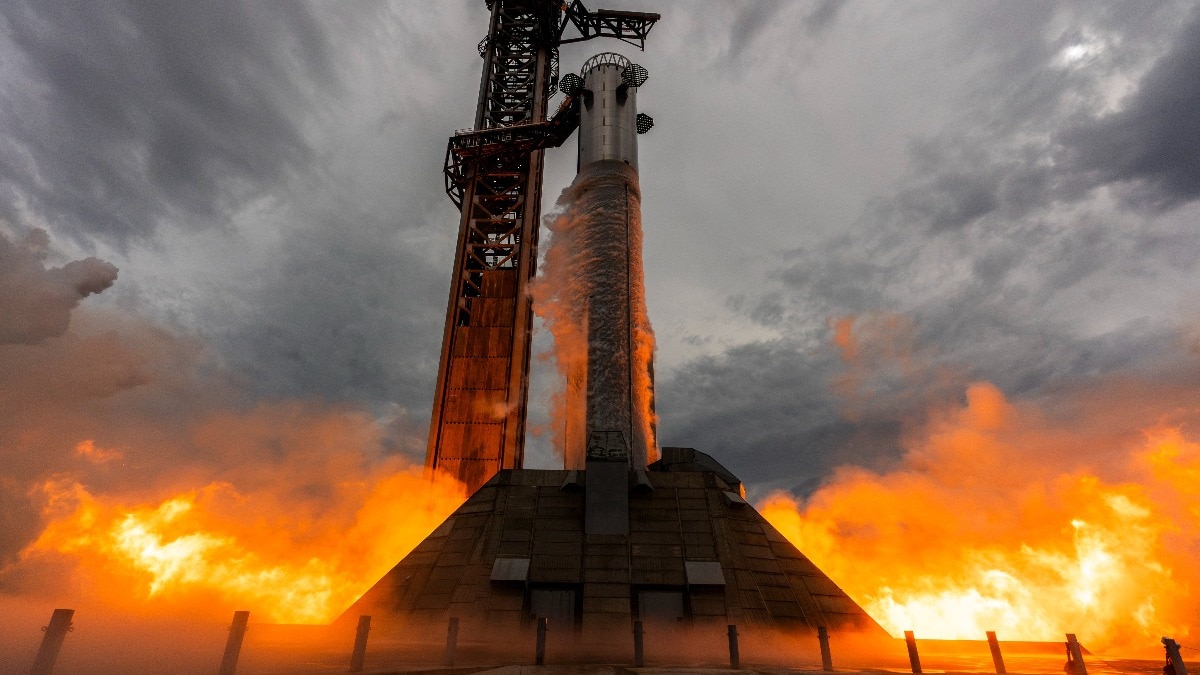
SpaceX ignited all 33 Raptor engines on its Starship prototype, marking a pivotal step toward fully reusable interplanetary travel. The test underscores the company's push to make lunar and Martian missions more affordable and reliable.
मुख्य बिंदु (Key Takeaways)
- SpaceX simultaneously fired 33 Raptor engines on Starship
- The test aims to validate reliability of fully reusable launch systems
- Implications for upcoming lunar and Mars missions are significant
In a landmark demonstration last week, SpaceX activated every one of the 33 Raptor engines on its Starship prototype. Dubbed a “full‑engine fire,” the 30‑second burn evaluated the coordinated performance of the most powerful rocket ever built, while probing the durability of its reusable architecture.
Technical Overview
Starship’s propulsion suite consists of 18 sea‑level and 15 vacuum‑optimized Raptor engines, each capable of delivering over 200 meganewtons of thrust. When fired together, they generate roughly 7.5 million pounds of thrust, enough to push the massive vehicle beyond low‑Earth orbit. The recent test deliberately ignited all engines simultaneously, measuring thrust uniformity, vibration spectra, and thermal loads across the vehicle’s structure.
Historical Context
Since early 2023, SpaceX has conducted a series of incremental tests on Starship prototypes, culminating in this full‑engine demonstration. Elon Musk, the company’s founder, hailed the event as “the beginning of a new era in spaceflight,” emphasizing how reusability at this scale could revolutionize access to space. The achievement aligns with NASA’s Artemis program and the long‑term goal of establishing a sustainable human presence on the Moon and Mars.
Future Prospects
Successful validation paves the way for Starship’s first orbital flight, cargo deliveries to the International Space Station, and eventually crewed missions beyond Earth. Analysts project that the cost per kilogram to orbit could drop by up to 90 % once the vehicle’s rapid turnaround is proven, potentially opening the market to new commercial players and emerging space nations.
Challenges Ahead
Despite the triumph, the test also highlighted formidable engineering hurdles. The combined acoustic, vibrational, and thermal stresses on the vehicle’s skin and internal systems demand rigorous long‑term monitoring. SpaceX must now focus on refining heat‑shield materials, engine throttling algorithms, and rapid‑refurbishment processes to ensure safe, repeatable launches.


