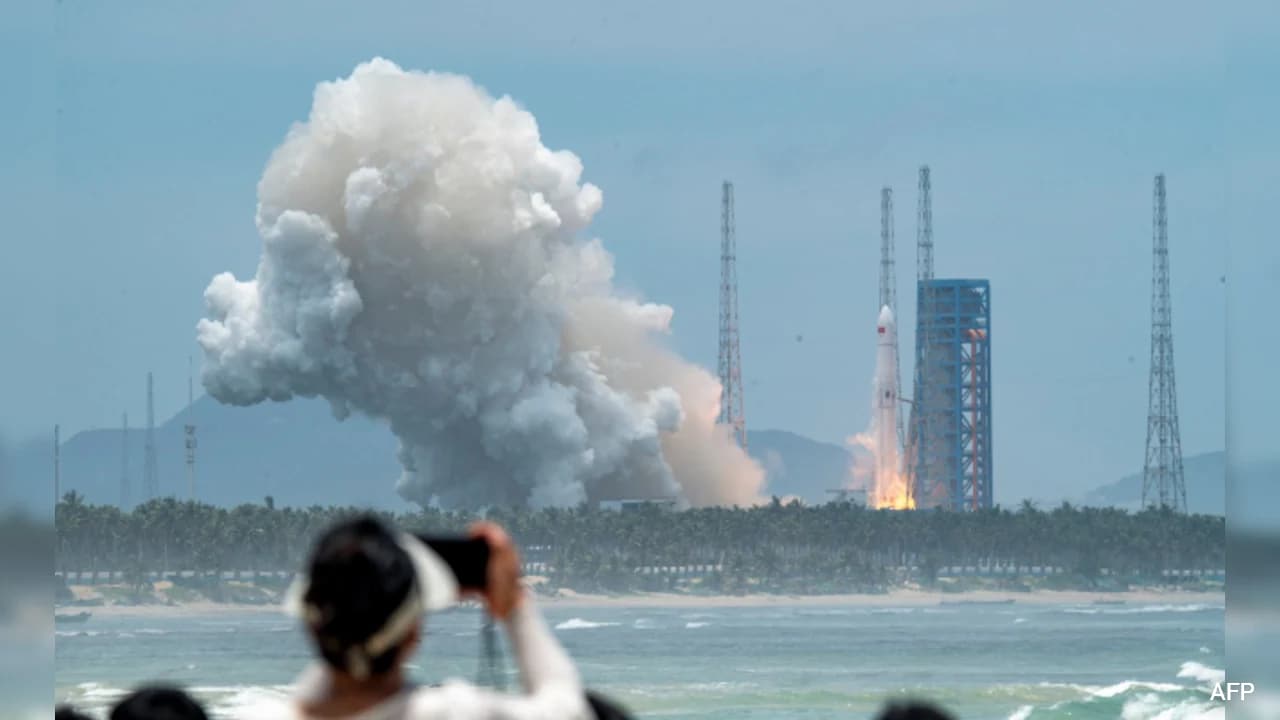
China's successful launch of the Long March‑10B carrier rocket from Hainan signals a rapid acceleration in its space capabilities. As the United States pushes ahead with cutting‑edge innovations, the rivalry has shifted from discovery to industrial speed.
मुख्य बिंदु (Key Takeaways)
- The Long March‑10B launch showcases China’s advancing rocket technology.
- The US continues to lead in rapid innovation and prototype development.
- Space competition now centers on industrialisation speed rather than mere discovery.
The Long March‑10B carrier rocket lifted off from the Hainan Commercial Spacecraft Launch Site, marking a milestone in China’s transition from experimental testing to regular commercial operations. First flight‑tested in 2023, the vehicle now promises higher payload capacity, reduced launch costs, and partial re‑usability, reinforcing China’s ambition for autonomous and reliable access to orbit.
Historical Context
Since the Cold War era, space has been a barometer of national power. The United States secured early dominance with multi‑stage launch systems in the 1990s, while China entered the human‑spaceflight arena in the early 2000s. Today the contest has evolved beyond satellite deployment; it focuses on rapid rocket manufacturing, re‑usability, and commercial viability.
America’s Innovation Engine
The United States has leveraged a vibrant private‑sector ecosystem—SpaceX, Blue Origin, Relativity Space—to accelerate prototype cycles and achieve reusable launch vehicles. In 2024, these firms delivered heavy‑lift missions to lunar orbit, granting the U.S. both economic returns and a technological edge.
China’s Industrial Momentum
China’s Long March‑10B launch signals its shift from experimental to production‑grade capability. By integrating larger payloads, cost‑effective launch services, and nascent reusable components, the rocket positions China as a formidable competitor in the global satellite market. Analysts predict a cascade of domestic contracts and foreign investment as China demonstrates consistent launch reliability.
Future Outlook and Risks
While the U.S. maintains its lead in breakthrough innovation, China’s aggressive industrialisation is reshaping the strategic balance in space. Diverging regulatory frameworks, security concerns, and differing technical standards could limit bilateral cooperation, turning the arena into a new front of geopolitical tension. This “new cold war” will influence not only scientific progress but also economic and strategic calculations worldwide.



