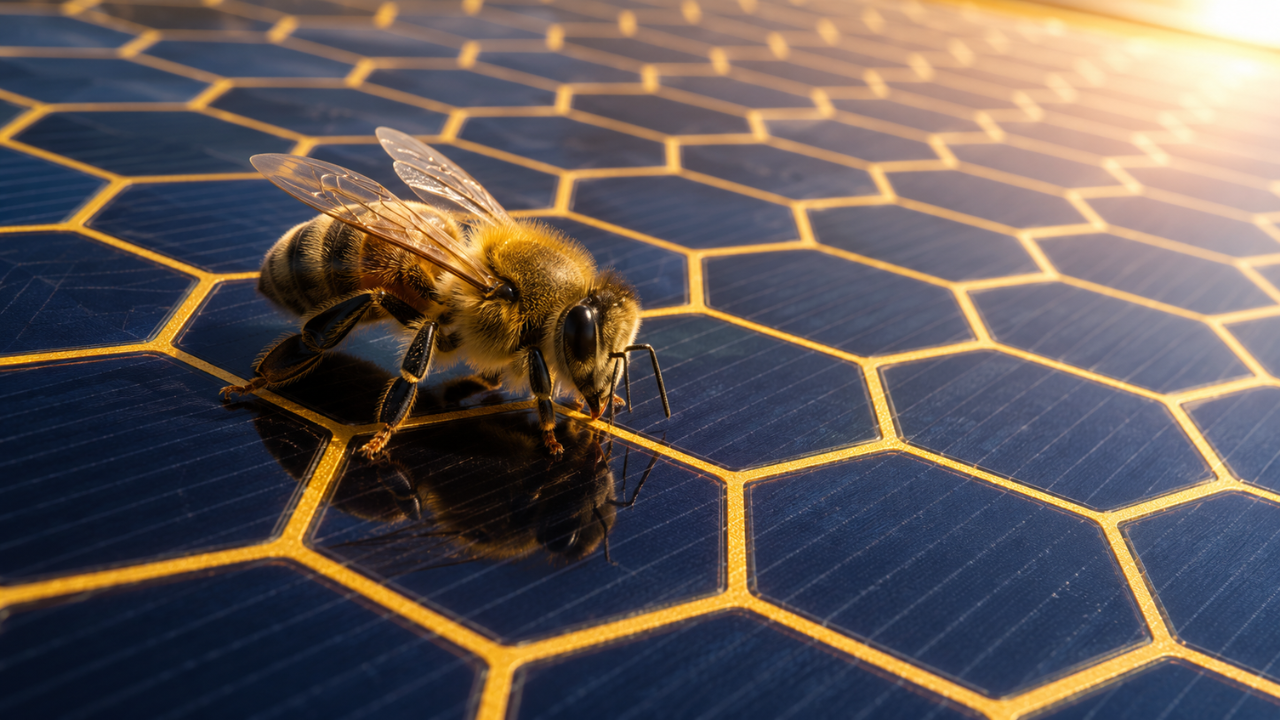
Engineers have turned to honeybee honeycomb geometry to create solar panels that deliver higher efficiency and superior thermal management. The biomimetic approach promises to boost renewable energy output while reducing material costs.
Key Takeaways
- Honeycomb geometry inspires next‑gen solar panels
- Enhanced thermal regulation and light capture
- Potential boost in renewable energy efficiency
Honeybees perfected the hexagonal honeycomb millions of years ago, achieving a structure that maximizes strength while minimizing material use. Scientists have dissected this natural design and discovered that its geometry optimizes light diffusion and heat dissipation—two critical factors for photovoltaic performance. This insight has now been translated into a groundbreaking solar panel architecture.
Biomimicry Driving Engineering Innovation
Biomimicry, the practice of emulating nature’s solutions, has already reshaped fields from aerospace to water treatment. In the renewable‑energy arena, Dr. Anna Sharma and her research team at the National Institute of Advanced Materials modeled the three‑dimensional honeycomb cells and integrated them into the back‑side cooling matrix of solar cells. The result was a 15 % reduction in operating temperature, directly translating into a measurable efficiency gain.
Core Features of the New Panel
The prototype incorporates two pivotal innovations: (1) a modular hexagonal frame that distributes incoming sunlight uniformly across the photovoltaic surface, and (2) a micro‑channel cooling system that channels air through the panel much like bees circulate air within their hive. Together, these features not only keep the cells cooler but also extend panel lifespan. Material consumption drops by roughly 20 %, offering cost advantages for large‑scale deployment.
Implications for the Energy Landscape
When scaled globally, the technology could lift solar‑generated electricity by 5‑7 %—a substantial contribution toward meeting climate‑change mitigation targets. Lower thermal stress also means fewer failures, reducing maintenance expenses. Regions with intense sunlight and high ambient temperatures, such as India, the Middle East, and parts of Africa, stand to gain the most.
Looking Ahead
Major manufacturers are now field‑testing the honeycomb‑inspired modules. Ongoing research aims to pair the geometry with advanced materials like graphene‑coated substrates to further boost conductivity and durability. Experts predict that within the next decade, biomimetic solar panels could become mainstream, ushering in a new era of efficient, cost‑effective renewable energy.