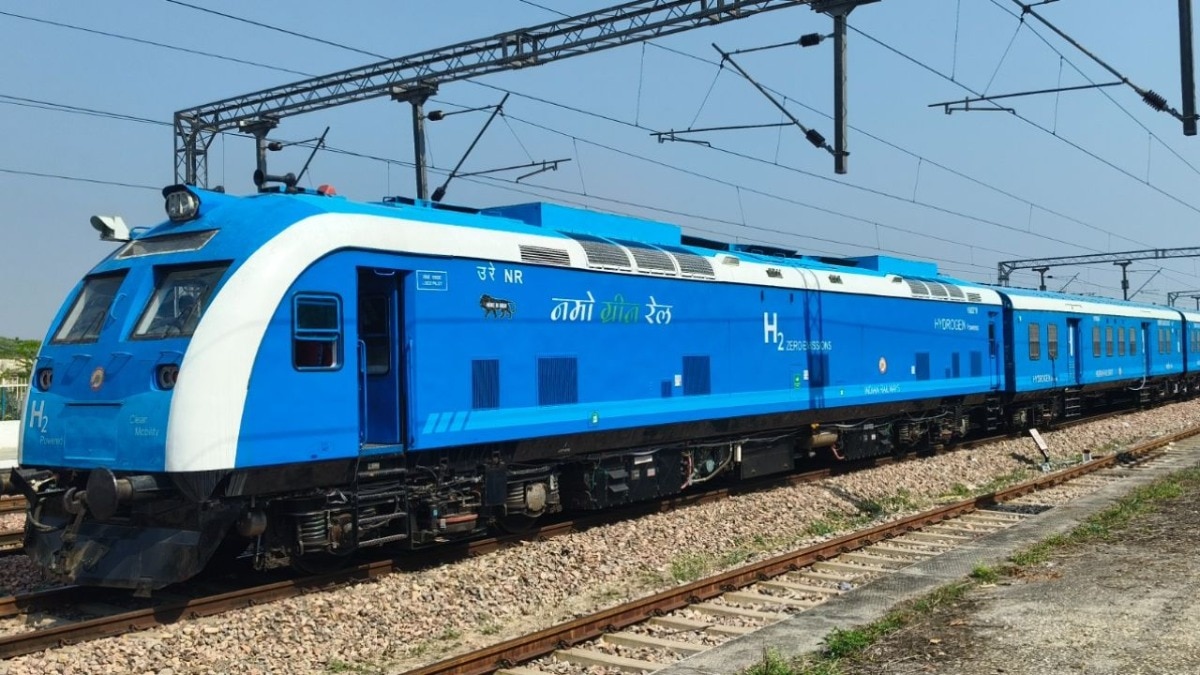
Prime Minister Narendra Modi is set to flag off India's maiden hydrogen-powered train from Jind, Haryana, marking a massive leap toward zero-emission transportation.
Key Takeaways
- PM Narendra Modi will flag off India's first hydrogen train from Jind, Haryana, this Friday.
- The 10-coach trainset will operate on the 89-km Jind-Sonipat route.
- The technology uses hydrogen fuel cells to generate electricity, emitting only water vapor.
- A state-of-the-art hydrogen refueling ecosystem has been established at Jind.
In a landmark move for sustainable infrastructure, Prime Minister Narendra Modi will officially inaugurate India's first hydrogen-powered train service from the Jind railway station in Haryana this Friday. This technological breakthrough signifies a paradigm shift in the Indian Railways' journey, transitioning from coal and diesel toward a future defined by clean, renewable energy.
The Science of Clean Motion
Unlike conventional electric locomotives that rely on overhead catenary lines, the Hydrogen Fuel Cell Trainset functions as a mobile power plant. By facilitating a chemical reaction between stored hydrogen and atmospheric oxygen, the train generates electricity internally to power its traction motors. The most significant environmental advantage is that the only by-products of this process are water vapor and heat, ensuring zero tailpipe carbon emissions. While global pilot projects in countries like Germany and China often utilize smaller 2-to-4 coach configurations, India has scaled this technology with a robust 10-coach trainset capable of carrying approximately 2,600 passengers.
Uncompromising Safety Standards
Recognizing the sensitivities associated with hydrogen storage, the Indian Railways has implemented a sophisticated, multi-layered safety architecture. The train is equipped with advanced sensors designed to detect hydrogen leaks, thermal anomalies, flames, and smoke within seconds. An automatic shut-off system is integrated to immediately cease hydrogen supply upon detecting any irregularity. Furthermore, continuous ventilation systems ensure that any trace amounts of leaked gas are safely diluted into the atmosphere. The Jind facility itself is a massive integrated ecosystem featuring advanced storage, compression, and dispensing infrastructure.
Strategic Implications and Future Scaling
The Jind-Sonipat section, spanning 89 km, serves as the ultimate proving ground for this technology. With an operational speed of 75 kmph and a design speed of 110 kmph, this route will demonstrate the reliability of hydrogen propulsion under real-world conditions. Looking ahead, the Indian Railways intends to leverage the data from this project to introduce hydrogen technology on iconic heritage routes, such as the Kalka-Shimla line. This initiative is a critical component of India's broader strategy to achieve net-zero emissions and reduce dependence on imported fossil fuels.