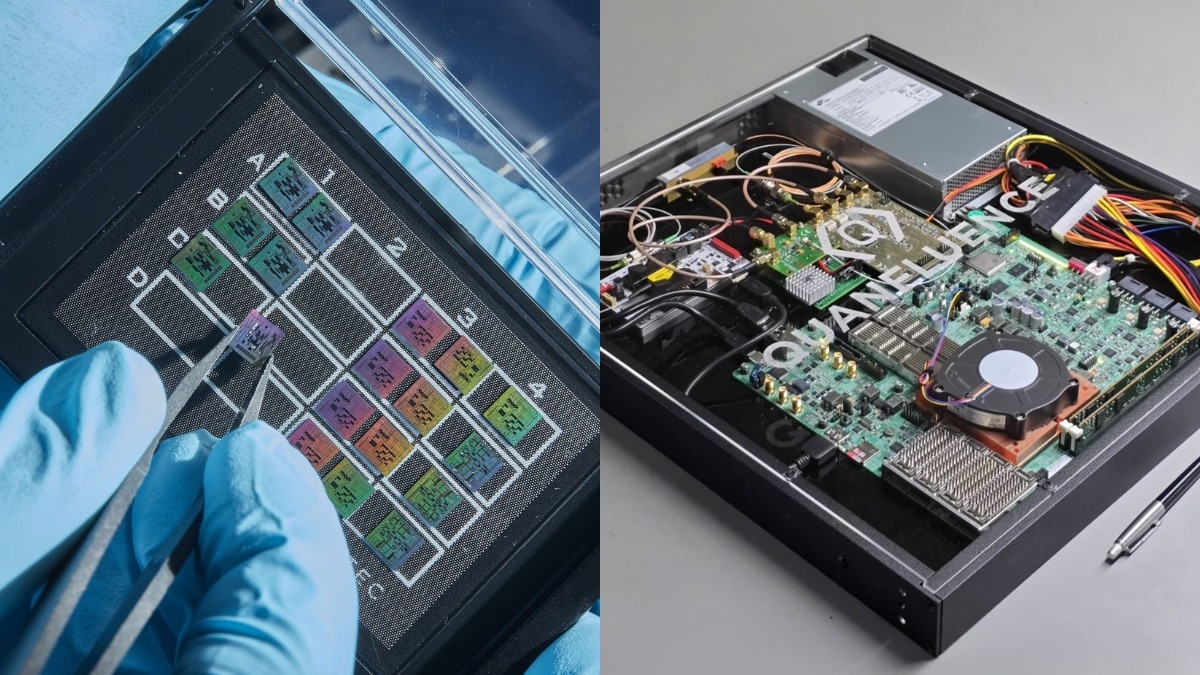
Quantum computers need near‑absolute‑zero temperatures to operate, limiting their practicality. Bengaluru‑based Quanfluence proposes a light‑based approach that could make room‑temperature quantum computing a reality.
Key Takeaways
- Quantum computers currently require ultra‑low temperatures near -273 °C.
- Quanfluence proposes a photonic approach that could operate at room temperature.
- The startup’s Optical Ising Machine is already commercialised for complex optimisation tasks.
Quantum computers promise exponential speed‑ups for problems that are intractable for today’s supercomputers, but their need for cryogenic environments has kept them confined to specialised labs.
Industry giants such as Google and IBM rely on massive cryogenic refrigerators to keep superconducting qubits stable, driving up costs and limiting scalability.
In Bengaluru, the startup Quanfluence is betting on light‑based photonic circuits instead of superconducting electronics, aiming to eliminate the need for extreme cooling.
Founded by serial entrepreneurs Sujoy Chakravarty, Ravi Mehta and Biman Chattopadhyay—who previously sold Silicon and Beyond to Synopsys—the team explored superconducting, ion‑trap and photonic architectures before selecting photonics as the most practical for India’s infrastructure constraints.
The company’s first marketable product, an Optical Ising Machine, leverages photonic optimisation to solve complex planning problems for enterprises, demonstrating the viability of light‑driven computation.
Historical Background
The quest for quantum computing began in the 1980s, with early proposals focusing on superconducting circuits that required temperatures close to absolute zero. Over the decades, researchers have pursued various qubit technologies—including trapped ions, topological qubits and, more recently, photonic qubits—to overcome decoherence and scaling challenges.
Why This Matters
BozokMedia analysis shows that a room‑temperature photonic quantum computer could dramatically lower entry barriers, enabling wider adoption across Indian industries such as pharmaceuticals, logistics and finance.
"Photonics offers a scalable pathway to quantum advantage without the prohibitive costs of cryogenics," says Dr. Ananya Rao, quantum‑technology analyst.
Frequently Asked Questions
- Can photonic quantum computers replace superconducting ones? While photonic systems excel in certain optimisation tasks, they currently complement rather than replace superconducting qubits for universal quantum computing.
- When might a room‑temperature quantum computer be commercially available? Experts estimate a viable product could emerge within the next 5‑7 years as photonic integration matures.