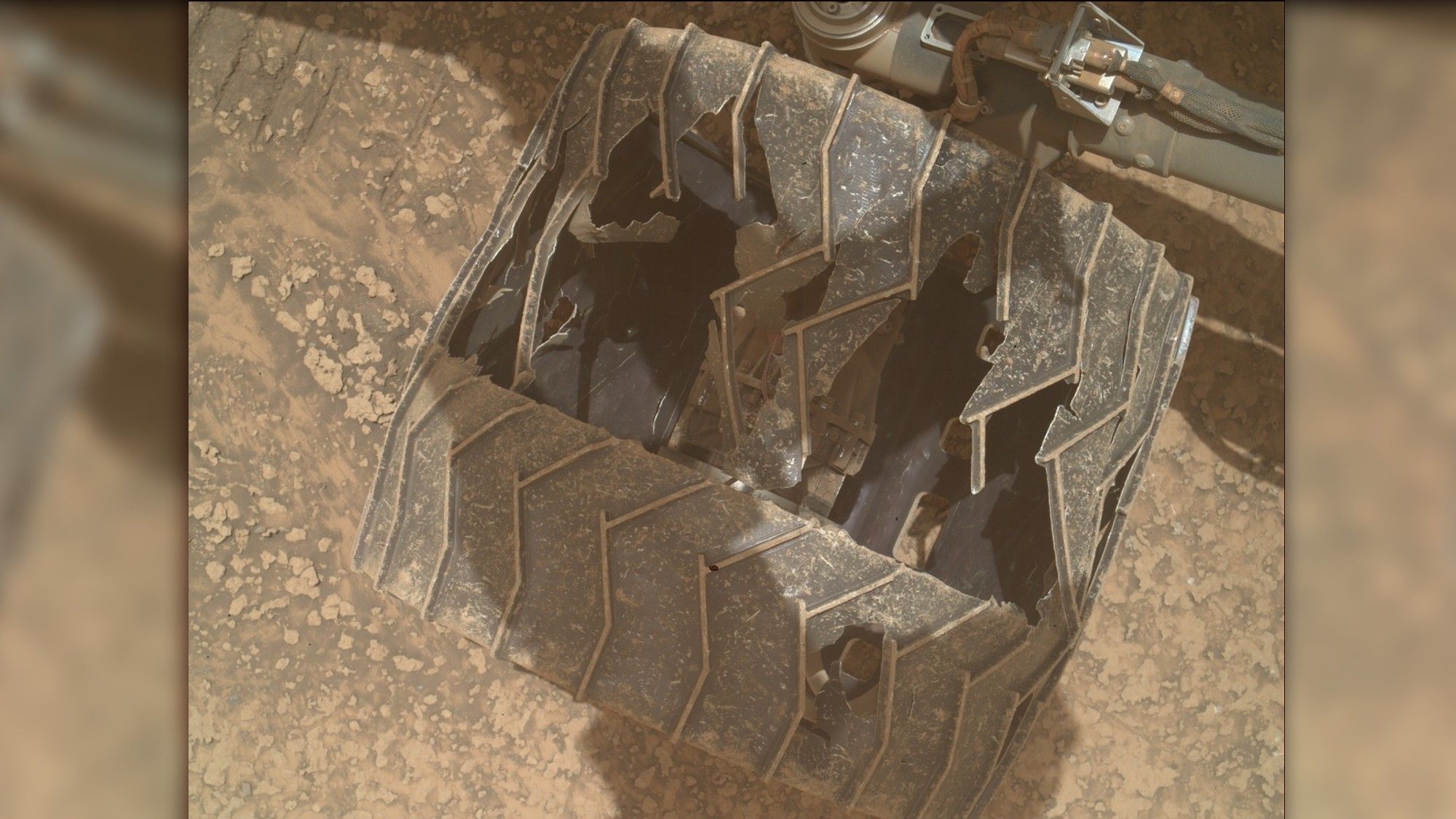
NASA's Curiosity Mars rover has beamed back striking new close-up images of its heavily damaged wheels after nearly 14 years of traversing the rugged Martian terrain. Despite the deep cracks and holes, mission engineers confirm the one-ton robotic explorer remains fully operational. These images highlight the extreme challenges of interplanetary exploration.
Key Takeaways
- Curiosity took close-up images of its damaged wheels on July 23, 2026 (Sol 4963).
- The rover has traveled over 20 miles (32 km) across Gale Crater since landing in 2012.
- Despite significant cracks and holes, JPL engineers confirm the wheels are holding up remarkably well.
NASA's Curiosity Mars rover has experienced serious wear and tear during its nearly 14 years exploring the Red Planet. A new photo posted to Curiosity's raw image server offers a stark, close-up view of the damage one of the rover's wheels has sustained while traversing the rugged, unforgiving Martian surface.
The image, captured by the rover's Mars Hand Lens Imager (MAHLI) on July 23, 2026, or Sol 4963 of its mission, shows gaping holes and structural cracks in the aluminum skin. Because Curiosity weighs over a ton and the terrain in Gale Crater is extremely rocky, the thin metallic wheels have taken a brutal beating over the years.
Curiosity vs. Perseverance: Wheel Comparison
To prevent similar damage on future missions, NASA redesigned the wheels for its newer Perseverance rover. The table below highlights the key structural differences:
| Feature | Curiosity Rover (2012) | Perseverance Rover (2020) |
|---|---|---|
| Wheel Material | Thin Aluminum (0.75 mm) | Thicker, Redesigned Aluminum |
| Tread Design | Chevron pattern with Morse code holes | Gently curved, denser treads |
| Damage Susceptibility | High (prone to punctures/cracks) | Low (optimized for sharp rocks) |
Why This Matters
BozokMedia analysis shows that these wear-and-tear patterns provide invaluable telemetry for designing future Mars exploration vehicles, including crewed rovers. By studying how these materials degrade under extreme thermal cycles and abrasive soils, aerospace engineers can build more resilient interplanetary machinery.
"The wheels are taking a beating, but they were engineered with remarkable structural redundancy to keep the mission rolling despite severe physical degradation."
Historical Background
Curiosity landed in Mars' Gale Crater on August 5, 2012, touching down using the revolutionary 'sky crane' maneuver. Since then, the rover has traveled over 20 miles (32 kilometers) across the Martian soil, searching for potential signs of ancient microbial life and analyzing the planet's climate and geology. Despite the battle scars on its wheels, the mission continues to redefine our understanding of the solar system.
Frequently Asked Questions
1. Will the cracked wheels stop Curiosity from moving?
No. NASA engineers designed the wheels with internal stiffeners. Even if pieces of the outer skin break off entirely, the structural ribs are robust enough to allow Curiosity to continue its science mission for years to come.
2. How does NASA monitor the wheel damage?
The mission team conducts periodic "wheel imaging" sessions using the MAHLI camera on the rover's robotic arm to track the progression of cracks and plan safer driving routes over smoother terrain.