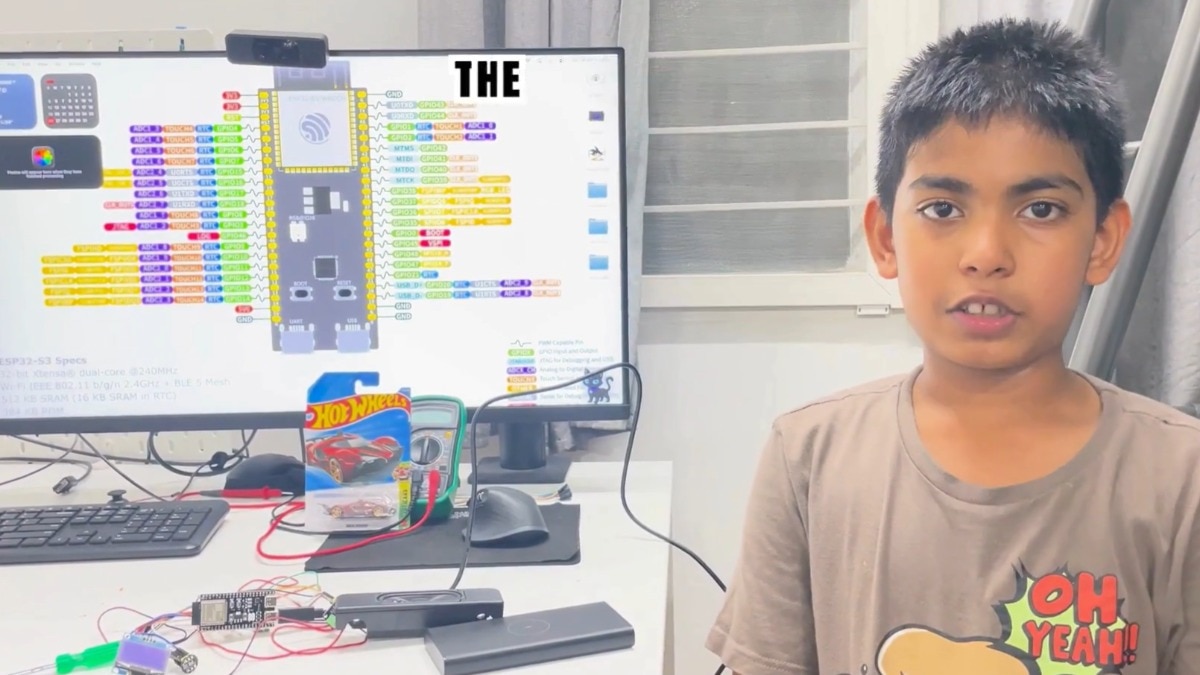
Eight‑year‑old Indian prodigy Laksh has engineered a voice‑controlled AI storytelling gadget that runs entirely offline on an ESP32‑S3 microcontroller, costing just ₹760. The project showcases the power of open‑source models combined with ultra‑low‑cost hardware.
Key Takeaways
- Fully offline AI operation on ESP32‑S3
- Hardware cost under $8 (₹760)
- Voice commands generate, read, and animate stories
New Delhi—Eight‑year‑old developer Laksh assembled a voice‑controlled AI storytelling device using an ESP32‑S3 microcontroller, an INMP441 microphone, a MAX98357A amplifier, and an I2S speaker, all for roughly ₹760 ($8).
The system requires no Wi‑Fi, cloud services, or external APIs, making it ideal for schools and remote areas where internet connectivity is scarce. All processing happens on the chip itself, ensuring privacy and low latency.
Laksh leveraged an open‑source language model called TinyStories LLM for ESP32, originally designed to generate short tales without internet access. He enhanced it with voice interaction, playback controls, and simple animations, and released the source code on GitHub for community development.
During a live demo, Laksh instructed the device with “Make a funny story.” The AI instantly crafted a humorous narrative, read it aloud, and displayed animated visuals. Users could then command “play,” “pause,” “resume,” or “next story” to control playback—all offline.
The next development goal is improving the text‑to‑speech (TTS) quality, as the current English voice sounds robotic. Enhancing TTS will make the storytelling experience more natural and engaging.
Why This Matters
BozokMedia analysis shows that low‑cost, offline AI solutions can bridge the digital divide in emerging markets, delivering educational content without reliance on unstable internet connections.
"This offline AI prototype could revolutionize education, especially in underserved regions," says Dr. Anita Sharma, Professor of Robotics at Delhi University.
Frequently Asked Questions
Q1: Can the device support languages other than English?
A1: The current model is English‑centric, but the open‑source code can be retrained for Hindi or other languages.
Q2: Is it possible to add internet connectivity later?
A2: Yes, the ESP32 hardware already includes Wi‑Fi, enabling optional cloud‑based features in future upgrades.


