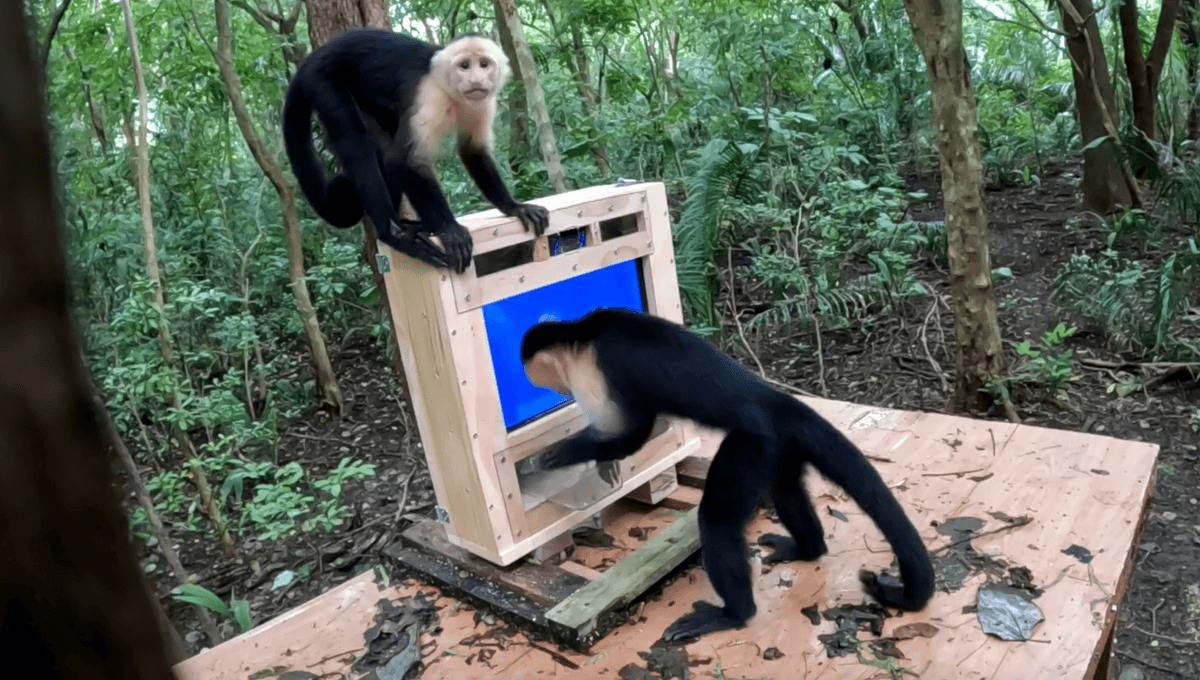
Scientists have deployed 'CapuchinAI', a cutting-edge artificial intelligence system, in the Costa Rican jungle to study the intelligence of wild capuchin monkeys. This breakthrough could redefine our understanding of animal cognition.
Key Takeaways
- Researchers deployed 'CapuchinAI', a custom-built AI system, in Costa Rica's Taboga Forest Reserve.
- The system uses facial recognition to identify individual white-faced capuchin monkeys.
- Monkeys successfully learned to interact with the screen to receive food rewards like banana slices.
- This technology allows for non-invasive, rapid cognitive testing in natural habitats.
The tidal wave of artificial intelligence is reaching even the deepest jungles. In a groundbreaking study, scientists from Emory University and the Georgia Institute of Technology have introduced wild capuchin monkeys to a novel computer system known as 'CapuchinAI'. Located in the Taboga Forest Reserve of Costa Rica, this experiment aims to unlock the mysteries of primate intelligence.
The hardware itself is a marvel of DIY engineering. Built in a researcher's garage using parts from a local store, the system is housed in a weatherproof and wildlife-proof enclosure. Utilizing advanced facial recognition software, the system detects the presence of white-faced capuchins (Cebus imitator), triggering a vivid blue screen that captures their innate curiosity.
Why This Matters
BozokMedia analysis shows that this development represents a paradigm shift in primatology. Previously, conducting cognitive experiments in the wild required bulky, specialized apparatus. With CapuchinAI, researchers can simply code a new test and deploy it instantly via the screen, allowing for high-quality, comparable data across different species and locations.
"Capuchins are generally incredibly inquisitive animals. Whenever they encounter something new or unusual, they rapidly approach," stated Federico Sánchez Vargas, lead author of the study.
The results have been remarkable. During testing, monkeys discovered that specific interactions—such as pressing their lips to the screen—resulted in a banana slice reward. Out of 10 monkeys that initially interacted with the device, 8 demonstrated a full understanding of the task, anticipating rewards with precision.
Historical Background
This research draws inspiration from the legendary primatologist Frans de Waal, whose work revolutionized how humans perceive animal empathy, morality, and intelligence. CapuchinAI continues this legacy by providing a tool to observe complex behaviors in a natural setting without disrupting the animals' lives.
Frequently Asked Questions
1. How does CapuchinAI identify individual monkeys?
It uses specialized facial recognition software to distinguish between individual capuchins, allowing researchers to collect longitudinal data.
2. Can this system be used for other animals?
While currently optimized for smaller monkeys, the research team believes the system can be adapted for various other primate species.

