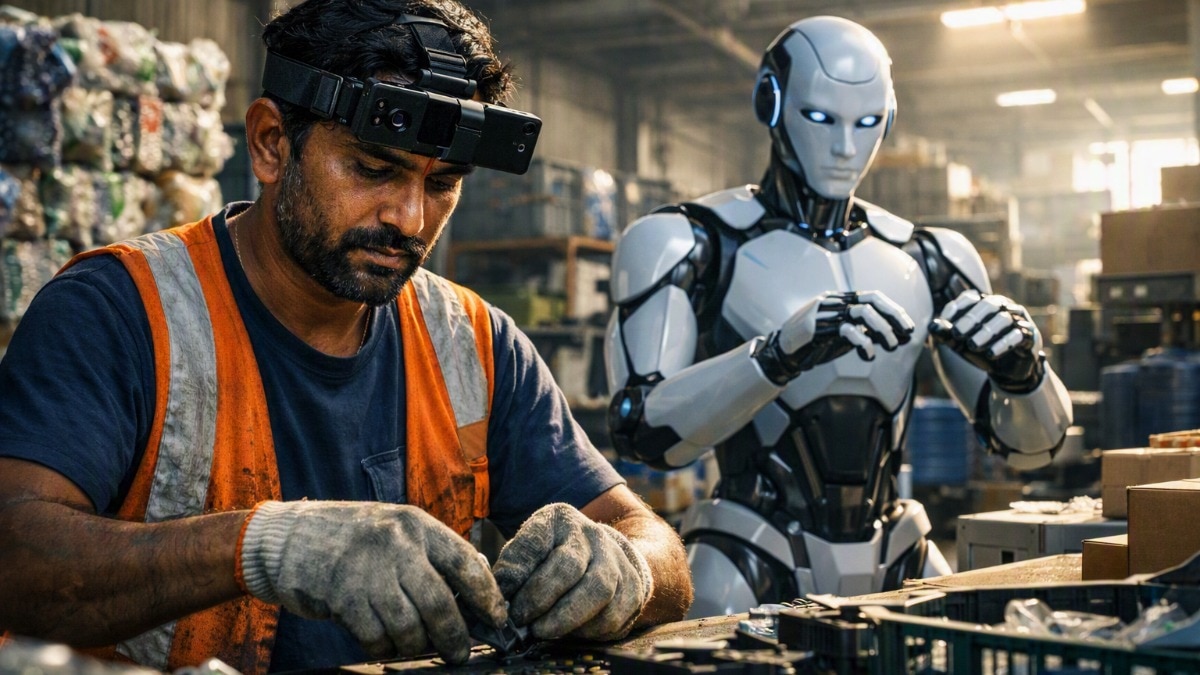
Workers across India are being paid extra to record their manual tasks, providing crucial data to train humanoid robots that could eventually automate their jobs.
Key Takeaways
- Indian laborers are recording daily tasks to help train global humanoid robots.
- Workers receive additional compensation, sometimes up to ₹150-300 extra per day.
- India is becoming a massive real-world data source for the global AI race.
- Privacy concerns arise as cameras may capture personal details and faces.
In the outskirts of New Delhi, 43-year-old Sunita Rathore performs a task that is increasingly common across the country. While sorting plastic waste, an iPhone strapped to her head records every precise movement of her hands. For this added layer of work, she earns an additional ₹150 per hour, a sum she uses to fund her children's education.
Sunita is part of a massive, quiet shift in the labor market. From textile factories to sprawling warehouses, Indian workers are being outfitted with cameras, motion-tracking gloves, and helmet-mounted devices. This footage is being harvested to solve the biggest hurdle in robotics: teaching machines how to navigate the messy, unpredictable movements of the real world.
Why This Matters
BozokMedia analysis shows that India holds a unique strategic advantage in the global AI race. While high-income nations have already automated many manual processes, India still possesses a massive workforce performing diverse manual tasks. This provides robotics startups with an unparalleled variety of human movement data—from folding clothes to picking up small objects—which is essential for perfecting humanoid robots.
Workers are effectively creating detailed instructional manuals for the very machines that could eventually render their labor obsolete.
The economic incentive is clear. Raw first-person video can fetch over $7 an hour, but highly annotated data—where specific movements are labeled—can command prices as high as $30 per hour.
Frequently Asked Questions
Q1: Is there a risk to worker privacy?
A: Yes. Cameras may unintentionally record faces, personal belongings, and domestic environments, raising significant consent and data protection issues.
Q2: Will robots actually replace these workers?
A: While it is not immediate, the goal of the companies collecting this data is to create robots capable of performing these exact manual tasks autonomously.