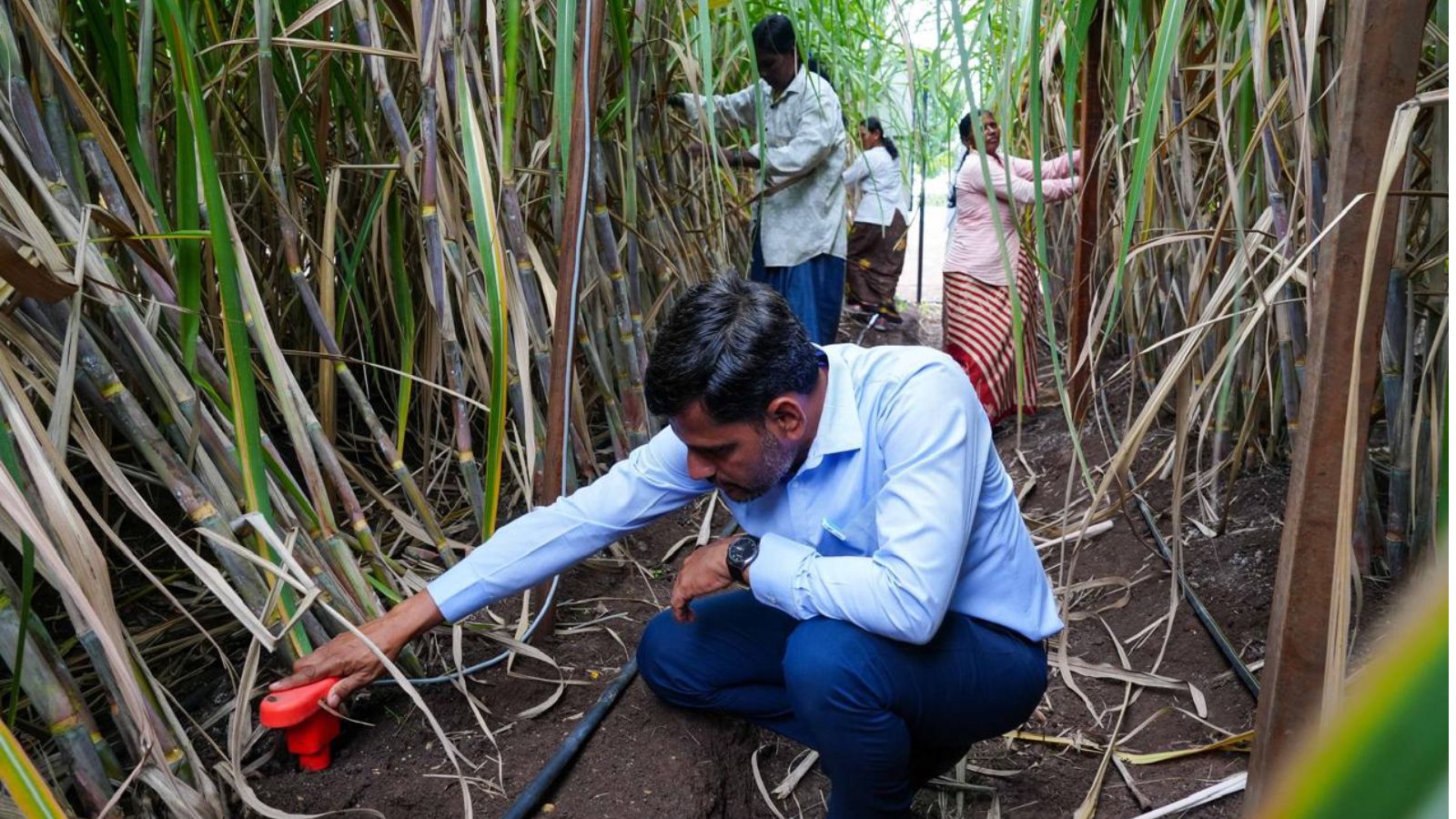
A groundbreaking 'Tiny AI' pilot project in Baramati, Maharashtra, has outperformed global agricultural benchmarks. Developed by the Agricultural Development Trust in collaboration with Oxford University and Microsoft, the system doubled sugarcane yields while slashing water and fertilizer usage.
Key Takeaways
- Baramati's "Tiny AI" pilot doubled sugarcane yields, beating global FAO benchmarks.
- The system reduced water consumption by 40-50% and fertilizer usage by 30%.
- Designed for fragmented Indian farms, it delivers low-cost, real-time alerts via SMS in local languages.
At a United Nations Food and Agriculture Organisation (FAO) summit in Rome, global experts were discussing the future of farming when a project from Baramati, a small town in Maharashtra, walked away with a title nobody expected: "superior to global benchmarks." In a pilot spanning 10,000 sugarcane farms, yields doubled, water use dropped by up to 50%, and fertilizer use fell by 30%. For context, standard AI-driven agricultural pilots worldwide typically report yield gains of just 15-20%.
What makes this story unique is its focus on small-scale practicality. Most agricultural AI is engineered for massive, industrialized farms in the US or Brazil. In India, farms are small, fragmented, and often share water sources. To solve this, the Agricultural Development Trust (ADT) built 'Tiny AI' from scratch. Co-developed with Oxford University and Microsoft’s FarmVibes team, it is lightweight enough to run over SMS on ordinary smartphones in low-bandwidth villages.
Why This Matters
BozokMedia analysis shows that the Baramati model democratizes artificial intelligence, proving that cutting-edge technology does not require expensive infrastructure to yield revolutionary results in developing nations. By tailoring tech to local constraints, it bridges the digital divide for smallholder farmers.
"The future of agriculture lies in combining farmers' experience with data-driven technology. When science becomes accessible, every farming decision becomes smarter," says Prof. Nilesh Nalawade, CEO of ADT Baramati.
The system operates on a simple, economical hub-and-spoke design. One automated weather station covers a 2.5-km radius (the hub), while low-cost soil sensors act as the spokes feeding in local data. Every 30 minutes, the system captures 12 parameters, including soil moisture, temperature, and sunlight. This data is analyzed using Microsoft Azure, and instead of complex dashboards, farmers receive plain-language actionable alerts in Marathi directly on their basic phones.
| Parameter | Traditional Farming | Tiny AI Smart Farming |
|---|---|---|
| Water Usage | High (Calendar-based schedule) | Optimized (40-50% reduction via sensor tracking) |
| Fertilizer Use | Excessive runoff/waste | 30% reduction (Targeted application) |
| Crop Yield | Standard baseline | Doubled (100% increase) |
The single biggest shift was moving away from calendar-based watering to evapotranspiration-based irrigation, meaning farmers water only when the crop actually needs it. Beyond sugarcane, this system is now expanding to pigeon pea, turmeric, banana, grapes, cotton, and soybean. Farmers in Uttar Pradesh, Madhya Pradesh, Tamil Nadu, and Karnataka have already begun adopting the system, showcasing its immense scalability.
Frequently Asked Questions
1. What is "Tiny AI" in the context of Baramati farming?
It is a lightweight AI system designed specifically for small, fragmented farms that delivers real-time agricultural recommendations via SMS, eliminating the need for high-end smartphones or internet connectivity.
2. How does the system save water?
By replacing fixed-schedule watering with evapotranspiration-based irrigation, which uses sensors to determine exactly when and how much water the soil needs.


