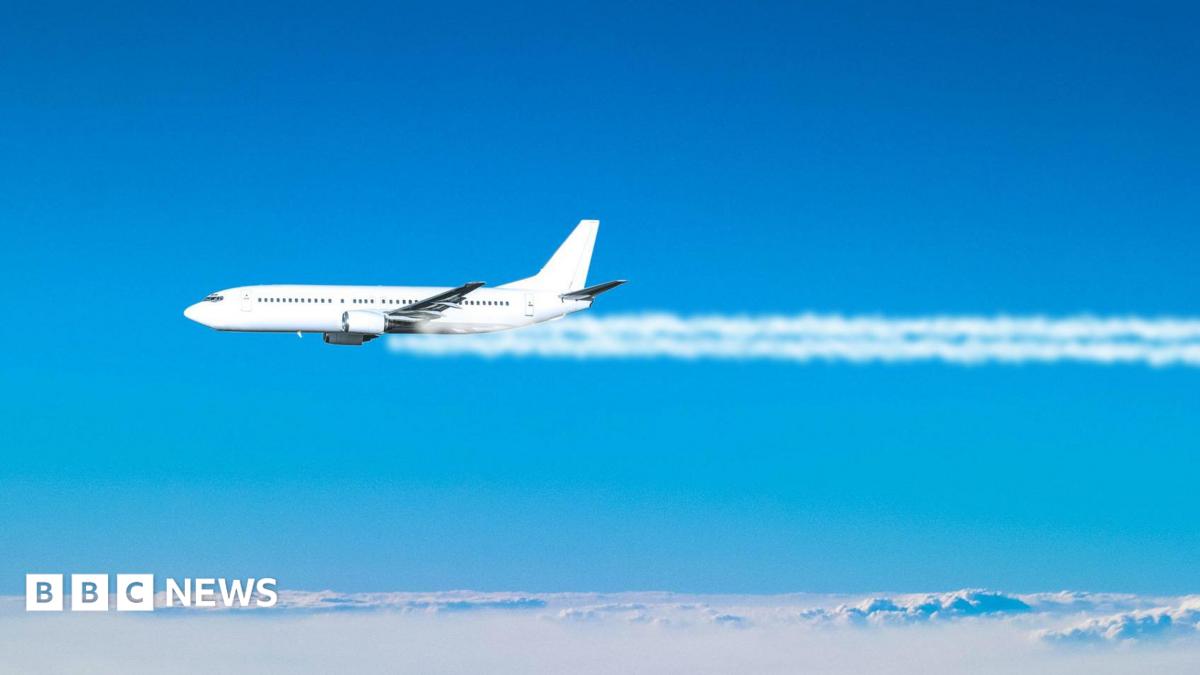
A groundbreaking £5m UK trial is set to test whether Artificial Intelligence can predict and prevent the formation of warming contrails left by aircraft. This 'Operation Blue Skies' aims to mitigate one of aviation's biggest climate impacts.
- Contrails (condensation trails) are estimated to contribute up to one-third of aviation's total climate warming impact.
- The 'Operation Blue Skies' project is a 30-month collaboration involving Google, the UK government, and leading universities.
- Small adjustments in flight altitude (approx. 2,000ft) can significantly reduce warming without major passenger disruption.
The white streaks trailing behind aircraft in the sky—known as contrails—are more than just a visual phenomenon; they are a significant driver of global warming. These icy clouds form when hot engine exhaust meets cold, humid air at high altitudes, trapping heat that would otherwise escape Earth's atmosphere. Now, a pioneering £5 million UK trial is set to deploy Artificial Intelligence (AI) to combat this 'sky graffiti.'
The project, titled 'Operation Blue Skies,' will test whether AI can predict where warming contrails are most likely to form. By identifying these specific atmospheric conditions, air traffic controllers can instruct pilots to adjust their flight paths slightly to avoid them. The trial will focus on the Shanwick Oceanic airspace in the North Atlantic, a corridor responsible for roughly 5% of global contrail warming.
Why This Matters
BozokMedia analysis shows that while the aviation industry has focused heavily on reducing direct CO2 emissions, the indirect impact of contrails has often been overlooked. As global air travel demand continues to rise, finding tech-driven solutions that do not require massive structural changes to flight paths is crucial for achieving net-zero goals.
Contrail warming is thought to be responsible for approximately one-third of all aviation-related climate warming.
This 30-month initiative brings together a powerhouse of expertise, including Google, the UK government, the Met Office, National Air Traffic Services (NATS), and researchers from the University of Cambridge and Imperial College London. Google will leverage satellite imagery and historical flight data to model weather patterns and predict contrail-prone zones.
To avoid these zones, aircraft will not need massive rerouting. Instead, pilots will be directed to change their altitude by approximately 2,000 feet. This maneuver is similar to those already used to avoid turbulence, meaning passengers are unlikely to notice any change in their journey. While some worry that changing altitude might increase fuel consumption, experts note that the CO2 penalty is less than 1%, whereas the climate benefit of preventing the contrail is significantly larger.
Frequently Asked Questions
Question 1: What exactly are contrails?
Answer: Contrails, or condensation trails, are ice crystals formed when hot jet exhaust meets the freezing air at high altitudes.
Question 2: Will this make flights more expensive due to fuel use?
Answer: While there may be a very slight increase in fuel use (less than 1%), the net benefit to the climate far outweighs the minimal increase in carbon emissions.


