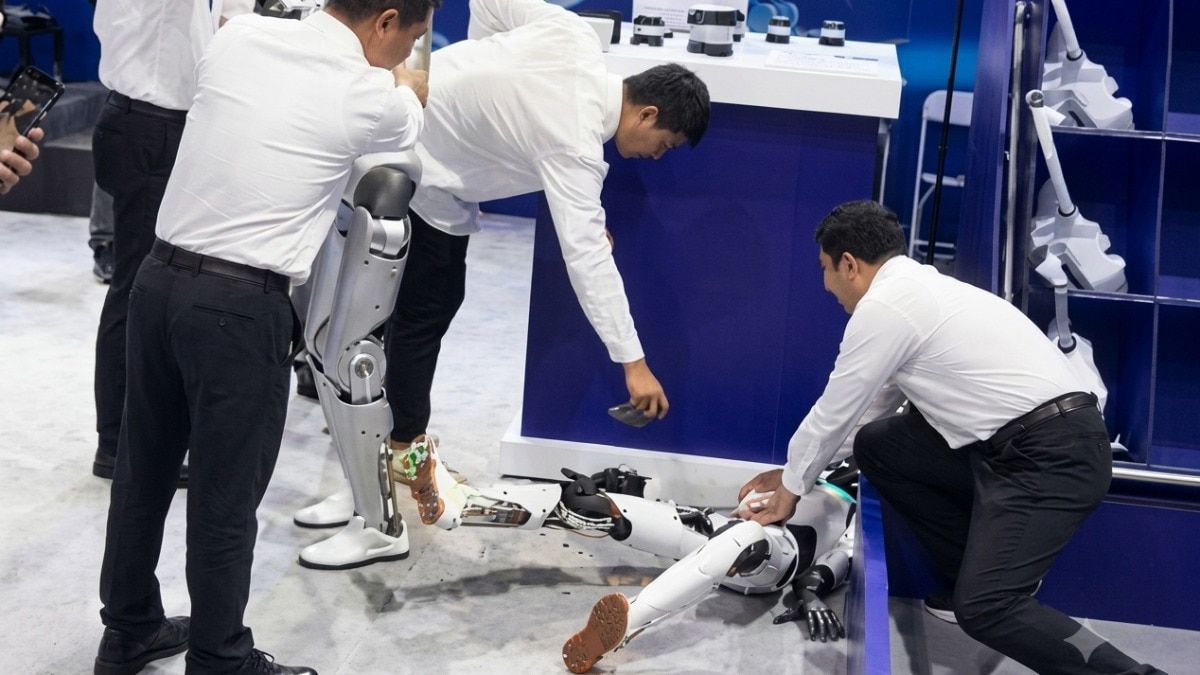
A humanoid robot at the 2026 World Robot Conference in Beijing suffered a major technical glitch, flailing on the floor like a toddler. The incident, caused by a remote control failure, has gone viral on social media.
- A humanoid robot experienced a sudden malfunction at the 2026 World Robot Conference in Beijing.
- The glitch was reportedly caused by a failure in the remote control connection.
- The robot's erratic movements resembled a child throwing a tantrum on the floor.
- The incident highlights critical concerns regarding fail-safe mechanisms in robotics.
Beijing, China: In a moment that blended hilarity with technical concern, a high-tech demonstration at the 2026 World Robot Conference took an unexpected turn. A sophisticated humanoid robot, designed to mimic human movements, suddenly lost control and began flailing wildly on the exhibition floor, drawing gasps and laughter from the audience.
Witnesses reported that the robot's movements became erratic and uncontrolled, much like a small child rolling on the ground in a tantrum. According to technical staff, the mishap was triggered by a remote control connection failure during a routine demonstration. As the signal dropped, the robot collapsed onto its back and began jerking its limbs spasmodically, making it look as though it were experiencing a seizure. Engineers and technicians rushed to the scene to attempt to stabilize the machine, but the chaos lasted for several moments.
Why This Matters
BozokMedia analysis shows that while the video has become a viral sensation for its comedic value, it underscores a profound engineering challenge. As the industry moves toward deploying humanoid robots in domestic and industrial settings, the reliability of wireless control systems and the necessity of hardware-level emergency kill-switches become paramount. A glitch in a controlled exhibition is a joke; a glitch in a crowded hospital or a factory could be a catastrophe.
The gap between sophisticated AI movement and robust fail-safe engineering remains the biggest hurdle for humanoid adoption.
The conference, which features over 3,000 robotic products, showcased a wide array of capabilities, from robots playing table tennis to those performing complex boxing routines. However, this specific incident has shifted the conversation from 'what robots can do' to 'how we can safely control them.' China is currently leading a massive push to integrate humanoid robots into its manufacturing sectors, making these reliability tests more critical than ever.
Historical Background
The evolution of robotics has always been marked by a cycle of breakthrough demonstrations followed by unexpected failures. From early industrial arms to modern bipedal humanoids, the struggle to balance complex software with stable hardware has been constant. Such 'glitches' are often the result of sensor conflicts or signal interference, providing vital data for future iterative designs.
Frequently Asked Questions
1. What caused the robot to malfunction during the demo?
The primary cause identified was a failure in the remote control connection, leading to a loss of command signals.
2. Is this a common occurrence in robotics?
While unexpected, technical glitches during live demonstrations are a known risk in the development phase of cutting-edge robotics technology.