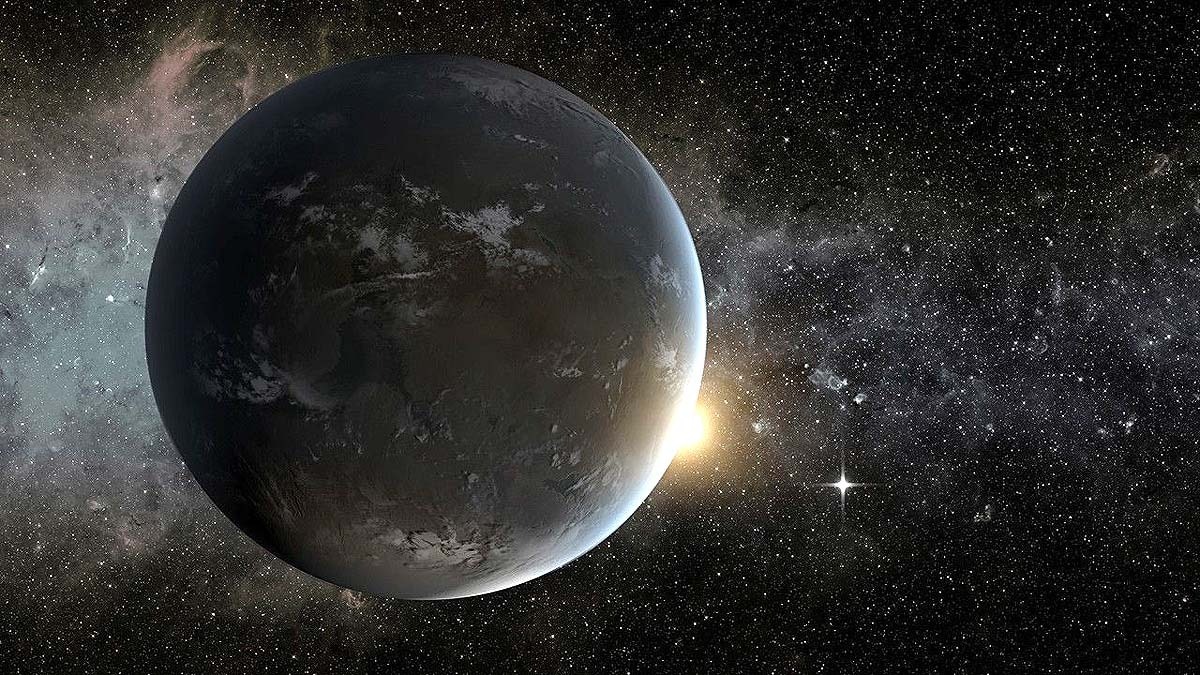
Scientists have identified GJ 3378b, a 'Super-Earth' located in the habitable zone of its star, just 25 light-years from our solar system.
- GJ 3378b is classified as a 'Super-Earth' with twice the mass of Earth.
- The planet orbits within the 'Habitable Zone' of its host star.
- Discovered using the Radial Velocity method via Hobby-Eberly and WIYN telescopes.
- Located only 25 light-years away in the Camelopardalis constellation.
In a landmark discovery for space exploration, astronomers have identified a potentially life-sustaining world located remarkably close to our solar system. The newly discovered exoplanet, designated GJ 3378b, has sent ripples through the scientific community due to its unique characteristics and proximity.
Located just 25 light-years away, GJ 3378b is described as a 'Super-Earth,' meaning it possesses a mass significantly greater than our own planet—estimated at more than twice the mass of Earth. Preliminary data suggests the planet likely features a rocky surface, a crucial prerequisite for life as we know it.
Why This Matters
BozokMedia analysis shows that the most critical aspect of this discovery is the planet's orbital position. GJ 3378b resides within the 'Habitable Zone' of its host star, a cool red dwarf known as GJ 3378. This region is characterized by temperatures that allow liquid water to exist on a planet's surface, making it a prime candidate in the search for extraterrestrial life.
The planet receives approximately 90% of the light intensity that Earth receives from the Sun, creating a potentially temperate environment.
The discovery was made possible through the Radial Velocity technique, employing the Hobby-Eberly Telescope and the WIYN Telescope. Rather than capturing a direct image, scientists detected the subtle 'wobble' of the host star caused by the gravitational pull of the orbiting planet.
Historical Background
The hunt for exoplanets has evolved from theoretical speculation to a rigorous observational science. Since the first confirmed discovery of a planet orbiting a sun-like star in the 1990s, missions by NASA and other space agencies have expanded our catalog of worlds. The discovery of GJ 3378b represents the next frontier: finding planets that aren't just rocks in space, but potential homes.
While the excitement is palpable, scientists remain cautious. Current data does not confirm the presence of an atmosphere or specific gases like oxygen. The next phase of research will involve using advanced space telescopes to perform atmospheric spectroscopy to detect the chemical signatures of life.
Frequently Asked Questions
Question 1: Is GJ 3378b definitely habitable?
Answer: While it sits in the habitable zone where liquid water could exist, scientists have not yet confirmed the presence of water or an atmosphere.
Question 2: How did scientists find this planet?
Answer: They used the Radial Velocity method, which measures the gravitational influence a planet has on its parent star.