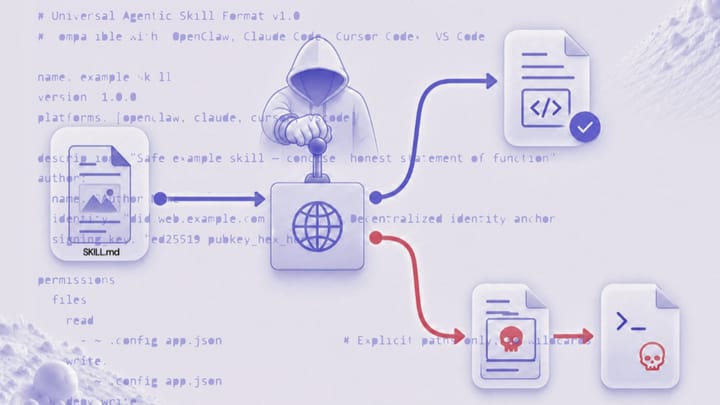
OWASP has unveiled a groundbreaking Top 10 security list specifically for AI agentic skills, highlighting 'Malicious Skills' as the primary threat and introducing a new Universal Skill Format.
- 'Malicious Skills' ranks as the #1 security threat in the new OWASP AI report.
- A new 'Universal Agentic Skill Format' has been introduced to standardize security.
- Supply chain compromises and untrusted external instructions are critical vulnerabilities.
The landscape of artificial intelligence is shifting from simple chatbots to autonomous agents, and with this shift comes a new frontier of cyber threats. The Open Worldwide Application Security Project (OWASP) has officially released its first-of-its-kind list of the top 10 security issues specifically targeting agentic skills. This move follows a sophisticated July incident where attackers used look-alike domains to distribute Trojanized Python packages and weaponized AI skills.
The Double-Edged Sword of AI Skills
AI 'skills'—the natural language or coded recipes that allow agents to perform complex tasks—are what make modern AI powerful. However, they also serve as a massive vector for untrusted input. According to the OWASP report, Malicious Skills hold the number one spot on the risk list. Because these skills often bypass traditional automated scanners, they can achieve hundreds of thousands of installs before being detected.
Why This Matters
BozokMedia analysis shows that as enterprises rush to integrate agentic AI into their workflows, the security of the 'skill layer' is being overlooked. If AI agents are viewed as the new operating systems, then skills are the applications. Without a robust security framework, deploying these agents is akin to running unverified software on a mission-critical server.
Without knowledge of what risks exist with skills, organizations are essentially operating blind.
The risk profile is diverse, featuring two critical risks, four high-severity risks, and four medium-severity risks. The second critical threat is Supply Chain Compromise. Attackers can exploit repositories like GitHub to plant malicious dependencies, which can then be pulled by legitimate agents, potentially affecting thousands of users within hours.
Standardizing Security: Universal Skill Format
To combat the growing chaos of unstandardized AI instructions, OWASP has debuted the Universal Agentic Skill Format v1.0. This YAML-based template is designed to provide consistent security signals, allowing automated analysis tools to distinguish between legitimate capabilities and malicious exploits.
Frequently Asked Questions
1. What are agentic skills?
They are scripts or instructions, often in natural language, that give AI agents the ability to interact with external tools and data.
2. How does OWASP help AI developers?
OWASP provides standardized frameworks and risk assessments to help developers build more resilient and secure AI applications.


