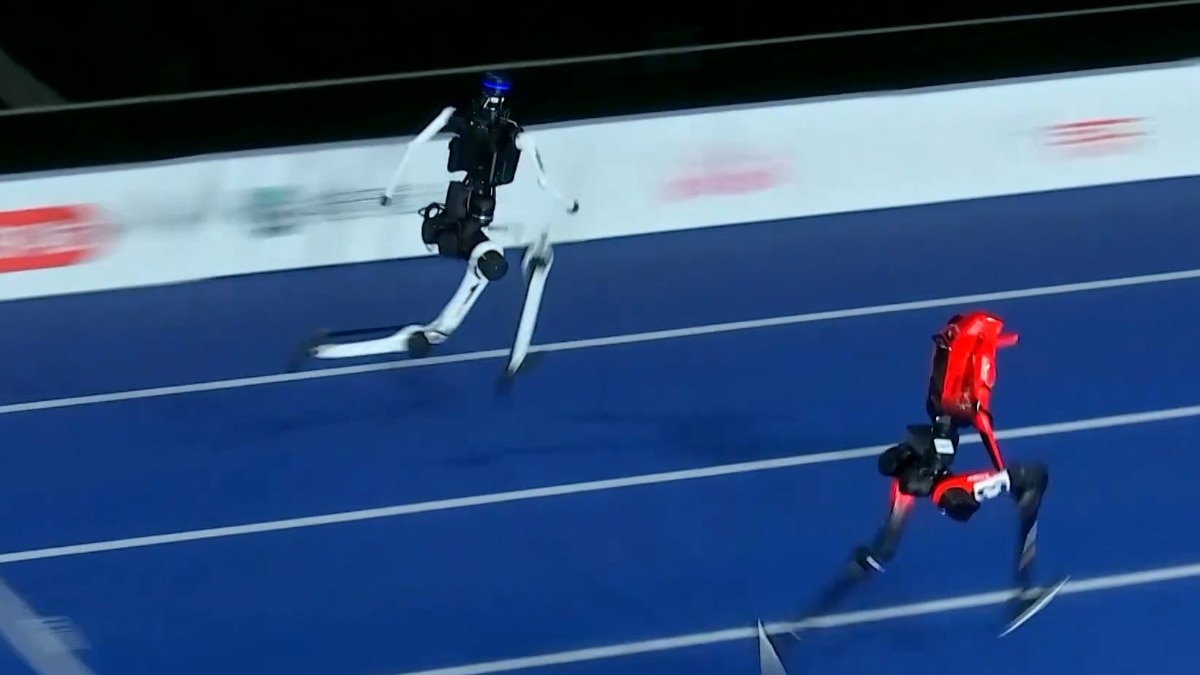
In a historic moment at the World Humanoid Robot Games in Beijing, the Tiangong Ultra robot clocked 9.39 seconds in a 100m sprint, surpassing Usain Bolt's legendary human record.
- Chinese robot 'Tiangong Ultra' completed 100m in 9.39 seconds.
- This time beats Usain Bolt's human world record of 9.58 seconds.
- The robot showed a massive 12-second improvement from the previous year.
The boundaries between science fiction and reality have officially blurred. At the World Humanoid Robot Games held in Beijing, a Chinese humanoid robot named Tiangong Ultra stunned the global community by completing a 100-meter sprint in a breathtaking 9.39 seconds. This feat officially eclipses the iconic 100m world record held by Jamaican sprinting legend Usain Bolt, which stands at 9.58 seconds.
A Leap in Robotic Evolution
The progression of this technology is nothing short of miraculous. During the inaugural games last year, Tiangong Ultra finished the 100m dash in 21.50 seconds. To see a reduction of over 12 seconds in just one year highlights the unprecedented acceleration in AI-driven mechanical engineering. This rapid evolution underscores how quickly humanoid capabilities are scaling.
The Race for Supremacy
The competition was intense. The robot Lightning, developed by smartphone maker Honor, provided stiff competition. While Tiangong Ultra secured the win with its late-stage surge, Lightning clocked an impressive 9.47 seconds. Interestingly, reports indicated that Lightning had previously hit a speed of 9.32 seconds during preparatory testing, reaching peak speeds of 14.5 meters per second.
The convergence of high-speed hardware and advanced AI is turning humanoid robots from laboratory experiments into elite athletes.
Why This Matters: BozokMedia Analysis
BozokMedia analysis shows that this is not merely a sporting achievement but a demonstration of geopolitical technological dominance. China is positioning humanoid robotics as a core strategic industry. The market response has been explosive; Unitree, a leading Chinese humanoid robot manufacturer, saw its market value soar to approximately $50 billion following a massive surge in its Shanghai trading debut. The integration of these robots into logistics, manufacturing, and consumer sectors is now inevitable.
Historical Context
Usain Bolt's record, set at the 2009 World Athletics Championships in Berlin, was long considered the pinnacle of human physiological potential. By breaking this barrier, humanoid robots are forcing a global conversation about the definition of 'speed' and the future role of biological humans in physical competitions.
Frequently Asked Questions
Question 1: What was the time clocked by Tiangong Ultra?
Answer: Tiangong Ultra clocked 9.39 seconds for the 100m sprint.
Question 2: How much faster is the robot than Usain Bolt?
Answer: The robot is 0.19 seconds faster than Bolt's 9.58-second record.