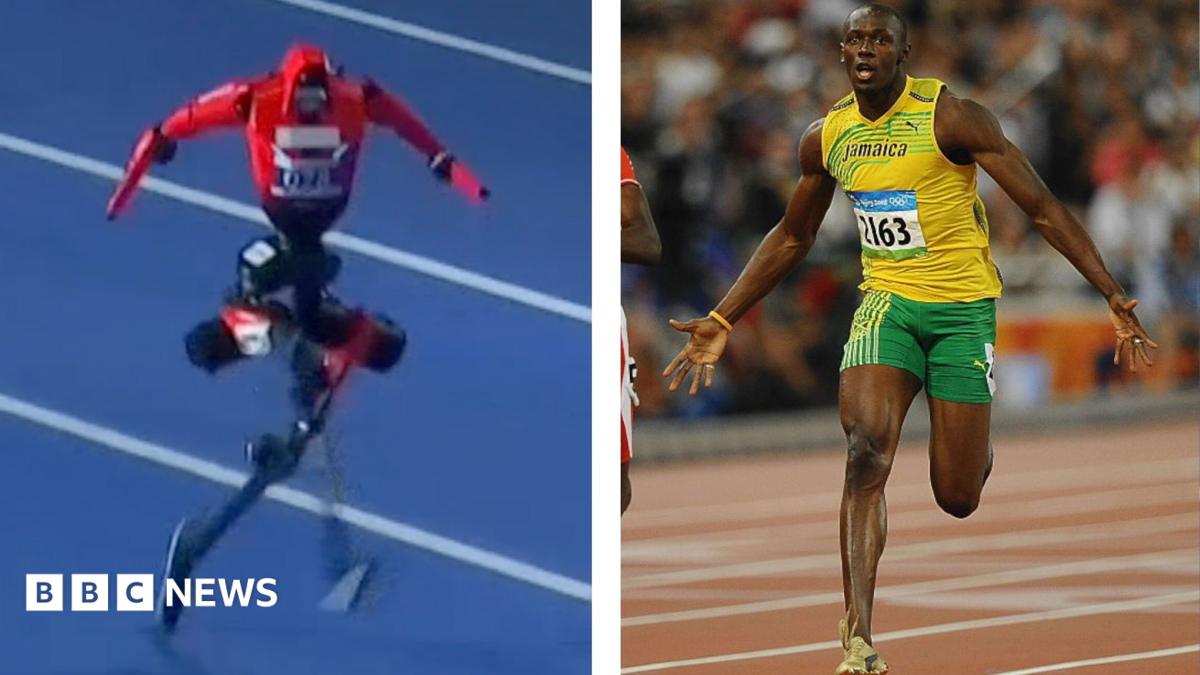
In a groundbreaking moment at the World Humanoid Robot Games in Beijing, a robot named 'Lightning' outperformed human speed by clocking 9.32 seconds in the 100m sprint, surpassing Usain Bolt's legendary record.
- A humanoid robot named 'Lightning' broke the human 100m sprint record at the World Humanoid Robot Games in Beijing.
- The robot clocked a time of 9.32 seconds, beating Usain Bolt's 9.58-second record.
- Over 2,000 robots from 16 countries are participating in this massive robotics showcase in China.
The boundary between human capability and machine precision has officially blurred. During the World Humanoid Robot Games held in Beijing, a sleek, black and red humanoid robot named Lightning achieved what was once considered physically impossible for a biological entity. According to manufacturer Honor, the robot successfully completed a 100m sprint in a staggering 9.32 seconds.
To put this achievement into perspective, eight-time Olympic gold medalist Usain Bolt set the gold standard for human speed in 2009 with a time of 9.58 seconds. For over a decade, Bolt's record stood as the pinnacle of human athleticism. However, the rapid advancement in actuator technology and real-time processing has allowed 'Lightning' to surpass this human milestone, signaling a new era in kinetic robotics.
Why This Matters
BozokMedia analysis shows that this event is a profound demonstration of China's massive strategic investment in robotics and artificial intelligence. This isn't just about speed; it's about the convergence of high-performance hardware and sophisticated AI algorithms. As robots begin to outperform humans in specialized physical tasks, the implications for sports, manufacturing, and emergency response are immense.
The transition from robots performing repetitive industrial tasks to mastering complex human physical feats marks a paradigm shift in autonomous technology.
The games, which commenced this Saturday, feature a diverse array of competitions. Beyond sprinting, robots are competing in boxing and football, and even demonstrating domestic skills such as folding laundry. The scale of the event is unprecedented, with more than 2,000 robots representing 16 different nations, turning Beijing into a global hub for robotic innovation.
Historical Background
Since the dawn of the industrial revolution, robots were designed to be stationary tools in factories. The evolution toward 'humanoid' forms is a recent phenomenon aimed at making machines compatible with human environments. The leap from simple automation to breaking world-class athletic records represents decades of research in biomechanics and sensor integration.
| Metric | Usain Bolt (Human) | Lightning (Robot) |
|---|---|---|
| 100m Sprint Time | 9.58 Seconds | 9.32 Seconds |
| Record Context | 2009 World Record | World Humanoid Robot Games |
Frequently Asked Questions
Question 1: Is this robot available for public use?
Currently, these robots are part of specialized research and competitive showcases by companies like Honor.
Question 2: How many countries are participating in the games?
The event features participants from 16 different countries.