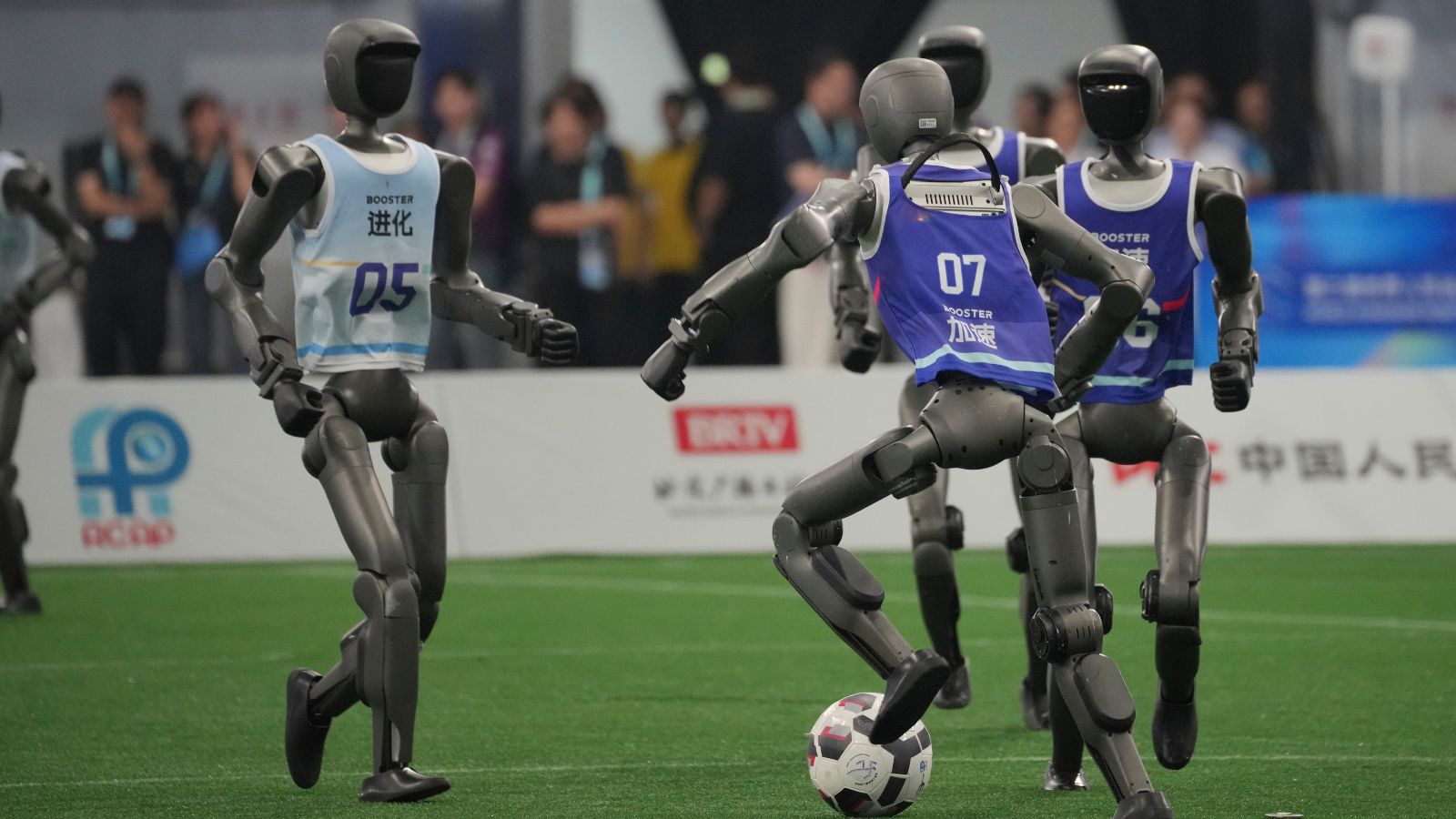
In a groundbreaking moment for robotics, the Chinese humanoid robot 'Tianzhuo' clocked 9.39 seconds in a 100m sprint, surpassing Usain Bolt's legendary human record.
- The humanoid robot 'Tianzhuo' completed the 100m sprint in 9.39 seconds.
- It outperformed Usain Bolt's human world record of 9.58 seconds.
- Developed by the Beijing Innovation Centre of Humanoid Robotics.
In an era where artificial intelligence and mechanical engineering converge, a massive technological milestone has been reached. During the World Humanoid Robot Games held in Beijing, a Chinese humanoid robot named 'Tianzhuo' redefined the limits of speed by completing a 100-meter dash in a staggering 9.39 seconds. This feat officially eclipses the long-standing human world record of 9.58 seconds set by the legendary Usain Bolt.
The robot, a product of the Beijing Innovation Centre of Humanoid Robotics, showcased unparalleled precision and power. In a head-to-head competition against two other domestically produced Chinese robots, Tianzhuo demonstrated superior locomotive algorithms and mechanical efficiency to secure its victory. This event marks a significant shift in how we perceive the physical capabilities of non-biological entities.
Why This Matters
BozokMedia analysis shows that this development is far more than a sporting curiosity; it is a demonstration of rapid advancements in high-speed bipedal movement. The ability to maintain stability and explosive power at such velocities suggests that humanoid robots are nearing a level of physical dexterity that was once thought to be decades away.
The leap from human-like movement to human-surpassing speed signals a new era of robotic autonomy and physical prowess.
The engineering behind Tianzhuo involves highly sophisticated actuators and real-time sensory feedback loops that allow the machine to adjust its stride and balance instantly. As these technologies mature, the implications for high-speed logistics, emergency response, and even specialized athletic training are profound.
Historical Background
For over a decade, Usain Bolt's 9.58-second sprint in Berlin (2009) has stood as the ultimate benchmark of human biological potential. The breaking of this barrier by a machine invites a philosophical and scientific debate regarding the intersection of biology and synthetic engineering.
Frequently Asked Questions
Question 1: Who developed the Tianzhuo robot?
Answer: It was developed by the Beijing Innovation Centre of Humanoid Robotics.
Question 2: How much faster was the robot than Usain Bolt?
Answer: The robot was 0.19 seconds faster than Bolt's 9.58-second record.