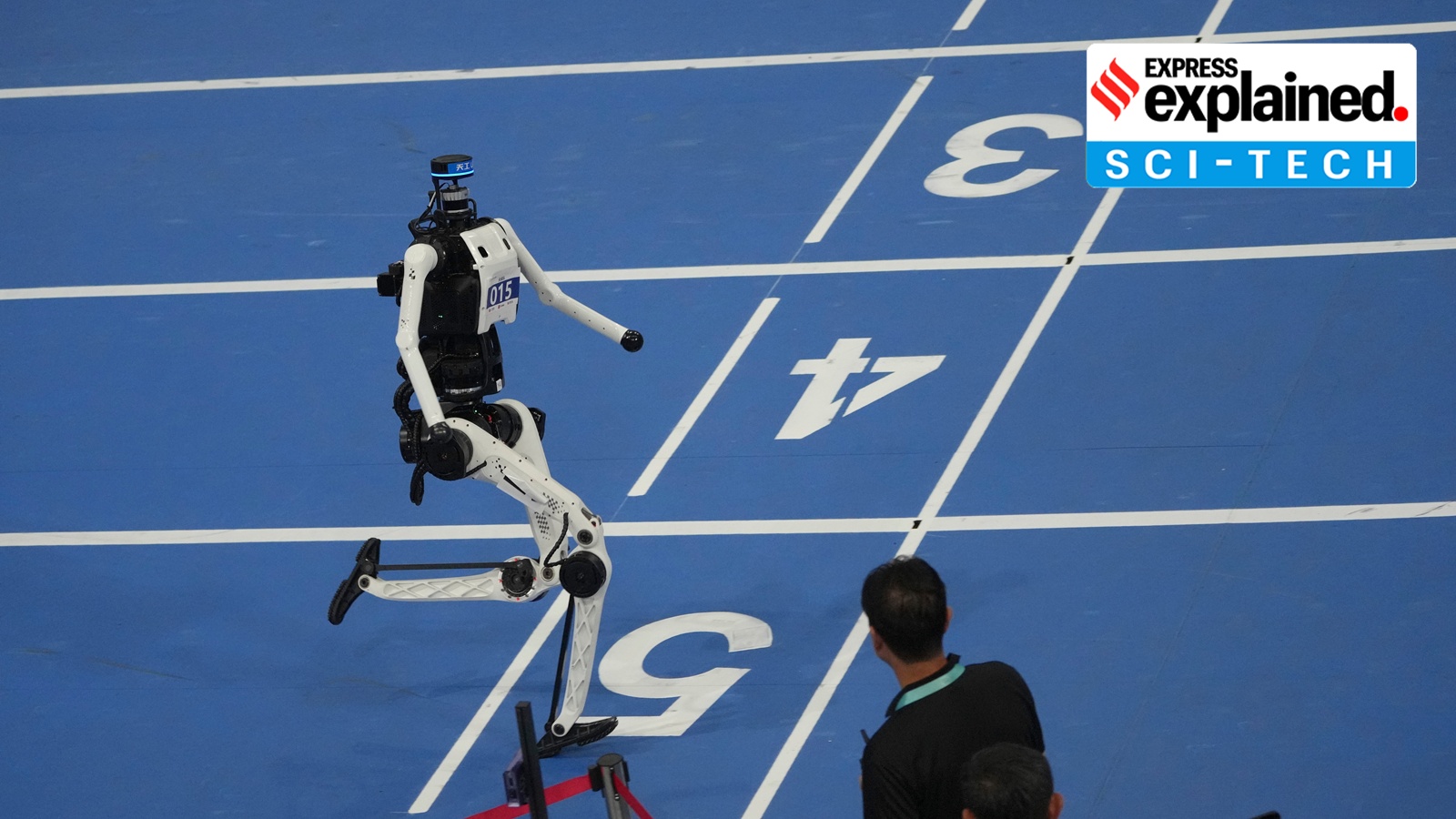
In a groundbreaking display of engineering, China's Tiangong Ultra robot clocked a 100m sprint in 9.39 seconds, outperforming Usain Bolt's legendary human record.
- China's 'Tiangong Ultra' robot completed a 100m sprint in 9.39 seconds, beating Usain Bolt's 9.58s record.
- The feat was achieved at the World Humanoid Robot Games in Beijing.
- This technology is critical for disaster relief, military applications, and autonomous industrial tasks.
In a moment that blurs the line between science fiction and reality, a Chinese humanoid robot has achieved what was once thought impossible. During a preliminary round at the World Humanoid Robot Games in Beijing, the Tiangong Ultra, developed by the Beijing Humanoid Robot Innovation Center, sprinted 100 metres in a staggering 9.39 seconds. To put this in perspective, the legendary Usain Bolt holds the human world record at 9.58 seconds.
The competition was not just a solo show of speed. Another robot named 'Lightning,' produced by the smartphone giant Honor, clocked in at 9.47 seconds, though it required medical assistance via a stretcher immediately after the race. This highlights the immense physical strain and the current developmental stage of high-speed humanoid robotics.
Why This Matters: Beyond the Spectacle
While the sight of a robot outrunning the fastest man in history is mesmerizing, the underlying engineering purpose is much more profound. Teaching a robot to run is not about creating athletes; it is about mastering the complex interplay of sensing, prediction, and physical execution.
BozokMedia analysis shows that a sprint forces engineers to solve multiple high-level problems simultaneously: rapid acceleration, limb coordination, maintaining balance on unpredictable surfaces, and controlled deceleration. Unlike a static factory arm, a running robot must process environmental data in real-time to prevent falling—much like a human does when they trip and instinctively correct their posture.
Mastering high-speed locomotion is the ultimate litmus test for a robot's ability to navigate the chaotic, unstructured environments of the real world.
From Racing Tracks to Disaster Zones
The implications of this technology extend far beyond the stadium. Once a robot can master the mechanics of a sprint, it can be deployed in scenarios where human presence is too dangerous. For instance, in disaster response, robots capable of navigating rubble, climbing stairs, and maintaining balance on uneven terrain can search for survivors and deliver supplies in collapsed buildings.
The strategic importance is also evident in military applications. Much like advanced drones, ground-based humanoid robots could navigate hazardous zones, carry heavy equipment, or operate alongside soldiers in high-risk environments. This physical dimension of AI is where the next frontier of the global tech race lies.
China is positioning itself to lead this charge. According to the International Federation of Robotics, China's latest Five-Year Plan (2026-2030) places robotics at the very heart of its industrial strategy. With 54% of the world's annual industrial robot installations already located in China, the nation is pivoting its AI research toward physical, real-world applications to drive massive economic growth.
Frequently Asked Questions
1. Is the robot's speed a permanent advantage?
While the speed is impressive, the focus is on the balance and coordination required to achieve it, which is more useful for real-world tasks than raw speed alone.
2. How will this impact the workforce?
These robots are designed to handle dangerous or repetitive tasks, potentially augmenting human roles in logistics, disaster relief, and manufacturing.