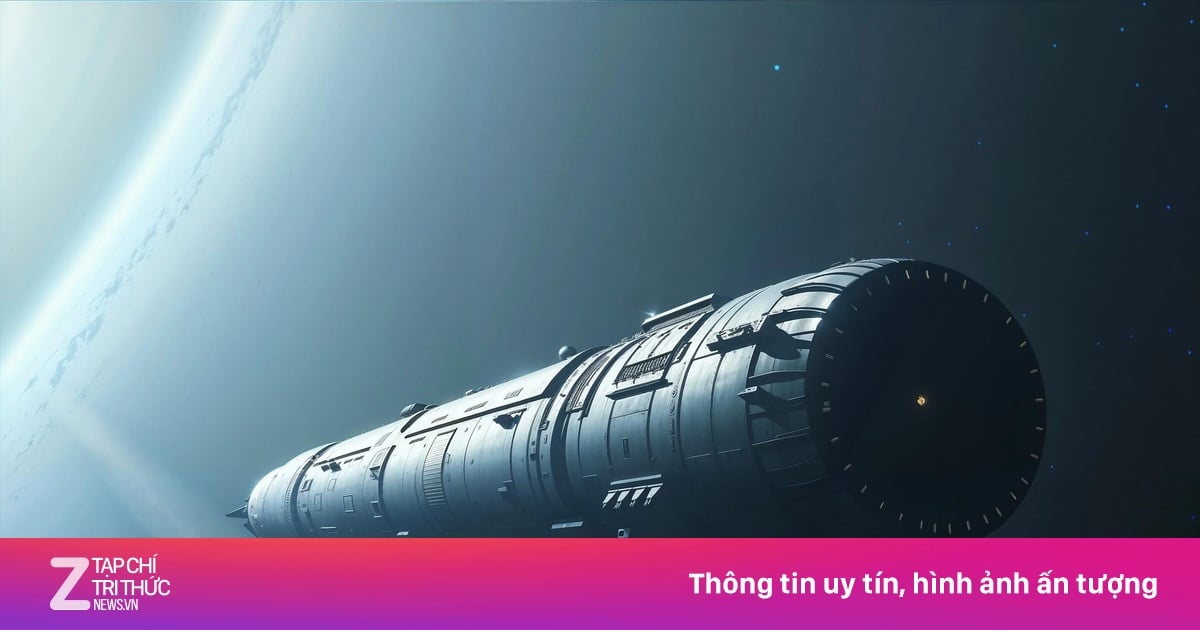
Designed by the Interstellar Institute (i4is), 'Chrysalis' is a massive 58km-long spacecraft engineered to carry 2,400 people to Proxima Centauri over a 400-year voyage.
- Chrysalis is a massive 58km long and 6km wide interstellar spacecraft.
- The mission targets Proxima Centauri B, located 4.24 light-years away.
- The journey is estimated to take 400 years at a speed of 3,000 km/s.
- The ship features artificial gravity, a closed ecosystem, and a population of 2,400.
In a monumental leap for space exploration, the 'Chrysalis' project has emerged as the winner of the Project Hyperion competition organized by the UK's Interstellar Institute (i4is). Moving beyond mere science fiction, Chrysalis presents a comprehensive, viable research model for sustaining human life within a closed community in deep space.
The spacecraft is engineered to transport 2,400 people to the Proxima Centauri star system, specifically targeting Proxima Centauri B—a planet located within the habitable zone approximately 4.24 light-years from Earth. To complete this epic 400-year journey, the vessel must maintain an average velocity of roughly 3,000 km/s, which is more than 1% of the speed of light.
Why This Matters
BozokMedia analysis shows that projects like Chrysalis represent the shift from theoretical physics to practical long-term survival strategies. It addresses the fundamental engineering and sociological hurdles of becoming a multi-planetary species, highlighting that the challenge is as much about social governance as it is about propulsion.
"The greatest challenge is that future generations will have no choice regarding being born on the ship, its destination, or how to live there."
The sheer scale of Chrysalis is staggering. At 58 kilometers in length and 6 kilometers in diameter, its mass is estimated in the billions of tons. A significant hurdle remains the assembly process; current Earth-based launch systems cannot deploy such massive structures. The design team suggests that assembly in orbit using space-derived materials and fully automated manufacturing could take 20 to 25 years.
To combat the physiological effects of long-term weightlessness, the ship utilizes rotating cylinders to generate centrifugal force, providing Earth-equivalent artificial gravity. The interior is organized into five functional levels: Agriculture (food/ecosystem), Public (schools/hospitals), Residential, Industrial (manufacturing), and Automation (maintenance).
Technical Specifications at a Glance
| Feature | Specification |
|---|---|
| Total Length | 58 Kilometers |
| Target Destination | Proxima Centauri B |
| Estimated Travel Time | 400 Years |
| Passenger Capacity | 2,400 (Stable population ~1,500) |
| Average Velocity | 3,000 km/s |
Socially, the ship must function as a self-contained civilization. To maintain genetic diversity and resource stability, the team proposes strict regulation of reproduction, limiting pregnancy to women between the ages of 28 and 31.
Frequently Asked Questions
Q1: Is Proxima Centauri B confirmed to be habitable?
A: While it sits in the habitable zone, its actual atmospheric and surface conditions remain unverified, posing a significant risk to the mission.
Q2: How will the crew survive for 400 years without Earth?
A: The ship is designed as a closed-loop ecosystem with dedicated agricultural levels for food, water, and oxygen recycling.
