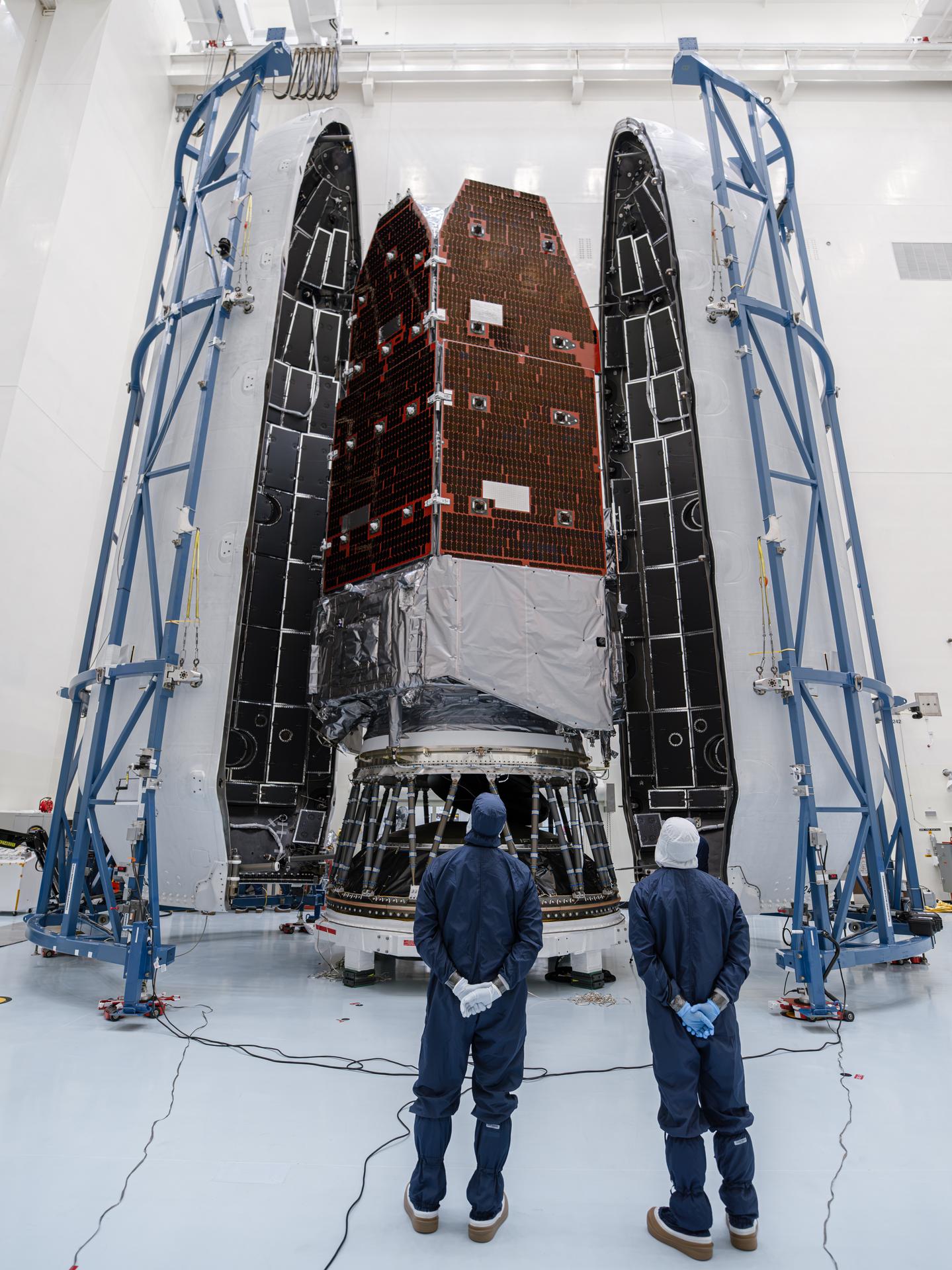
NASA has finalized coverage plans for the upcoming launch of the Nancy Grace Roman Space Telescope via a SpaceX Falcon Heavy rocket. This next-generation observatory aims to solve the mysteries of dark energy and dark matter.
- The Nancy Grace Roman Space Telescope is scheduled to launch on Sunday, Aug. 30, from Kennedy Space Center, Florida.
- The mission will utilize a SpaceX Falcon Heavy rocket for liftoff.
- The telescope offers a field of view 100 times larger than the Hubble Space Telescope.
- Key scientific goals include studying dark energy, dark matter, and exoplanets.
NASA has officially released its coverage plans for the highly anticipated prelaunch and launch activities of the Nancy Grace Roman Space Telescope. Designed to probe the deepest mysteries of the cosmos, the observatory is set to embark on its journey from Launch Complex 39A at the Kennedy Space Center in Florida. The mission is targeting a liftoff no earlier than 7:26 a.m. EDT on Sunday, Aug. 30, powered by a SpaceX Falcon Heavy rocket.
Named in honor of NASA’s first chief astronomer, the Roman telescope represents a massive leap forward in observational astronomy. By pairing sharp infrared vision with a sweeping field of view that is at least 100 times larger than that of the Hubble Space Telescope, it will provide a much broader perspective of the universe than ever before. This capability is crucial for mapping billions of galaxies and characterizing distant exoplanets.
Why This Matters
🚀 BozokMedia analysis shows that this mission is strategically designed to address the 'missing pieces' of our cosmic puzzle. While Hubble gave us unprecedented depth, Roman will provide the necessary breadth to understand the large-scale structure of the universe, specifically focusing on the elusive forces of dark energy and dark matter.
The Roman Space Telescope will bridge the gap between deep-field observations and wide-area surveys, revolutionizing our cosmic map.
Following its separation from the Falcon Heavy rocket, the telescope will travel approximately one million miles from Earth to the second Sun-Earth Lagrange point (L2). This stable orbital position will allow for continuous, high-precision scientific observation. The primary mission lifetime is set for five years, with an ambitious goal of operating for a decade.
Historical Background
For decades, the Hubble Space Telescope has been the flagship of space observation. However, as our understanding of the accelerating expansion of the universe grew, the need for a wider-angle instrument became apparent. The Nancy Grace Roman Space Telescope is the direct evolutionary successor to this need, designed to perform wide-area surveys that were previously impossible with existing technology.
Technical Comparison: Hubble vs. Roman
| Feature | Hubble Space Telescope | Roman Space Telescope |
|---|---|---|
| Field of View | Standard Narrow Field | 100x Larger Field |
| Primary Vision | Visible/UV/Near-IR | Advanced Infrared |
| Primary Focus | Deep-field high resolution | Wide-area cosmic surveys |
Frequently Asked Questions
1. Where can I watch the Roman Space Telescope launch live?
Live coverage will be streamed through various platforms, including NASA's official website at nasa.gov/live.
2. What is the main scientific objective of the mission?
The primary goal is to investigate dark energy, dark matter, and to map billions of galaxies to understand the universe's expansion.