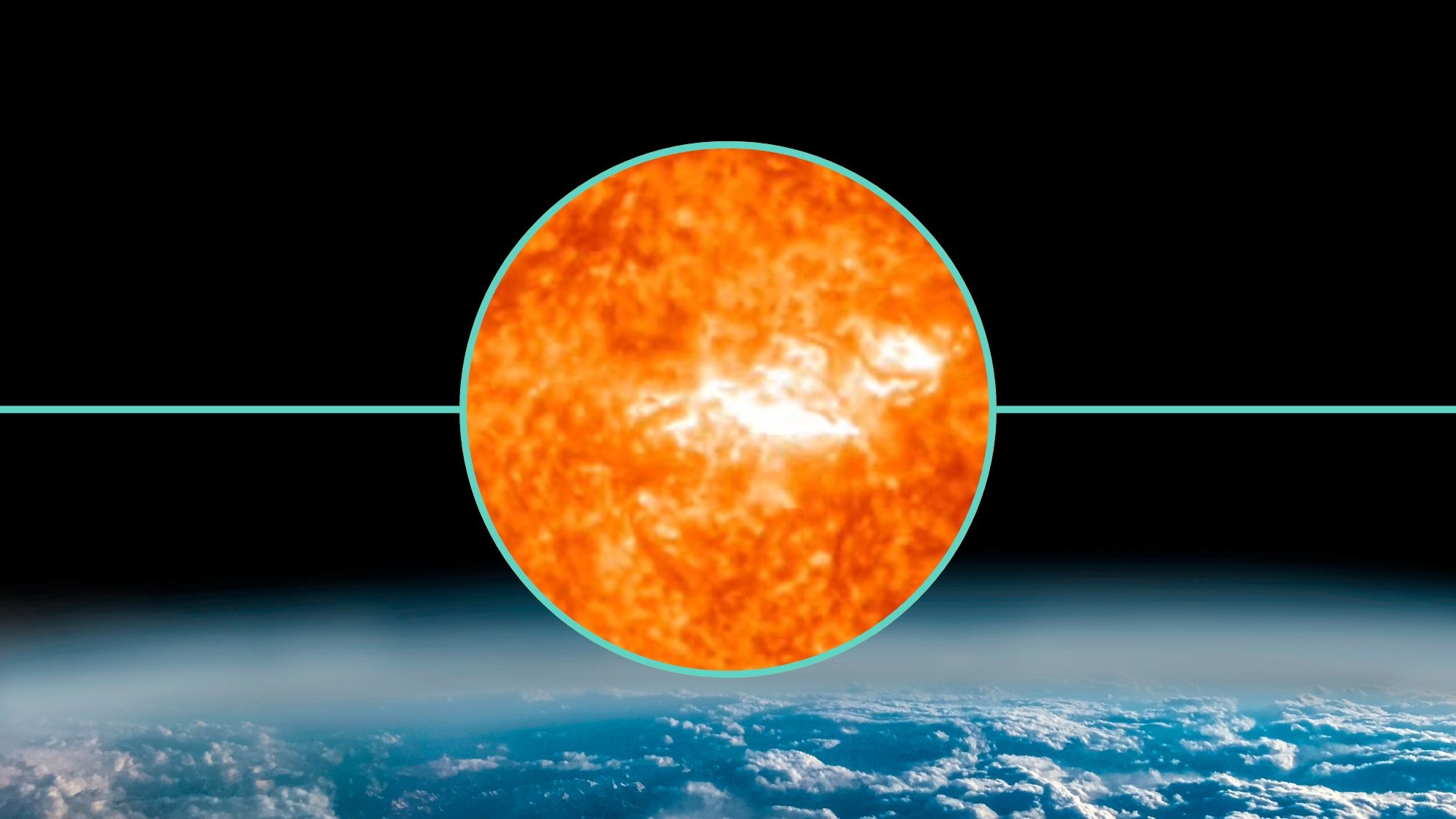
A massive M6.9 solar flare and a Coronal Mass Ejection (CME) have erupted from the sun, potentially triggering geomagnetic storms and enhancing Northern Lights visibility on Earth.
- A powerful M6.9 solar flare erupted from the active sunspot region 4513.
- The eruption caused a moderate (R2) radio blackout in Africa, Europe, and the Arctic.
- A Coronal Mass Ejection (CME) is expected to reach Earth around August 28.
- A combination of solar wind and the CME could boost Aurora activity.
Today, August 25, the sun unleashed a formidable M6.9 solar flare from a restless, Earth-facing sunspot, launching a Coronal Mass Ejection (CME) into space. This solar event has placed Earth potentially in the firing line for significant space weather activity.
According to SpaceWeatherLive, the M6.98 solar flare originated from the highly active sunspot region 4513, peaking at 6 a.m. EDT. This specific region has been exceptionally volatile over the last 24 hours, producing a barrage of solar activity, including five intense M-class eruptions. Solar flares are categorized into five classes—A, B, C, M, and X—with M-class flares being the second-strongest category, just below the massive X-class eruptions.
Why This Matters
BozokMedia analysis shows that such solar events are not merely astronomical curiosities; they have tangible impacts on our modern infrastructure. The recent eruption triggered a moderate (R2) radio blackout across the sunlit side of the planet, disrupting high-frequency radio communications over vast stretches of Africa, Europe, and the Arctic.
The intersection of solar flares and CMEs represents a critical window for both technological risk and celestial beauty.
The primary focus now shifts to the incoming CME. Early modeling suggests Earth could receive a 'glancing blow' from this ejection on Friday, August 28. Aurora chaser Jure Atanackov noted that NASA's models predict the CME's arrival around 6-7 a.m. EDT, though there remains an uncertainty margin of approximately seven hours.
While the CME itself might be slow-moving, a secondary factor is complicating the forecast. The Solar Influences Data Analysis Center (SIDC) predicts that a high-speed stream of solar wind from a coronal hole will begin influencing Earth around August 27. If this high-speed stream coincides with the arrival of the CME, the combined energy could significantly ramp up geomagnetic activity.
Solar Flare Strength Comparison
| Class | Intensity Level | Typical Impact |
|---|---|---|
| X-Class | Extreme | Global radio blackouts, long-duration storms |
| M-Class | Medium-Strong | Regional radio blackouts, Aurora enhancement |
| C-Class | Low | Minimal impact on Earth |
The ultimate intensity of the geomagnetic storm will depend on the orientation of the CME's magnetic field. A strong southward-pointing magnetic field would interact more aggressively with Earth's magnetic field, potentially leading to much more vibrant and widespread Aurora displays.
Frequently Asked Questions (FAQ)
1. What is a Coronal Mass Ejection (CME)?
A CME is a massive burst of solar wind and magnetic fields rising above the solar corona or plane of the solar surface.
2. Will the solar flare affect my internet?
While it can affect satellite communications and high-frequency radio, it is unlikely to impact standard terrestrial internet services directly.