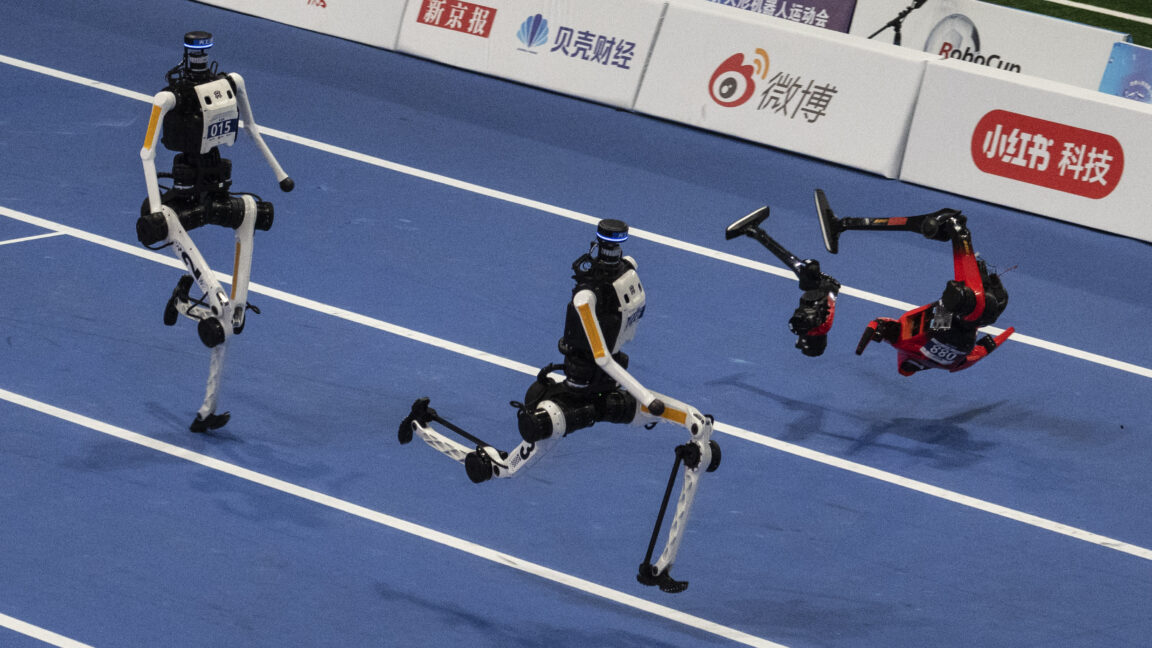
The second World Humanoid Robot Games in Beijing showcased incredible robotic speed alongside dramatic mechanical failures and fires.
- Humanoid robots challenged Usain Bolt's 100m sprint records at the Beijing games.
- Technical limitations led to crashes, mechanical breaks, and even fires during demonstrations.
- The event tested robots in diverse tasks ranging from kung fu to domestic chores.
The second edition of the World Humanoid Robot Games, held in Beijing from August 22–26, has become a viral sensation, showcasing the dual nature of modern robotics: incredible prowess and significant limitations. While some videos depict sprinting robots seemingly outperforming the 100-meter records held by Usain Bolt, others show a much more chaotic reality.
During the high-speed sprints, several robots struggled with braking mechanisms. Unable to stop effectively, these machines crashed into barriers, leading to spectacular mechanical failures. In some instances, robots broke at the waist, emitting showers of sparks, while others actually caught fire mid-demonstration, highlighting the volatile nature of current high-performance hardware.
Beyond the Sprint: A Test of Versatility
The competition was designed to push the boundaries of humanoid dexterity. Robots were tasked with performing kung fu moves, dancing, engaging in kickboxing, and even playing sports like soccer and table tennis. These challenges aim to test the complex integration of sensors, balance, and motor control.
However, the games also brought robots into the realm of everyday life. In tests involving humdrum tasks like washing and hanging laundry, the robots lagged significantly behind human speeds. This gap highlights the massive distance between specialized athletic robotics and practical, reliable domestic automation.
Why This Matters
BozokMedia analysis shows that this event is a strategic showcase of China's rapidly advancing robotics industry. Supported by Chinese state media and the Beijing city government, the games serve as a platform to demonstrate the commercial potential of humanoid machines to the global market.
The true measure of robotics success is not how fast a machine can run, but how reliably it can function in an unpredictable human environment.
As China continues to pour resources into AI and robotics, these games act as a high-stakes laboratory. The goal is to transition from robots that can perform spectacular feats in controlled environments to machines that can seamlessly integrate into the global workforce and household settings.
Frequently Asked Questions
Question 1: Why did the robots catch fire?
Answer: The fires were caused by mechanical failures and electrical shorts during high-intensity movement and collisions.
Question 2: Who organized these games?
Answer: The event was supported by the Beijing city government and Chinese state media to showcase technological progress.


