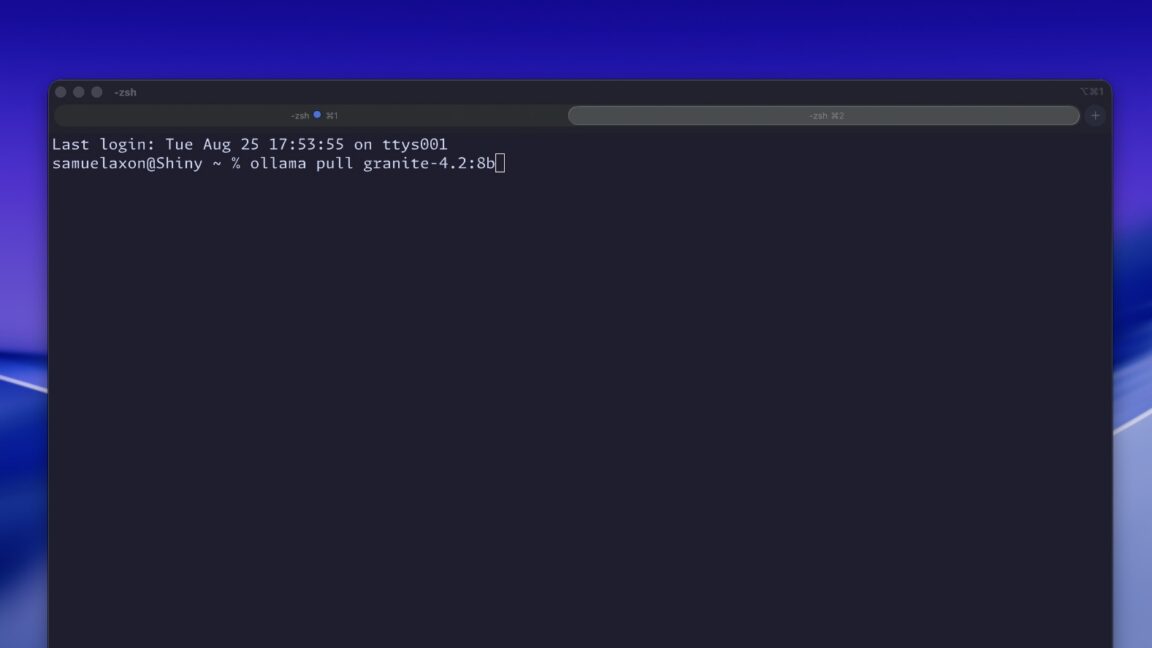
IBM has introduced its Granite 4.2 open-weight models, featuring 3B, 8B, and 30B variants designed for enterprise-grade local hosting and agentic capabilities.
- Granite 4.2 is available in 3B, 8B, and 30B parameter variants.
- Features a massive native 128,000-token context window.
- 8B and 30B models feature advanced agentic reinforcement learning for tool use.
IBM has officially expanded its artificial intelligence portfolio with the release of the Granite 4.2 family of open-weight large language models (LLMs). These models are specifically engineered for enterprises that prioritize self-hosting and data sovereignty, allowing organizations to download and run powerful AI locally without relying on third-party cloud providers.
The new lineup includes three distinct sizes: 3B, 8B, and 30B parameters, catering to different computational needs. Following a proven decoder-only architecture, these models provide high efficiency in language understanding and generation. A standout feature across the series is the native 128,000-token context window, enabling the processing of massive datasets, long documents, and complex instructions in a single pass.
Why This Matters
BozokMedia analysis shows that the industry is witnessing a massive shift from massive, centralized cloud models toward specialized, local, and agentic models. As enterprises face increasing regulatory pressure regarding data privacy, IBM's strategy to provide high-performance, self-hostable models positions them as a critical infrastructure provider for the next wave of AI integration.
The shift toward agentic reinforcement learning marks the transition from AI that merely converses to AI that actually executes complex workflows.
The most significant technical advancement in Granite 4.2 lies in its agentic capabilities. While the 3B model supports tool usage, the 8B and 30B variants have undergone specialized agentic reinforcement learning. This training allows these models to act as autonomous agents capable of navigating a terminal, performing web searches, and interacting with external software tools to complete multi-step tasks.
Historical Background
The evolution of LLMs has moved from general-purpose chatbots to highly specialized models. Earlier iterations focused primarily on text prediction, but the current frontier—represented by IBM's Granite series—focuses on 'agency,' where the model becomes an active participant in digital workflows rather than a passive responder.
Frequently Asked Questions
1. What makes Granite 4.2 different from previous versions?
The inclusion of agentic reinforcement learning and a significantly larger context window makes it much more capable of performing real-world tasks.
2. Can these models be used for sensitive corporate data?
Yes, because they are open-weight and designed for self-hosting, companies can keep their data entirely within their own secure infrastructure.


