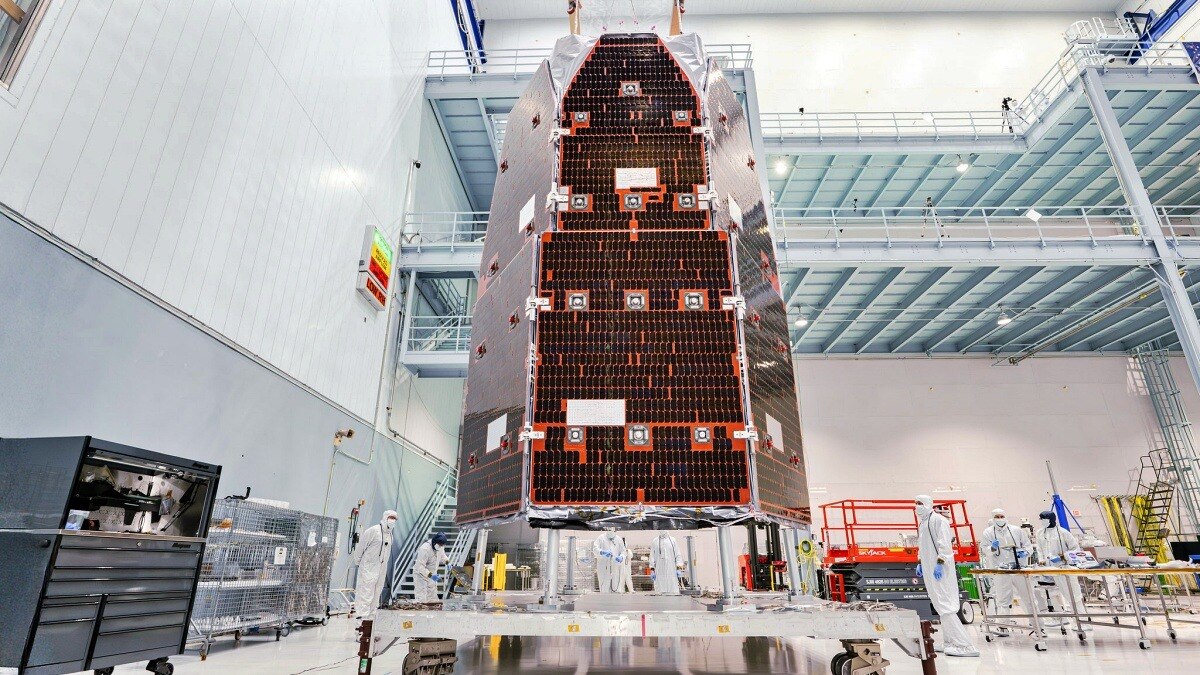
NASA and SpaceX are set to launch the Nancy Grace Roman Space Telescope this Sunday, sending it 1.5 million km away to unlock the mysteries of dark energy and dark matter.
- The Nancy Grace Roman Space Telescope launches this Sunday from Florida.
- It will be deployed via a SpaceX Falcon Heavy rocket to the L2 Lagrange point.
- The mission aims to study dark energy, dark matter, and distant exoplanets.
A monumental leap in space exploration is imminent. NASA and SpaceX are finalized for the launch of the Nancy Grace Roman Space Telescope this Sunday, August 30. This mission is designed to position a powerful new observatory approximately 1.5 million kilometers away from Earth to peer into the deepest reaches of the cosmos.
The launch is scheduled to take place from Launch Complex 39A at NASA's Kennedy Space Center in Florida, utilizing a SpaceX Falcon Heavy rocket. Once released from the rocket, the telescope will begin its long journey toward the second Sun-Earth Lagrange point (L2), a gravitationally stable region that allows for consistent astronomical observations.
Unveiling the Universe's Greatest Mysteries
Named after NASA's first chief astronomer, Nancy Grace Roman—often hailed as the 'Mother of Hubble'—the telescope represents a massive upgrade in observational capacity. While the Hubble Space Telescope provided stunningly sharp images, the Roman telescope will offer an extraordinarily wide field of view, capable of observing an area of the sky at least 100 times larger than Hubble in a single view.
The scientific community is particularly excited about the telescope's ability to probe dark energy and dark matter. Dark energy is the mysterious force driving the accelerated expansion of our universe, while dark matter remains an invisible substance that influences the structure of galaxies through gravity. By mapping billions of galaxies and searching for exoplanets, Roman will provide a comprehensive census of the observable universe.
Why This Matters
BozokMedia analysis shows that the deployment of the Roman telescope marks a transition from 'deep but narrow' observation to 'wide and deep' cosmic surveying. This capability will allow astronomers to see the 'big picture' of how the universe evolved over billions of years, bridging the gap between local observations and the cosmic web.
The Roman telescope is not just a new eye in the sky; it is a wide-angle lens for the entire cosmos, designed to capture the structural history of our universe.
The mission is slated for a five-year primary duration, though NASA engineers anticipate an operational lifespan of up to a decade. All scientific data processed from the mission will be made available to the global research community, fostering international collaboration in the quest to understand our origins.
Frequently Asked Questions
1. What makes the Roman telescope different from Hubble?
While Hubble provides high-resolution views of small areas, the Roman telescope has a field of view 100 times larger, allowing it to survey vast portions of the sky much faster.
2. Where will the telescope be located?
It will be positioned at the L2 Lagrange point, roughly 1.5 million kilometers away from Earth.