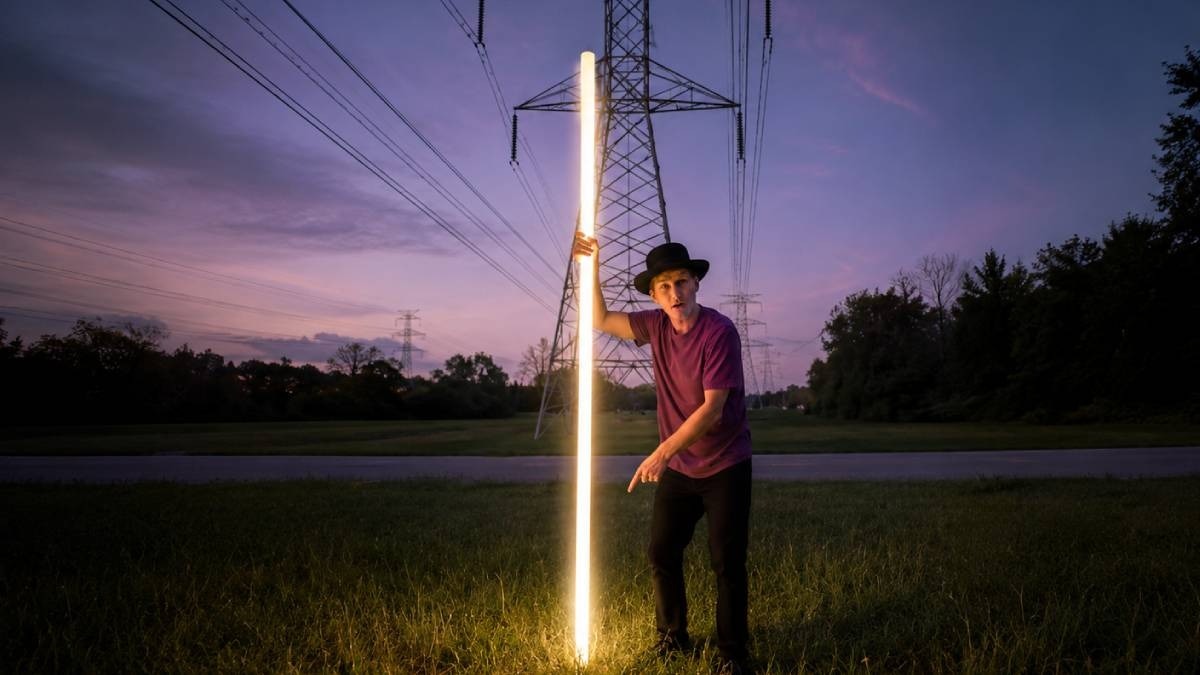
Proximity to high-voltage power lines can be fatal even without direct contact. Discover how 'Electric Arcs' work and why a glowing tubelight near power lines is a warning sign, not a trick.
- Electric arcs can cause fatal shocks without direct physical contact with the wires.
- Transmission lines can carry up to 765,000 volts, creating powerful electric fields.
- A tubelight glowing near these lines indicates a high-intensity electric field.
High-voltage transmission lines are the arteries of our modern electrical grid, transporting massive amounts of energy from power plants to cities. However, these lines pose a silent and invisible threat to those who venture too close. Most people believe that as long as they don't touch the wire, they are safe—a misconception that can be fatal.
The Invisible Threat: Electric Arcs
When voltage levels are extremely high, the electricity can overcome the insulating properties of the air. This phenomenon is known as an Electric Arc. Essentially, the electricity 'jumps' from the wire to the nearest conductive object or person. In some major transmission networks, voltages reach up to 765,000 volts, making the air itself a potential conductor under certain conditions.
Why This Matters
BozokMedia analysis shows a critical gap in public safety awareness regarding electromagnetic fields. Many individuals engage in construction or maintenance work near these lines without realizing that the 'safe distance' is not just about avoiding contact, but about avoiding the arc zone. Understanding this physics is a matter of life and death.
"At ultra-high voltages, the air becomes ionized, creating a conductive path that allows current to flow even across a gap, leading to devastating flashovers."
The Science Behind the Glowing Tubelight
Viral videos often show people holding a tubelight under high-voltage lines, causing the bulb to glow without any power source. This happens because the electric field surrounding the transmission line excites the gas inside the tubelight, triggering a glow. It is a visual demonstration of the invisible energy permeating the area.
However, it is vital to distinguish between the induction that lights a bulb and the current that kills a human. While the tubelight shows the field's presence, moving closer increases the risk of that field collapsing into a lethal arc that can travel through the human body.
| Feature | Domestic Electricity (Low Voltage) | Transmission Lines (High Voltage) |
|---|---|---|
| Voltage Level | 220-240V | Thousands to Millions of Volts |
| Danger Source | Direct Contact Only | Contact & Arcing (Proximity) |
| Electric Field | Negligible | Extremely Powerful |
Frequently Asked Questions
1. Is it safe to stand under power lines?
Generally yes, but it becomes extremely dangerous if you carry long conductive objects like metal ladders or poles.
2. What exactly is an electric arc?
An electric arc is a luminous discharge of electricity across an insulating medium, such as air, between two conductors.