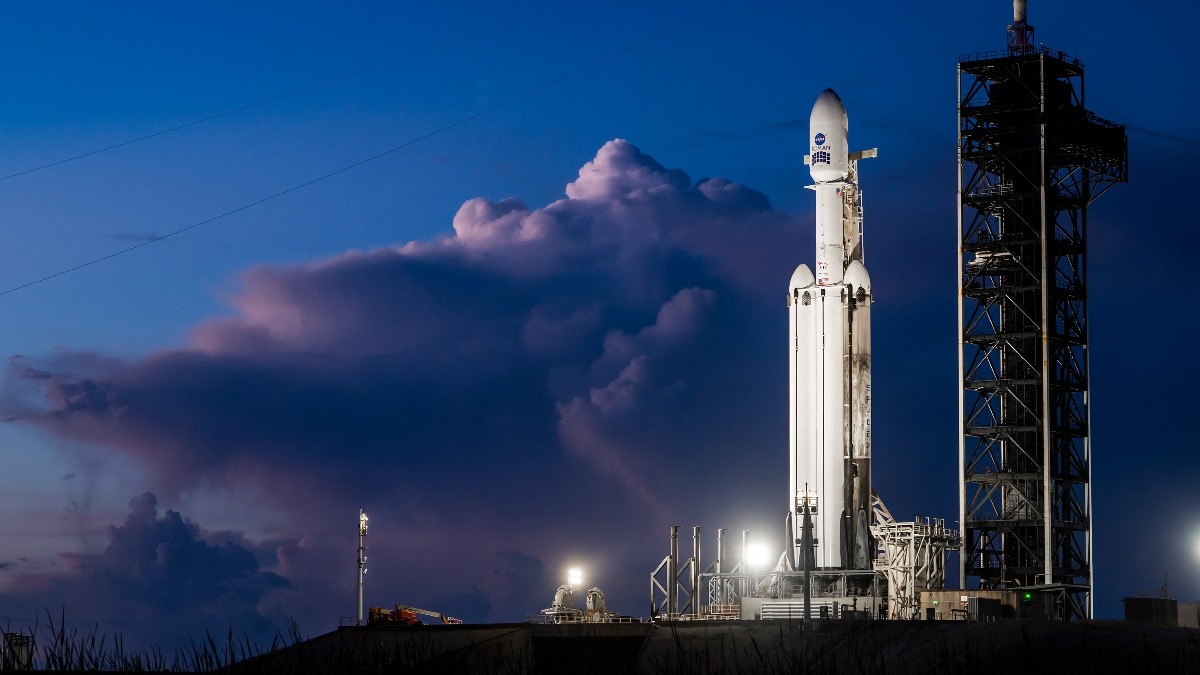
NASA is set to launch the ambitious Nancy Grace Roman Space Telescope via SpaceX's Falcon Heavy. This mission aims to decode the mysteries of dark matter and dark energy.
- The Nancy Grace Roman Space Telescope is launching aboard a SpaceX Falcon Heavy rocket.
- The mission target is the second Sun-Earth Lagrange point (L2), 1.5 million km from Earth.
- The telescope will focus on dark matter, dark energy, and galaxy evolution.
The countdown has begun for one of the most significant milestones in modern astronomy. NASA is preparing to launch the Nancy Grace Roman Space Telescope, a mission designed to expand our understanding of the cosmos on an unprecedented scale. The launch is scheduled to take place from Launch Complex 39A at the Kennedy Space Center in Florida, propelled by the formidable SpaceX Falcon Heavy rocket.
Destination: The L2 Point
Unlike many satellites that remain in Low Earth Orbit, the Roman telescope is destined for the second Sun-Earth Lagrange point (L2). Located approximately 1.5 million kilometers away from Earth, this gravitational sweet spot allows the spacecraft to maintain a stable position relative to the Earth and Sun, providing a clear, unobstructed view of the deep universe with minimal fuel consumption.
Wide-Angle Vision vs. Deep Detail
While the James Webb Space Telescope (JWST) is renowned for its ability to peer into the minute details of individual cosmic objects, the Nancy Grace Roman Telescope serves a different, complementary purpose. Equipped with a massive Wide Field Instrument, Roman can survey vast stretches of the sky in a single observation. If JWST is a high-powered microscope, Roman is a powerful wide-angle lens, providing the 'big picture' of the cosmos.
The synergy between Webb's detail and Roman's breadth will provide a holistic understanding of our universe never seen before.
Probing the Dark Universe
The primary scientific objectives of this mission are profound. Scientists aim to use the telescope to investigate the nature of Dark Matter and Dark Energy—the invisible forces that shape our universe. Additionally, the mission will survey billions of galaxies to understand their evolution and search for exoplanets orbiting distant stars.
Why This Matters
BozokMedia analysis shows that this launch represents a strategic shift in space observation, moving from studying isolated objects to conducting large-scale statistical surveys of the universe. This data will be crucial for testing our fundamental models of physics.
Frequently Asked Questions
1. How far will the telescope be from Earth?
It will be positioned at the L2 point, roughly 1.5 million kilometers away.
2. What is the main goal of the Roman Telescope?
Its main goal is to study dark energy, dark matter, and the large-scale structure of the universe.


