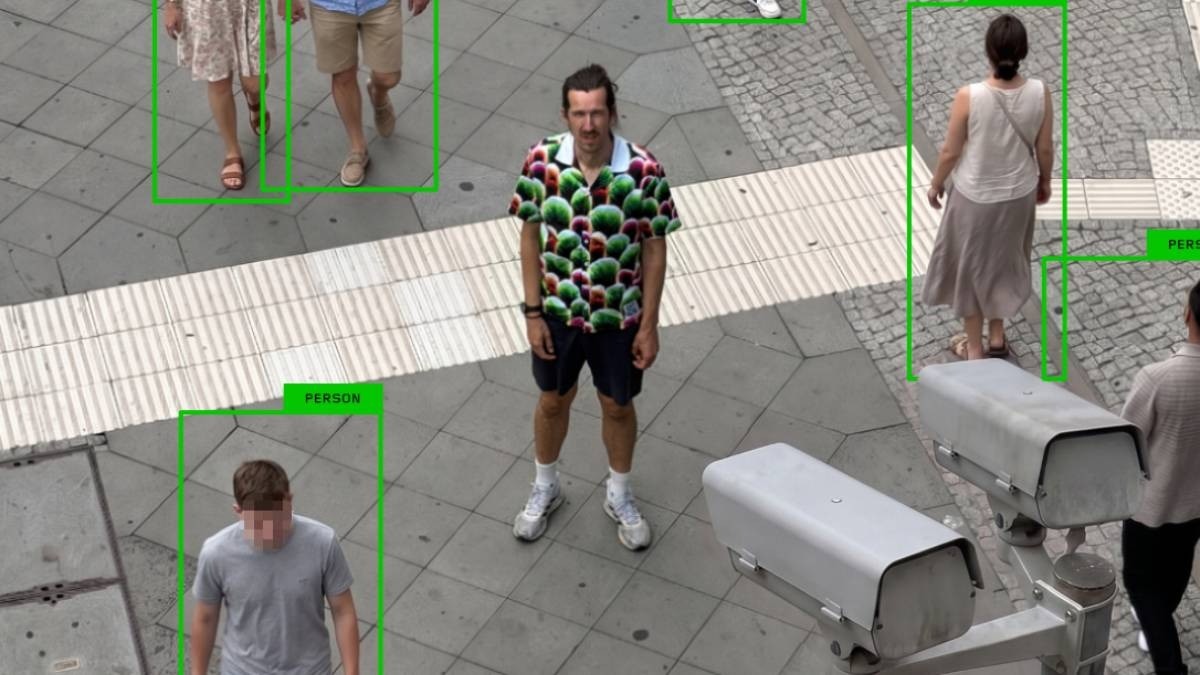
Digital artist Simon Wickert from Berlin has developed a specialized Hawaiian shirt designed to confuse AI surveillance systems using digital camouflage, effectively protecting the wearer's privacy.
- Berlin-based digital artist Simon Wickert created a Hawaiian shirt that disrupts AI surveillance.
- The design interferes with the AI's ability to recognize human body shapes and key anatomical points.
- The effectiveness was validated using the YOLO (You Only Look Once) open-source detection system.
In an era where Artificial Intelligence (AI) is integrated into almost every facet of urban life, the risk of privacy leaks has escalated. Modern public surveillance cameras are no longer passive recording devices; they are equipped with advanced capabilities to detect, track, and identify human beings in real-time. To counter this, Simon Wickert, a digital artist based in Berlin, Germany, has engineered a Hawaiian shirt that renders the wearer nearly invisible to AI detection systems.
How AI Cameras Detect Humans
Advanced security cameras utilize machine learning to identify specific biological markers. They are programmed to recognize the general silhouette of a human, focusing on key structural elements such as the shape of the head, the width of the shoulders, and the movement of limbs. Once these patterns are matched, the AI flags the object as a 'human'.
The Science of the 'Confusion' Design
The shirt created by Wickert appears as a standard, vibrant Hawaiian shirt to the human eye. However, it employs a sophisticated form of digital camouflage. The bright colors and specific geometric patterns are strategically placed to create visual noise for AI algorithms.
When an AI camera scans the wearer, the patterns break up the human outline. Instead of seeing a cohesive human shape, the AI perceives a series of random, fragmented shapes. This effectively 'glitches' the detection process, making it difficult for the system to confirm the presence of a person.
Why This Matters
BozokMedia analysis shows that this project represents the rise of 'Adversarial Fashion'. As facial recognition and behavioral tracking become ubiquitous, the battle for privacy is moving from the digital realm (VPNs, encryption) to the physical realm. This shirt demonstrates that physical objects can be designed to exploit the inherent weaknesses of machine learning models.
"Privacy in the digital age is no longer just about changing passwords; it's about how we physically present ourselves to an AI-driven world."
Development and Rigorous Testing
Simon Wickert utilized a 'trial and error' process, ironically using AI itself to help design the patterns that would defeat other AI systems. To ensure the shirt's efficacy, it was tested against YOLO (You Only Look Once), a widely used open-source AI object detection system. The tests confirmed that the shirt significantly lowered the probability of the AI correctly identifying the wearer as a human.
Frequently Asked Questions
Q1: Does this shirt make the wearer invisible to people?
No, the shirt is perfectly visible to human beings. It only confuses the mathematical patterns used by AI detection software.
Q2: Will this work on all AI cameras?
While it is highly effective against systems like YOLO, different AI models may have different detection parameters, meaning its effectiveness can vary across different systems.