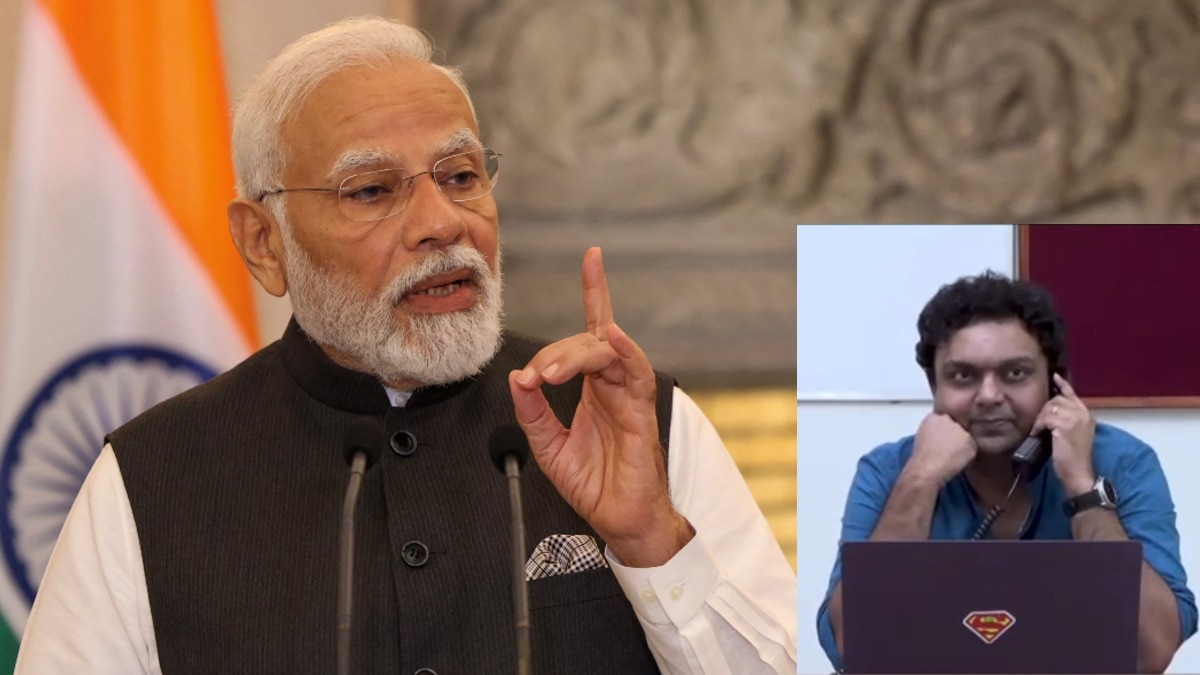
Krishna Seshadri from Mumbai has gone viral after Prime Minister Narendra Modi praised his AI-powered history website, 'Bharat Rajya', during the 137th episode of Mann Ki Baat.
- Krishna Seshadri built 'Bharat Rajya' using generative AI tools like Claude despite having no coding background.
- PM Modi highlighted the project in 'Mann Ki Baat' as a revolutionary learning tool for students.
- The platform visualizes the political history of the Indian subcontinent from 700 CE to the present.
In an era where technical barriers often hinder creativity, Krishna Seshadri, a resident of Mumbai, has broken the mold. Seshadri has captured national attention after Prime Minister Narendra Modi mentioned his interactive history website, BharatRajya, on the popular monthly radio program Mann Ki Baat. The project serves as a digital archive of the Indian subcontinent's political evolution.
During the 137th episode of the program, PM Modi explained the utility of the site, noting that users can select any specific year to discover which dynasty or power ruled which part of India at that time. The Prime Minister revealed that he discovered the project via social media around Ashadha Ekadashi and was immediately impressed by its educational potential.
Why This Matters
BozokMedia analysis shows that this incident marks a pivotal shift in the 'Creator Economy.' The ability of an amateur to build a complex, database-driven website using Generative AI tools like Claude proves that the barrier to entry for software development has collapsed. We are entering an age of 'Prompt Engineering' where the quality of the idea outweighs the ability to write syntax.
"The democratization of coding through AI is turning every curious citizen into a potential developer, fundamentally changing how we archive and consume history."
The BharatRajya platform is not merely a collection of maps. It covers a vast timeline of 13 centuries, starting from 700 CE. The database is remarkably granular, tracking territorial changes across more than 1,000 districts, including the shifts of the Mughal Empire, the Maratha Empire, and various princely states.
Seshadri's approach to accessibility is equally commendable. He released the mapping data under a Creative Commons Zero (CC0) license. This open-source philosophy ensures that educators, researchers, and content creators can modify and reuse the data without restrictive permissions, fostering a collaborative approach to historical study.
The interaction between the Prime Minister and Seshadri also highlighted a human side to the tech story. When asked about his life outside of history and tech, Seshadri jokingly described himself as a "boring type of person," a comment that drew laughter from the Prime Minister and added a touch of humility to his sudden viral fame.
Frequently Asked Questions
Q1: What is the BharatRajya website?
It is an interactive visualization tool that allows users to explore the political boundaries and rulers of the Indian subcontinent across 1,300 years of history.
Q2: How did Krishna Seshadri build it without coding skills?
He utilized generative AI tools, specifically Claude, to write the necessary code and structure the historical database.