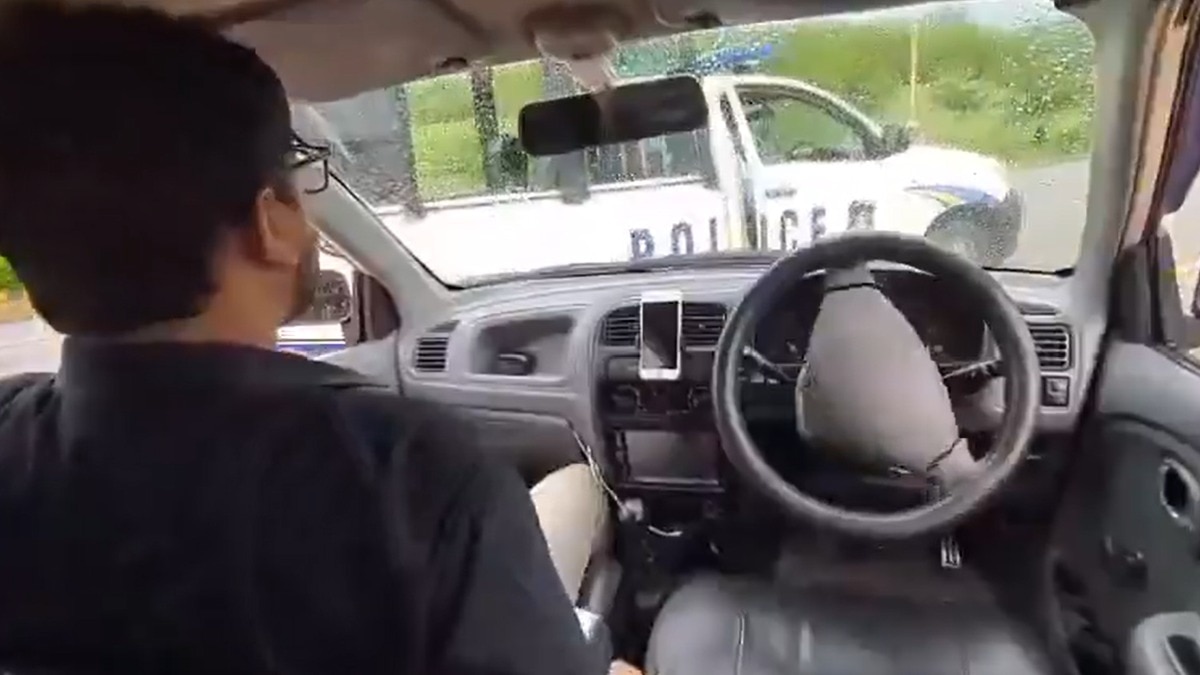
A homemade driverless car lost control and collided with a parked police vehicle during a public demonstration in Pakistan. The incident, captured on video, has sparked a debate over the safety of untested AI technology.
- A remote-operated driverless car crashed into a police van at D-Chowk, Pakistan.
- The collision was caused by a sudden internet disruption during remote operation.
- Journalist Muhammad Aalijah warned against deploying untested autonomous tech on public roads.
In a startling incident near Pakistan’s Parliament House at D-Chowk, a demonstration of a homemade driverless car ended in disaster. A video currently circulating on X (formerly Twitter) shows the vehicle, with an empty driver's seat, losing control and smashing directly into a parked police van. The footage has since gone viral, capturing the moment the technological experiment turned into a traffic accident.
The vehicle was being operated remotely via satellite and internet connections. Inside the car, journalist Muhammad Aalijah was seated in the front passenger seat, recording the event and narrating the car's features. As the vehicle accelerated, it suddenly veered off course. Despite Aalijah's frantic attempts to engage the handbrake, the collision was inevitable. Fortunately, the impact caused only minor damage, and no injuries were reported.
Why This Matters
BozokMedia analysis shows that this crash exemplifies the 'single point of failure' risk in remote-operated systems. Unlike true autonomous vehicles that process data locally via LiDAR and cameras, this prototype relied on a cloud-based link. When the connection dropped, the car became a projectile. This distinguishes 'remote control' from 'true autonomy'.
"The critical flaw here was the lack of a fail-safe mechanism; an autonomous vehicle must be programmed to stop immediately upon loss of signal."
Following the crash, Aalijah explained that rainy weather contributed to an internet disruption, which triggered the technical fault. He noted that he had been invited by Ehsan Zafar, a technology enthusiast from Abbottabad, to cover the project. Aalijah later stated that the video was intended to serve as a cautionary tale, emphasizing that the system was not yet "completely safe and reliable."
While this prototype failed, the global autonomous driving industry is far more advanced. Companies like Waymo in the US and Baidu or Pony.ai in China employ multi-layered safety protocols. Their vehicles use a combination of radar, ultrasonic sensors, and deep learning to navigate without needing a constant internet tether to a human operator, ensuring they can handle unexpected obstacles independently.
| Feature | Homemade Prototype (Pakistan) | Industrial AI (Waymo/Tesla) |
|---|---|---|
| Control Method | Remote Internet/Satellite | On-board AI & Sensors |
| Safety System | Manual Handbrake | Automatic Emergency Braking (AEB) |
| Connectivity | Fails on Signal Loss | Local Edge Computing |
Frequently Asked Questions
1. Were there any casualties in the accident?
No, the crash resulted in only minor material damage, and no one was injured.
2. What caused the car to lose control?
A technical fault caused by an internet disruption, likely exacerbated by rainy weather, led to the loss of remote control.