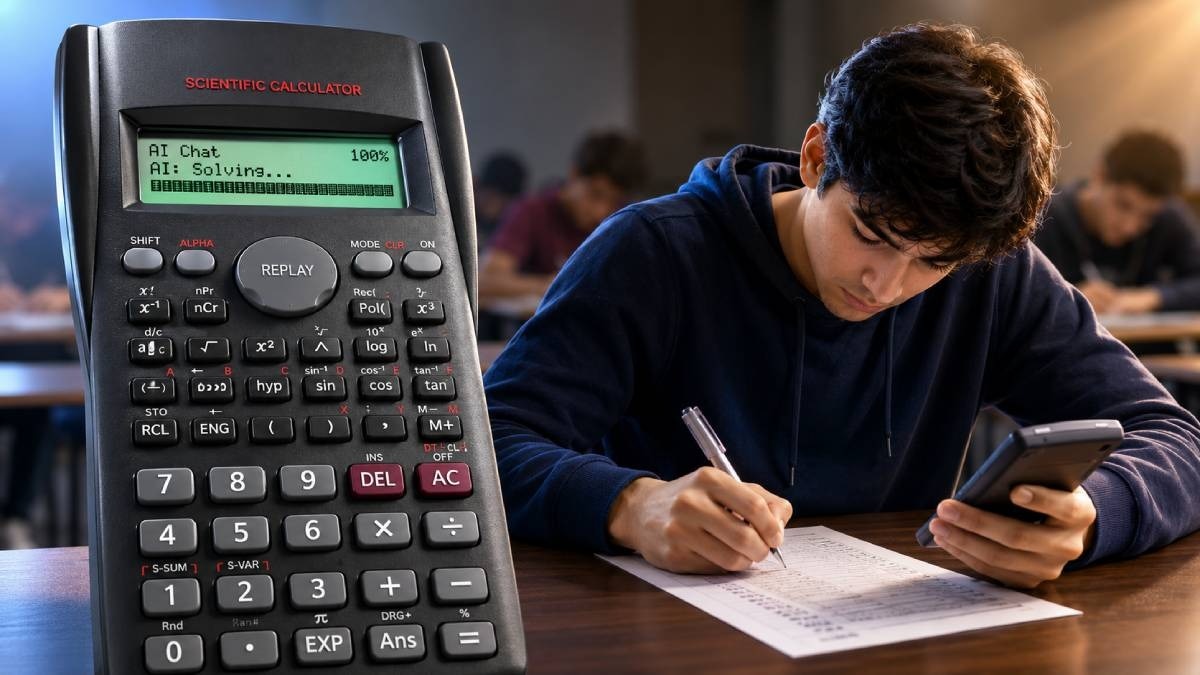
Artificial Intelligence has officially entered the world of handheld calculators, moving beyond simple arithmetic to complex problem-solving. While this promises to aid learning, it has triggered massive concerns regarding cheating in educational examinations.
- AI calculators can interpret and solve complex mathematical logic, not just basic math.
- They act as personalized tutors by explaining step-by-step solutions.
- The similarity to standard calculators poses a high risk of undetected cheating.
- Educational institutions may need to implement stricter device regulations.
The rapid evolution of Artificial Intelligence (AI) is no longer confined to smartphones, laptops, or sophisticated software. In a significant technological leap, AI has now integrated into handheld devices—specifically, the calculator. Unlike traditional devices that merely perform arithmetic, these new AI-powered calculators possess the intelligence to understand the context of a mathematical problem and provide comprehensive solutions.
Evolution: Traditional vs. AI-Powered Calculators
A standard calculator is a reactive tool; it waits for an input like '5 + 5' and provides '10'. However, an AI calculator is proactive and analytical. It can process complex algebraic equations, calculus, and even word problems by interpreting the underlying logic. This makes the transition from a simple tool to a cognitive assistant.
| Feature | Standard Calculator | AI-Powered Calculator |
|---|---|---|
| Functionality | Basic Arithmetic | Logic & Problem Solving |
| Learning Aid | None | Step-by-Step Explanations |
| Intelligence | Static/Pre-programmed | Dynamic/Context-Aware |
BozokMedia analysis shows that while this technology bridges the gap in mathematical understanding, it simultaneously creates a massive loophole in traditional assessment methods.
The Growing Fear of Exam Cheating
The primary concern among educators and exam boards is the 'stealth factor.' AI calculators are designed to look indistinguishable from standard, non-programmable calculators. In examinations where basic calculators are permitted, a student could potentially use an AI-integrated device to solve complex problems covertly, undermining the entire purpose of the test.
The challenge for modern education is to distinguish between using AI as a tutor and using it as a crutch for deception.
Impact on Students: Help or Hindrance?
For students struggling with Mathematics and Science, these devices can be revolutionary. They can serve as a 24/7 tutor, breaking down intimidating equations into digestible steps. However, there is a significant psychological risk: over-reliance on AI could lead to the atrophy of critical thinking and fundamental problem-solving skills, making students dependent on algorithms rather than their own intellect.
Historical Background: From Abacus to AI
Since the invention of the abacus and the later mechanical calculators by Pascal and Leibniz, every leap in calculation technology has been met with skepticism regarding human cognitive decline. However, the leap to AI is fundamentally different because it involves reasoning rather than just processing.
The Future of Examinations
To combat this, educational bodies are expected to tighten security. We may see a shift toward strictly regulated, non-smart calculators in exam halls, or a complete move toward oral and conceptual-based testing that AI cannot easily replicate. The focus will likely shift from 'finding the answer' to 'explaining the process.'
Frequently Asked Questions
1. How does an AI calculator differ from a normal one?
While a normal calculator only gives results, an AI calculator understands the logic of the question and can explain the solution steps.
2. Will AI calculators be banned in schools?
While not a global ban, many examination boards are likely to restrict the use of any device with internet or AI capabilities to ensure fairness.