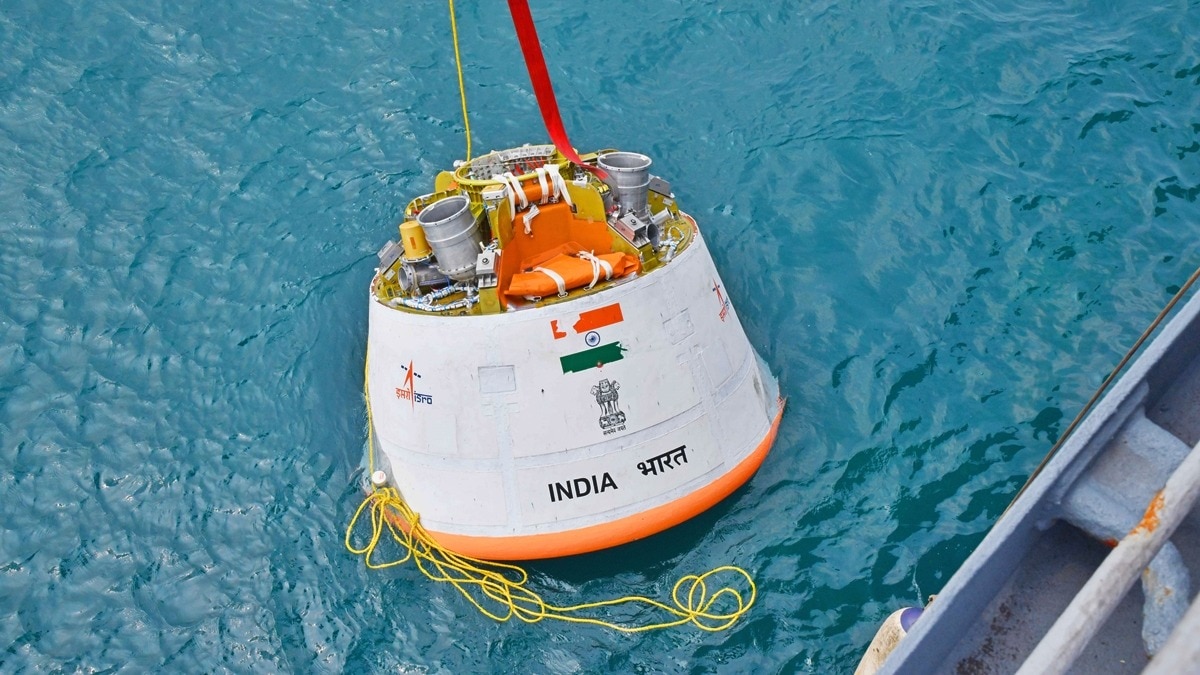
Following the successful EOS-05 launch, ISRO Chairman V. Narayanan has confirmed that the first uncrewed Gaganyaan mission is on track for a 2026 launch. The agency is gearing up for a massive year of space exploration.
- The successful deployment of EOS-05 marks a pivotal moment for ISRO's current fiscal year.
- The first uncrewed Gaganyaan mission (G1) is targeted for launch by the end of 2026.
- ISRO plans to execute six additional launches this year, including the NVS-03 satellite.
The Indian Space Research Organisation (ISRO) is entering a high-intensity phase of operations following the triumphant launch of the EOS-05 satellite. Utilizing the GSLV-F17 rocket, the agency successfully placed the advanced Earth observation satellite into its designated sub-geosynchronous orbit, signaling a major recovery after earlier mission challenges.
Speaking on the achievement, ISRO Chairman V. Narayanan emphasized that the agency is not slowing down. He reaffirmed that the cornerstone of India's upcoming space endeavors—the Gaganyaan programme—is moving forward with its first uncrewed flight, designated as G1, targeted for completion by 2026.
Why This Matters
BozokMedia analysis shows that ISRO's transition from purely satellite-based missions to human-centric spaceflight marks India's evolution into a premier space superpower. The success of the G1 uncrewed mission is critical to validating life-support systems and re-entry technologies required for safe human habitation in space.
"Reward for hard work is more work," stated V. Narayanan, highlighting the relentless pace of India's space program.
Beyond Gaganyaan, ISRO is optimizing its navigation capabilities. The upcoming launch of the NVS-03 satellite will bolster the NavIC constellation, providing enhanced positioning, navigation, and timing services across the Indian subcontinent and surrounding regions.
Historical Background
The path to EOS-05 was not without obstacles. Earlier this year, the PSLV-C62/EOS-N1 mission encountered an anomaly during its third-stage flight, resulting in failure. The success of EOS-05—India's first imaging satellite from a geosynchronous orbit at 36,000 km—serves as a vital technical comeback and a strategic milestone for Earth observation.
To prepare for the human element of Gaganyaan, ISRO has already conducted rigorous testing, including the Integrated Air Drop Tests in April and parachute qualification tests in July. These steps are essential precursors to the G1, G2, and G3 uncrewed missions that will pave the way for actual astronauts.
Frequently Asked Questions
1. What is the primary goal of the Gaganyaan G1 mission?
The G1 mission is an uncrewed flight designed to test all safety and life-support systems before humans are sent into orbit.
2. How does NVS-03 benefit India?
NVS-03 will strengthen the NavIC system, making India more self-reliant in satellite-based navigation services.


