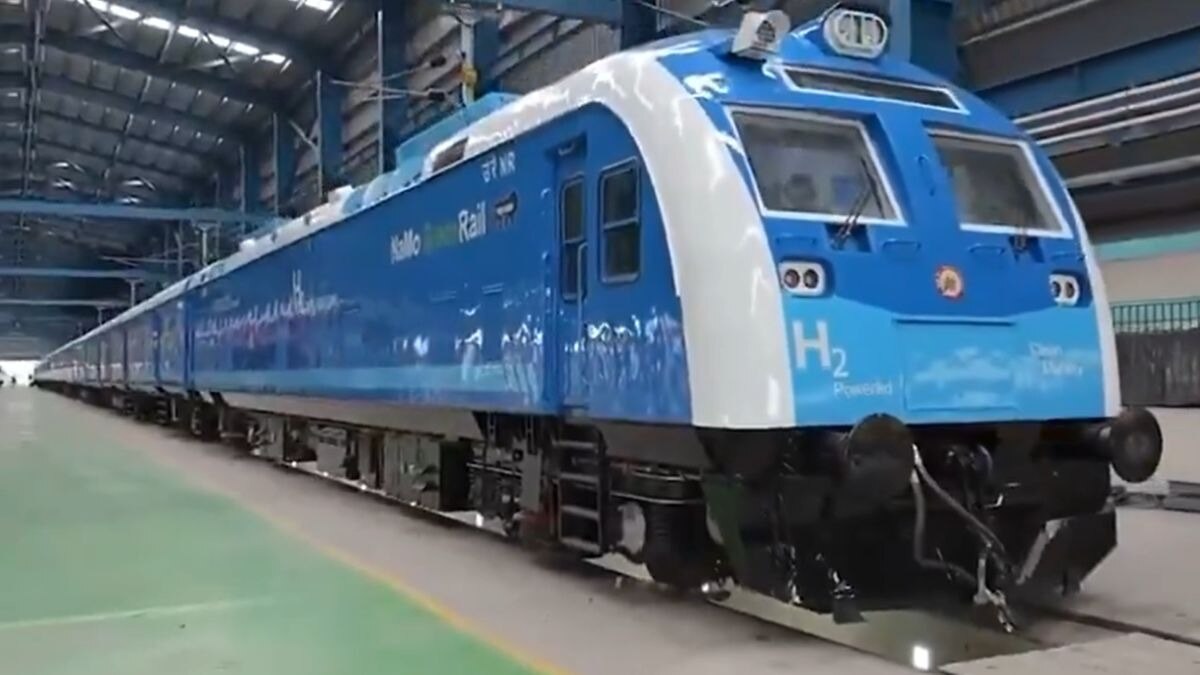
Indian Railways is gearing up to operate the nation's first hydrogen-powered train at speeds of up to 110 kmph. Following successful high-speed trials, officials are now finalizing routes and fuel logistics.
- India's first hydrogen train aims for an operational speed of 110 kmph.
- High-speed trials have already been successfully completed at 120 kmph.
- The train utilizes hydrogen fuel cell technology, emitting only water vapor.
- Railway expansion includes Vande Bharat sleeper services and major infrastructure projects.
In a significant leap toward sustainable transportation, Indian Railways is preparing to accelerate its first hydrogen-powered train to an operational speed of 110 kmph. Railway Board Chairman and CEO Satish Kumar confirmed that this follows successful trials conducted at a higher speed of 120 kmph. The authorities are currently in the process of consulting stakeholders to identify the most suitable rail sections for this green technology.
At present, the operational speed of the hydrogen train is maintained at 75 kmph. The transition to 110 kmph marks a crucial phase in testing the reliability and efficiency of the propulsion system. As mentioned by Kumar in Indore, the focus is now on resolving technical nuances and ensuring a seamless hydrogen fuel supply chain. The pilot project was recently flagged off by Prime Minister Narendra Modi on the 89-km Jind-Sonipat route in Haryana.
The Science of Green Motion: How it Works
Unlike conventional electric locomotives that rely on overhead traction lines, the Hydrogen Fuel Cell Trainset is a self-contained power plant. It generates electricity on board through a chemical reaction between hydrogen and oxygen. This process is entirely emission-free; the only by-products are water vapor and heat. This eliminates the need for carbon-intensive combustion or tailpipe emissions, making it a cornerstone of India's decarbonization strategy.
The integration of hydrogen technology represents a paradigm shift in how India approaches long-distance, eco-friendly rail travel.
Why This Matters: BozokMedia Analysis
BozokMedia analysis shows that this initiative is not merely about speed, but about strategic energy independence. By investing in hydrogen, India is positioning itself to reduce reliance on traditional power grids for rail operations and moving toward a decentralized, clean energy model. This aligns perfectly with the global push for Net Zero emissions.
Furthermore, the expansion of Vande Bharat sleeper services is set to transform the passenger experience. With the first sleeper service already running between Howrah and Kamakhya, the Railways is aggressively scaling up production through public-private partnerships. Additionally, massive infrastructure works, such as the Indore-Manmad railway line, are being fast-tracked to support growing economic corridors.
Comparison: Hydrogen vs. Traditional Electric Trains
| Feature | Hydrogen Fuel Cell Train | Conventional Electric Train |
|---|---|---|
| Power Source | On-board Hydrogen/Oxygen Reaction | Overhead Catenary Lines |
| Environmental Impact | Zero Emissions (Water Vapor only) | Zero (but requires grid power) |
| Infrastructure Needs | Minimal (No overhead lines needed) | Extensive (Wires and Substations) |
Frequently Asked Questions
1. Where is India's first hydrogen train currently operating?
It is currently operating on the 89-km Jind-Sonipat route in Haryana.
2. What is the main advantage of hydrogen trains?
They are zero-emission vehicles that produce only water vapor, making them extremely environmentally friendly.