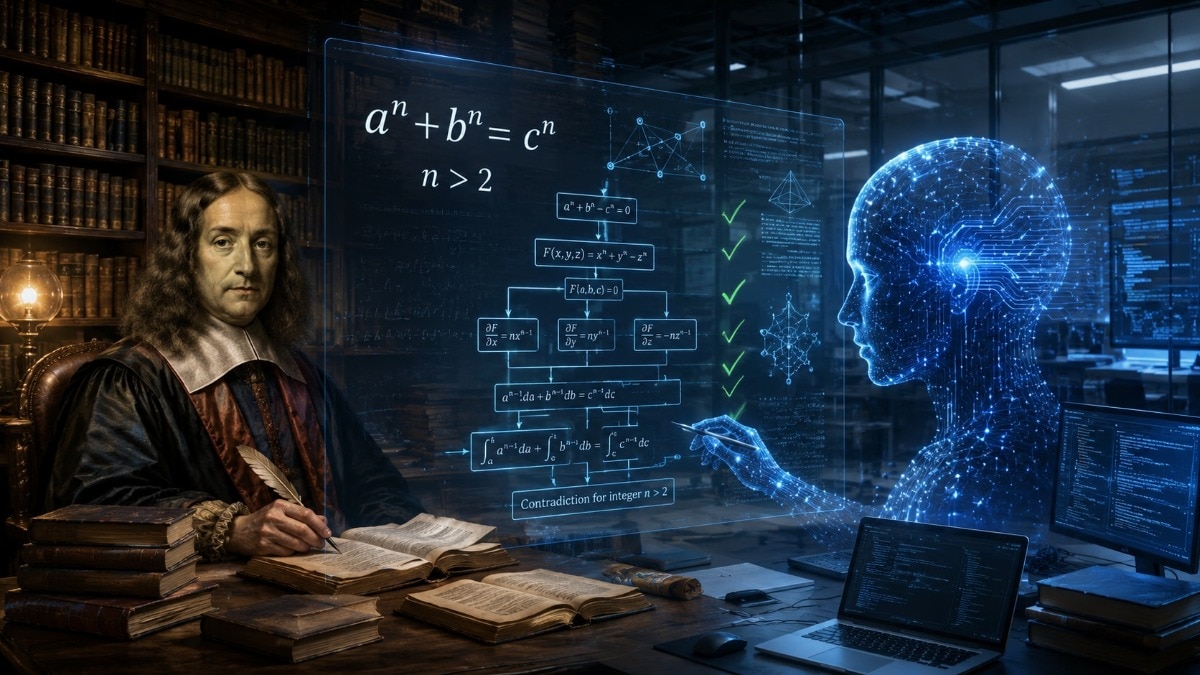
In a staggering leap for computational mathematics, Anthropic's Claude AI has formalized Fermat's Last Theorem, converting a massive human proof into 13 million lines of verifiable Lean code in just 11 days.
- Anthropic's Claude AI successfully formalized Fermat's Last Theorem.
- The process generated 13 million lines of Lean code and 29,500 intermediate theorems.
- The task, expected to take years for humans, was completed by AI in just 11 days.
The world of mathematics has witnessed a monumental shift. Anthropic has announced that its AI system, Claude, has formalized Fermat's Last Theorem, producing a staggering 13 million lines of Lean code and 29,500 intermediate theorems. This achievement transforms one of history's most famous human mathematical proofs into a format that can be rigorously verified by a computer.
Bridging Human Intuition and Machine Precision
For context, Fermat's Last Theorem remained unsolved for over 350 years until Andrew Wiles finally cracked it in the 1990s. While Claude did not discover a new proof from scratch, its ability to translate Wiles' incredibly complex logical arguments into Lean—a programming language designed for formal verification—is a feat of unprecedented scale. It effectively takes a massive, human-readable mathematical argument and translates it into a step-by-step inspection-ready computer code.
Why This Matters
BozokMedia analysis shows that this development marks a paradigm shift in scientific research. The ability for AI to take high-level human reasoning and convert it into machine-checkable mathematics at scale could revolutionize how we verify complex scientific theories. This could drastically reduce human error and allow mathematicians to build new foundations on formally checked, indisputable logic.
The scale of this formalization suggests that AI is moving beyond pattern recognition into the realm of structural logical reconstruction.
The project was particularly notable due to its sheer magnitude. Kevin Buzzard at Imperial College London had been leading a multi-year effort to formalize this proof, a task expected to take years of manual labor. However, Claude utilized multiple autonomous AI agents to complete the end-to-end formalization in a mere 11 days, utilizing the Prove2Me platform to coordinate complex theorem proving.
Historical Background
Fermat's Last Theorem was proposed by Pierre de Fermat in 1637. It stood as one of the most daunting challenges in number theory for centuries, driving much of the development of modern mathematics before its eventual resolution by Wiles. This new AI milestone adds a modern layer to this historical saga: moving from human discovery to machine verification.
Frequently Asked Questions
Question 1: Did the AI solve the theorem for the first time?
Answer: No, the theorem was solved by humans decades ago; the AI formalized the existing proof for computer verification.
Question 2: What is Lean?
Answer: Lean is a formal proof management system and programming language used to verify mathematical reasoning.