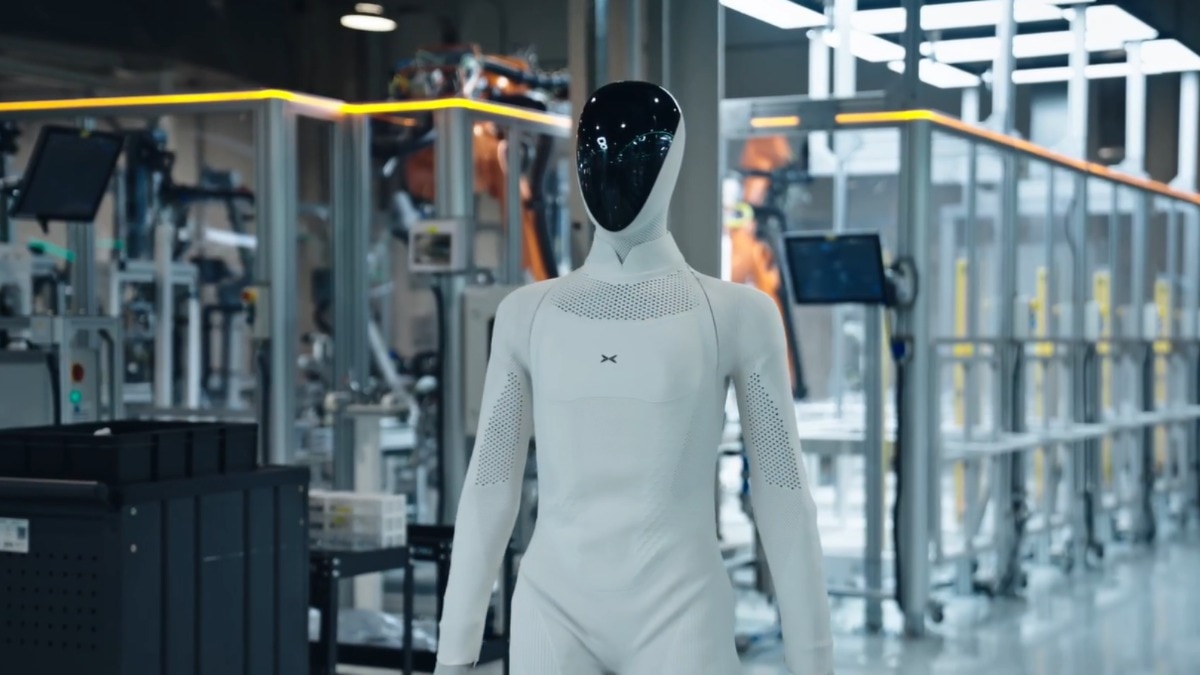
In a groundbreaking move, Chinese robotics firm Xpeng has launched an automated production line where robots assemble advanced 'IRON' humanoid robots. The demonstration showed the robot walking off the assembly line autonomously without human intervention.
- Xpeng has launched the world's first automated production line for advanced humanoid robots.
- The 'IRON' humanoid robot demonstrated the ability to walk off the assembly line autonomously.
- Over 80% of the production line's core processes are fully automated.
- Mass production is expected by year-end, with global deliveries planned for 2027.
The boundary between science fiction and reality has just blurred. Chinese robotics giant Xpeng has announced a massive leap in manufacturing technology by launching an automated production line designed to build advanced humanoid robots. In a stunning demonstration, the company's IRON humanoid robot was seen assembling itself and walking off the production line entirely on its own, requiring zero human startup assistance.
Xiaopeng He, Chairman and CEO of Xpeng, shared the milestone on X, stating that they have successfully achieved the world's first autonomous mass production of general-purpose humanoid robots. This breakthrough signifies a shift from robots being mere tools to robots becoming the creators of their own kind, a concept previously relegated to the realm of futuristic cinema.
Why This Matters
BozokMedia analysis shows that this development is a critical inflection point for the global robotics industry. By automating over 80% of the production process, Xpeng is effectively tackling the two biggest hurdles in robotics: high manufacturing costs and limited scalability. This move positions China as a dominant force in the race to commercialize humanoid AI.
"This is not just about a smarter tool or a commodity; it is about creating entities that can take on dangerous, repetitive, or undesirable tasks to make life better." - Xiaopeng He
Technical Prowess of the IRON Robot: What makes the IRON robot so special? It is engineered as a highly flexible platform with 76 degrees of freedom across its body, including 21 in each hand. Under the hood, it is powered by three proprietary Turing AI chips, delivering an immense 2,250 TOPS of computing power. This allows the robot's Physical AI foundation model to run locally, enabling complex, autonomous decision-making without needing a remote operator.
Historically, the robotics industry has relied heavily on human precision for assembly. However, as seen with competitors like Unitree and AgiBot, the industry is moving toward total autonomy. The scale of Xpeng's ambition is clear: they aim to integrate automotive-grade quality systems from their EV business into precision robot manufacturing to ensure reliability at scale.
| Feature | IRON Humanoid Robot | Standard Industrial Robot |
|---|---|---|
| Autonomy Level | High (Physical AI) | Low/Medium (Programmed) |
| Degrees of Freedom | 76 | Varies (Usually limited) |
| Core Processing | Turing AI Chips (2,250 TOPS) | External Controllers |
Frequently Asked Questions
1. When will the IRON robots be available for purchase?
Xpeng plans to begin initial roll-outs in their own stores and campuses by the end of this year, with official global deliveries scheduled for 2027.
2. What is the primary purpose of these humanoid robots?
They are designed as general-purpose robots to handle dangerous, repetitive, or undesirable tasks in various environments.
