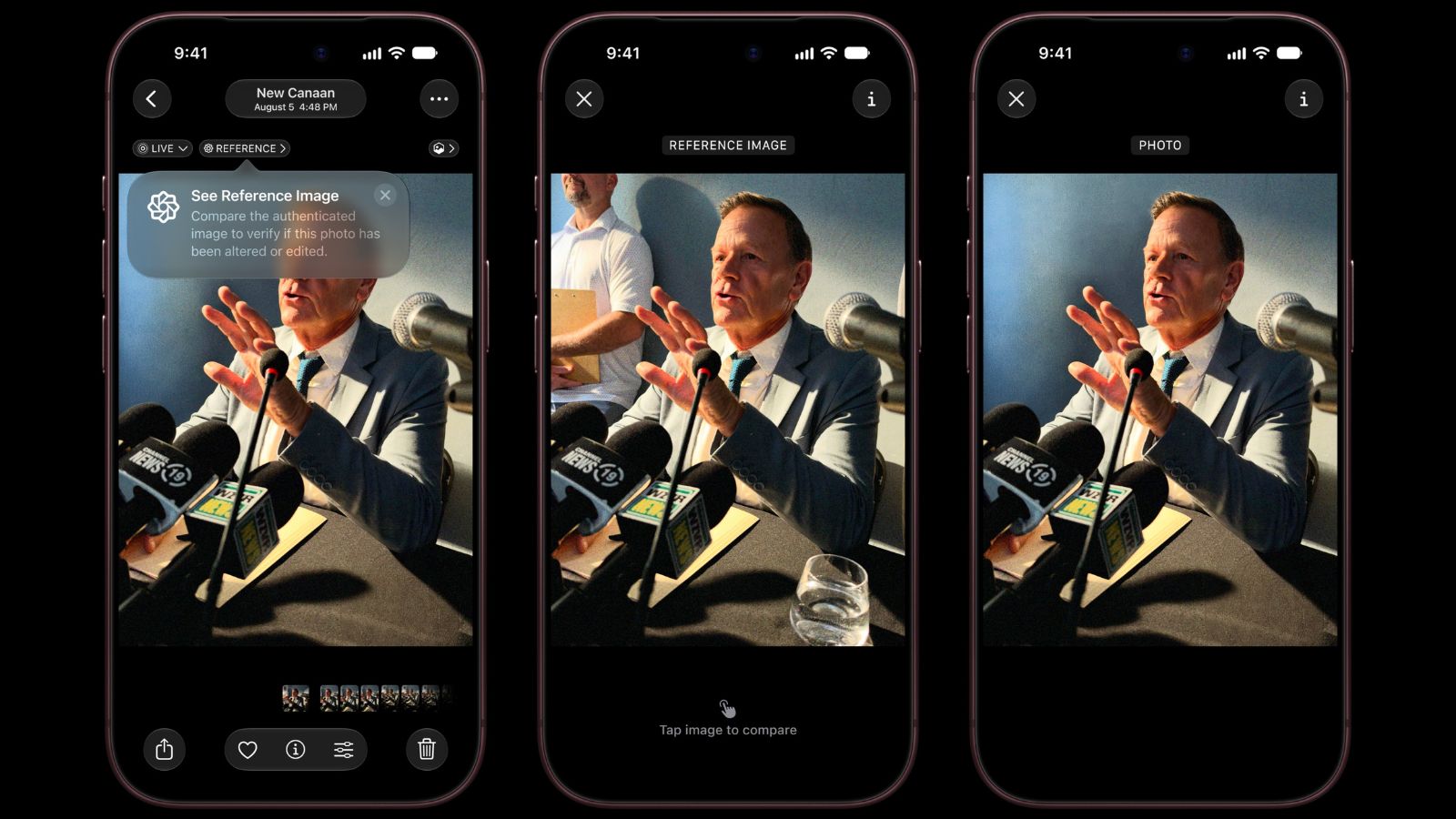
Apple has unveiled 'Reference Image,' a digital negative feature for the iPhone 18 Pro and iPhone Duo that allows users to verify photo authenticity against AI alterations.
- Apple Reference Image acts as a 'digital negative' to verify original sensor data.
- Available on iPhone 18 Pro, Pro Max, and the new foldable iPhone Duo running iOS 27.
- Supports Google DeepMind’s SynthID for identifying AI-generated content via invisible watermarks.
- Powered by a new Main camera sensor capable of signing every single pixel.
In an era where generative AI can create photorealistic imagery that is nearly indistinguishable from reality, Apple has introduced a critical tool for authenticity. During its latest hardware keynote, the tech giant announced 'Apple Reference Image,' a feature designed to provide an unalterable record of what a camera sensor actually captured at the moment of a photo's creation.
Functioning as a modern 'digital negative,' the Reference Image allows users to compare an original, signed capture with any subsequent edited or AI-altered versions. This capability is integrated into the premium lineup, including the iPhone 18 Pro, iPhone 18 Pro Max, and the historic iPhone Duo—Apple's first foldable smartphone—all powered by iOS 27.
Why This Matters
BozokMedia analysis shows that the industry is currently fragmented regarding AI labeling standards. By combining proprietary hardware signing (Reference Image) with industry-wide standards like SynthID, Apple is creating a comprehensive ecosystem of trust. This is not merely a photography tool; it is a forensic instrument essential for photojournalists and legal verification in a world of deepfakes.
"The transition from metadata-based verification to hardware-signed pixel data is a paradigm shift in digital trust."
Beyond its internal tools, Apple is embracing collaboration by supporting Google DeepMind’s SynthID. SynthID embeds an invisible watermark into AI-generated media, which can be detected later. This synergy between Apple and Google addresses the urgent need for a consensus on how to flag AI content across different platforms and devices.
The technical process involves a specialized sensor in the Main camera that signs each pixel. When 'Reference mode' is activated, the device captures this signed data and processes it via Apple’s Private Cloud Compute to ensure the resulting reference image remains tamper-proof.
| Feature | Apple Reference Image | SynthID (Google/OpenAI) |
|---|---|---|
| Mechanism | Hardware Sensor Pixel Signing | Invisible Digital Watermarking |
| Primary Goal | Prove Originality of a Capture | Identify AI-Generated Content |
| Device/Platform | iPhone 18 Pro / Duo (iOS 27) | Cross-platform AI Models |
However, global availability remains a hurdle. Due to strict regulatory environments, the feature will not be available at launch in China and the European Union (EU), although EU users on iOS 27 may still possess the ability to view and develop these images through specific APIs.
Frequently Asked Questions
Q1: Is the Reference Image feature available on all iPhone models?
No, it is exclusively available on the iPhone 18 Pro, iPhone 18 Pro Max, and the iPhone Duo.
Q2: Can I use this to verify photos taken on other devices?
No, the feature only works for photos captured using the specific signed sensor and 'Reference mode' on supported iPhone 18 Pro models.


