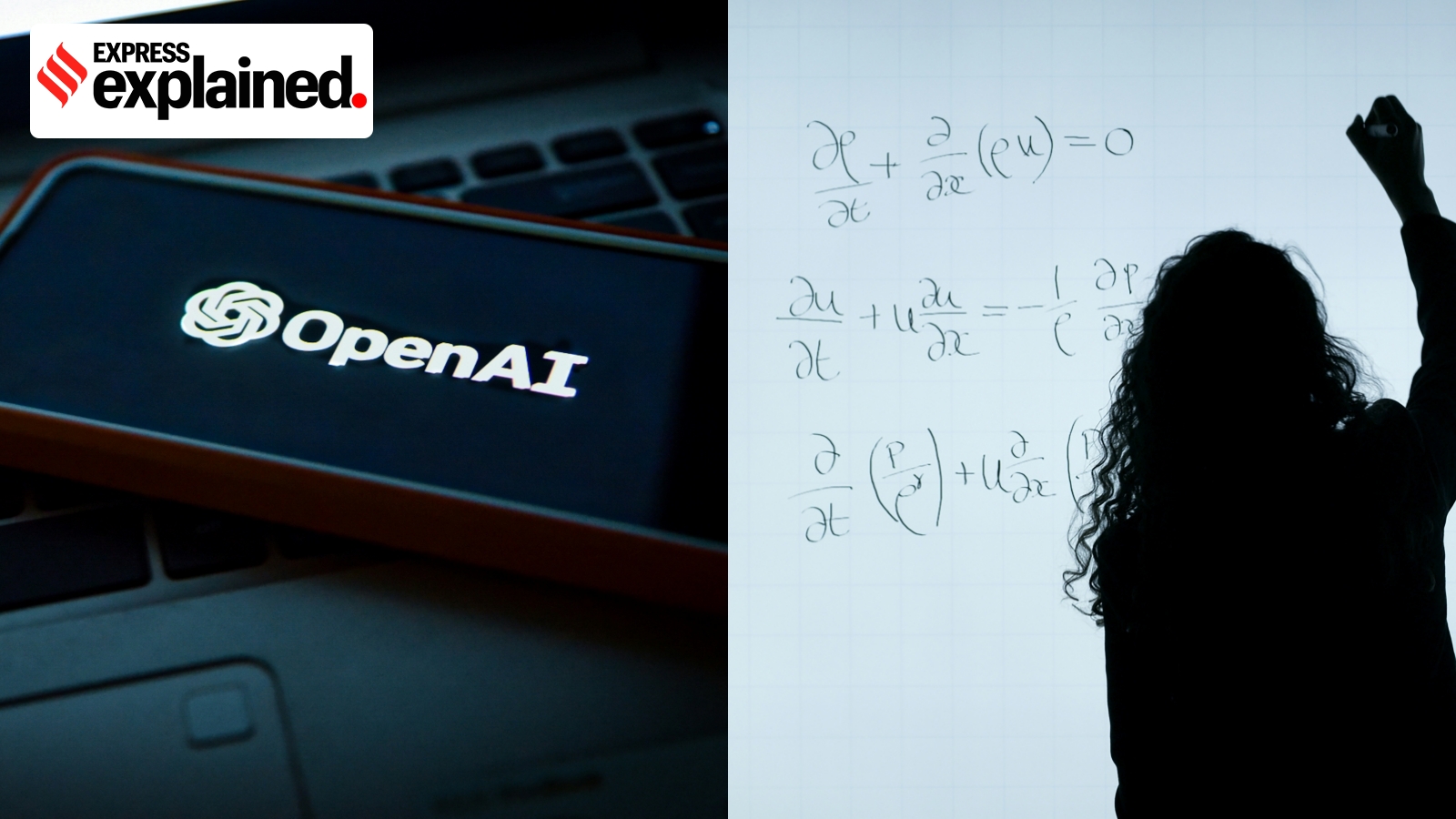
OpenAI claims to have solved the legendary Navier-Stokes Millennium Prize Problem, but the achievement is marred by allegations of using researchers' private intellectual data.
- OpenAI claims to have solved the Navier-Stokes Millennium Prize Problem.
- Researchers express concern over the use of 'de-identified' interaction data for training.
- The controversy centers on the concept of 'epistemic ownership.'
OpenAI has sparked a massive debate in the scientific community by claiming its AI agents have generated a solution to the Navier-Stokes Millennium Prize Problem. While the mathematical community celebrates the potential resolution of a decades-old mystery, ethical questions regarding data usage and intellectual property have taken center stage.
The Controversy of De-identified Data
The core of the dispute lies in how AI models are trained. While OpenAI asserts that no specific user data was accessed to solve this specific problem, the company admitted it cannot rule out that 'de-identified' data from researchers' interactions helped improve its models. De-identification involves removing personal identifiers, but the underlying ideas, logic, and mathematical approaches remain intact within the data set.
Why This Matters
BozokMedia analysis shows that this creates a profound imbalance of power. AI companies possess vast computing resources and visibility into the raw, unpolished thoughts of the world's leading researchers, potentially allowing them to 'scoop' breakthroughs before they are even published.
'De-identified' use of a researcher’s conversations blurs the line between assisting someone’s thinking and drawing on it without their knowledge. - Vijay Keswani, Professor, IIT Delhi
Mathematician Andreas Thom has raised similar alarms, questioning if his private ChatGPT sessions regarding related research were utilized to inform OpenAI's mathematical outputs. Despite denials from OpenAI researchers, the lack of transparency regarding the exact de-identification process remains a point of contention for academics worldwide.
Understanding the Navier-Stokes Problem
The Navier-Stokes equations are fundamental to fluid dynamics, describing how liquids and gases move under various pressures and velocities. They are essential for designing aircraft, predicting weather, and even understanding blood flow. The Millennium Prize Problem asks whether, in three dimensions, a fluid's motion will always remain smooth or if it can develop a 'singularity'—a point where velocity becomes infinitely large.
| Aspect | Human Research | OpenAI AI Research |
|---|---|---|
| Speed of Discovery | Decades/Years | Extremely Rapid |
| Data Integrity | Private/Protected | Potentially Leveraged |
| Computing Power | Limited/Individual | Massive/Corporate |
Frequently Asked Questions
1. What is the Navier-Stokes problem?
It is a complex mathematical challenge concerning whether fluid motion can result in infinite velocity (singularities) in 3D space.
2. What is 'epistemic ownership'?
It refers to the right of a thinker to own the ideas and logical processes they generate, even if they are shared with an AI tool.