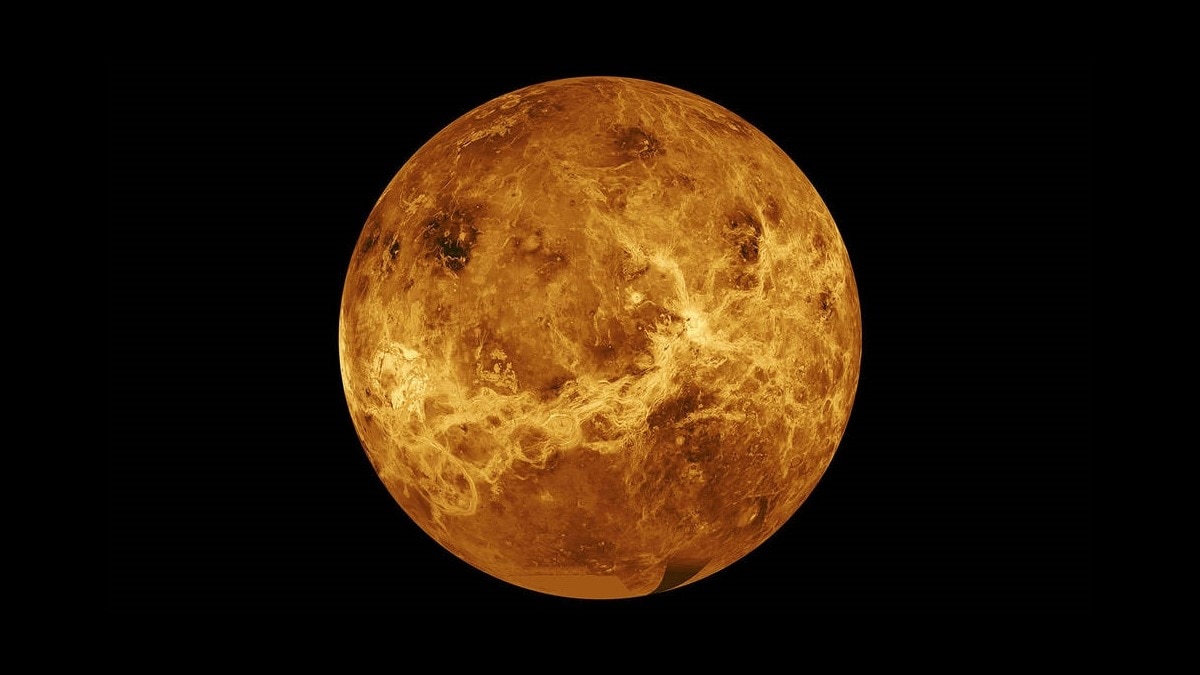
New astronomical theories suggest that Venus may have once possessed a moon, only to swallow it whole. This discovery reshapes our understanding of planetary evolution.
- Venus currently lacks any natural satellites.
- Theories suggest a past moon was absorbed by the planet.
- This event may have significantly altered Venus's rotation and atmosphere.
In a startling revelation that has sent shockwaves through the astronomical community, new evidence suggests that Venus, often called Earth's twin, may have engaged in a form of cosmic cannibalism. Researchers are exploring the possibility that the planet once hosted a moon, which it subsequently 'ate.'
Unlike the violent collisions we often see in deep space, this process appears to have been an incredibly smooth transition, leaving behind almost no detectable traces. This silent absorption could be a pivotal moment in the history of the solar system.
Why This Matters
BozokMedia analysis shows that understanding the loss of a moon is crucial for determining why Venus evolved so differently from Earth. While Earth stabilized with its moon, Venus underwent a radical transformation into a runaway greenhouse hellscape.
The disappearance of a moon can fundamentally rewrite a planet's rotational dynamics and atmospheric stability.
Historical Background: During the early stages of the solar system's formation, planetary orbits were highly unstable. Many planets underwent significant shifts in mass and rotation due to gravitational interactions with nearby celestial bodies and moons.
The hypothesis posits that gravitational tides or a slow inward spiral caused the moon to cross the Roche limit, leading to its destruction and eventual integration into the planet's mass. This could explain the lack of a magnetic field on Venus today.
Frequently Asked Questions
Question 1: Is there any proof Venus had a moon?
While direct evidence is scarce, mathematical models of planetary rotation strongly suggest a past satellite.
Question 2: How does this affect Earth?
It highlights how sensitive planetary systems are to orbital changes and gravitational pulls.