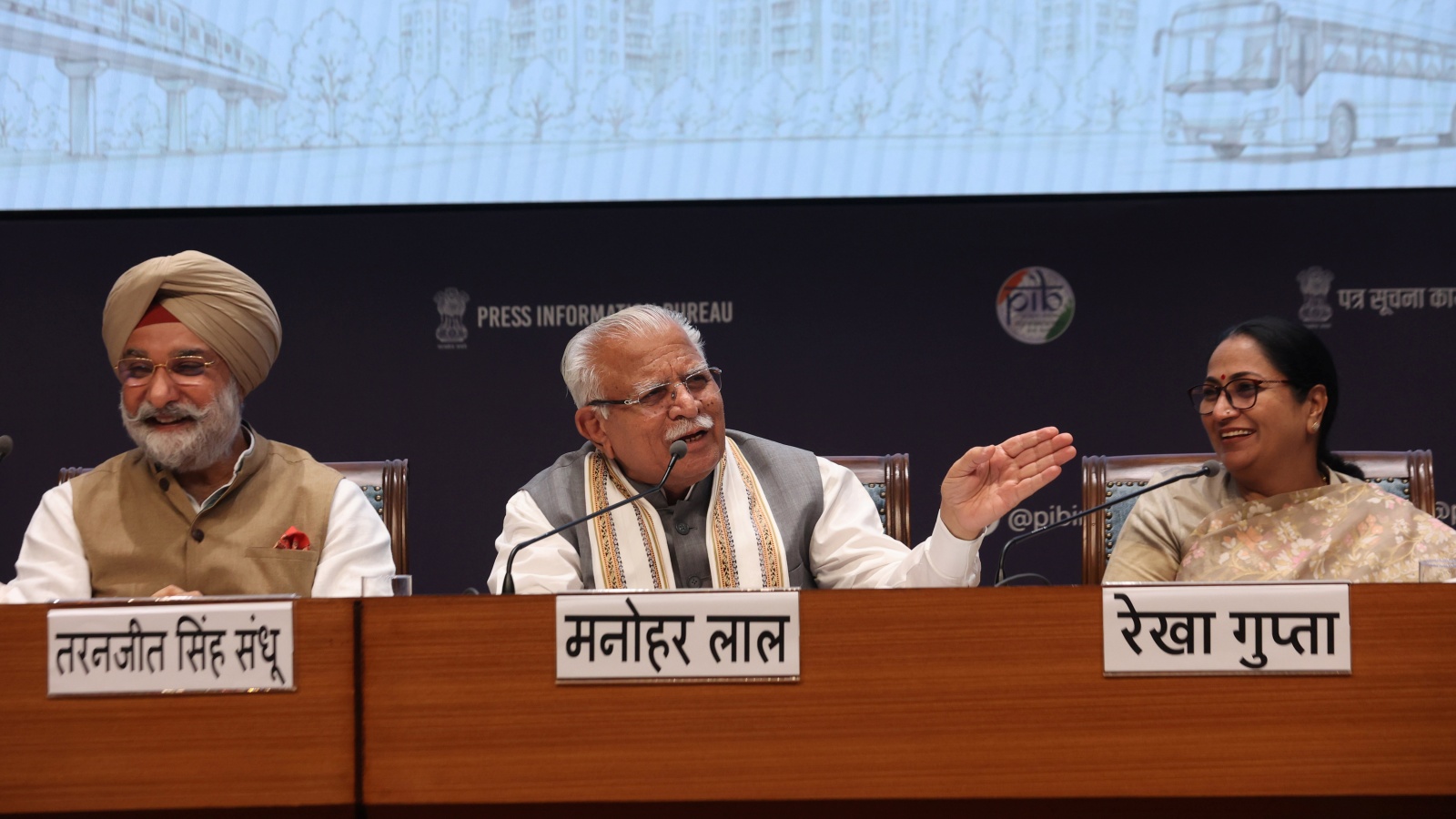
The Union Government has officially notified the Master Plan for Delhi (MPD)-2047, paving the way for high-rise developments, private sector expansion, and 40 lakh new affordable housing units to accommodate the city's growing population.
- Targeting the construction of 40 lakh new affordable housing units.
- 18 lakh homes planned near Metro corridors via TOD policy.
- 12 lakh homes expected through land pooling in Outer Delhi.
- Relaxed height and density restrictions to encourage private developers.
In a landmark move to reshape the national capital, the Centre has officially notified the Master Plan for Delhi (MPD)-2047. After a five-year delay, this strategic blueprint is set to transition Delhi from its traditional low-rise landscape to a modern, high-density metropolis characterized by soaring skyscrapers and extensive private-sector participation.
The plan was unveiled by Union Minister for Housing and Urban Affairs Manohar Lal Khattar, Delhi LG Taranjit Singh Sandhu, and Chief Minister Rekha Gupta. The primary driver behind this overhaul is the projected population explosion; Delhi's residency is expected to surge from 2.2 crore to 3.2 crore by the year 2047, necessitating a massive expansion in residential and commercial infrastructure.
Why This Matters
BozokMedia analysis shows that this policy shift addresses the critical housing crunch that has long plagued the NCR. Unlike neighboring Gurgaon or Noida, Delhi has historically been constrained by rigid height limits. By loosening these restrictions, the government is inviting massive capital infusion from the private sector to bridge the supply-demand gap.
The notification of MPD-2047 marks the end of Delhi's low-rise era and the beginning of a vertical revolution.
A cornerstone of this plan is the Transit-Oriented Development (TOD) policy. By allowing dense, high-rise construction within 200 sq km along Metro corridors, the government anticipates the addition of 18 lakh homes to the market. To ensure social equity, developers are mandated to dedicate 65% of their permissible construction to smaller flats with a carpet area of less than 60 sq m.
Furthermore, the Land Pooling mechanism will be utilized in Outer Delhi to develop approximately 12 lakh houses across 200 sq km. The plan also emphasizes the development of high-density corridors along the Urban Extension Road II (UER-II), spanning areas like Narela, Bawana, and Najafgarh.
Historical Background
For decades, Delhi's urban growth has been stifled by complex land-use regulations and strict Floor Area Ratio (FAR) limits. The previous regulatory framework involved 133 different land-use categories, making redevelopment a bureaucratic nightmare. MPD-2047 simplifies this by consolidating categories into just 45, significantly easing the process for developers and planners alike.
Frequently Asked Questions
1. How will MPD-2047 help the common man?
The plan focuses on creating 40 lakh affordable housing units and mandates that a large portion of new developments must consist of smaller, budget-friendly flats.
2. What is Land Pooling?
Land pooling is a strategy where landowners collectively assemble land for planned, large-scale development, reducing the need for government land acquisition.
| Feature | Traditional Delhi | MPD-2047 Vision |
|---|---|---|
| Building Profile | Low-rise / Plotted | High-rise / Vertical |
| Land Use Categories | 133 Categories | 45 Categories |
| Primary Developer | Cooperative/Individual | Large-scale Private Sector |