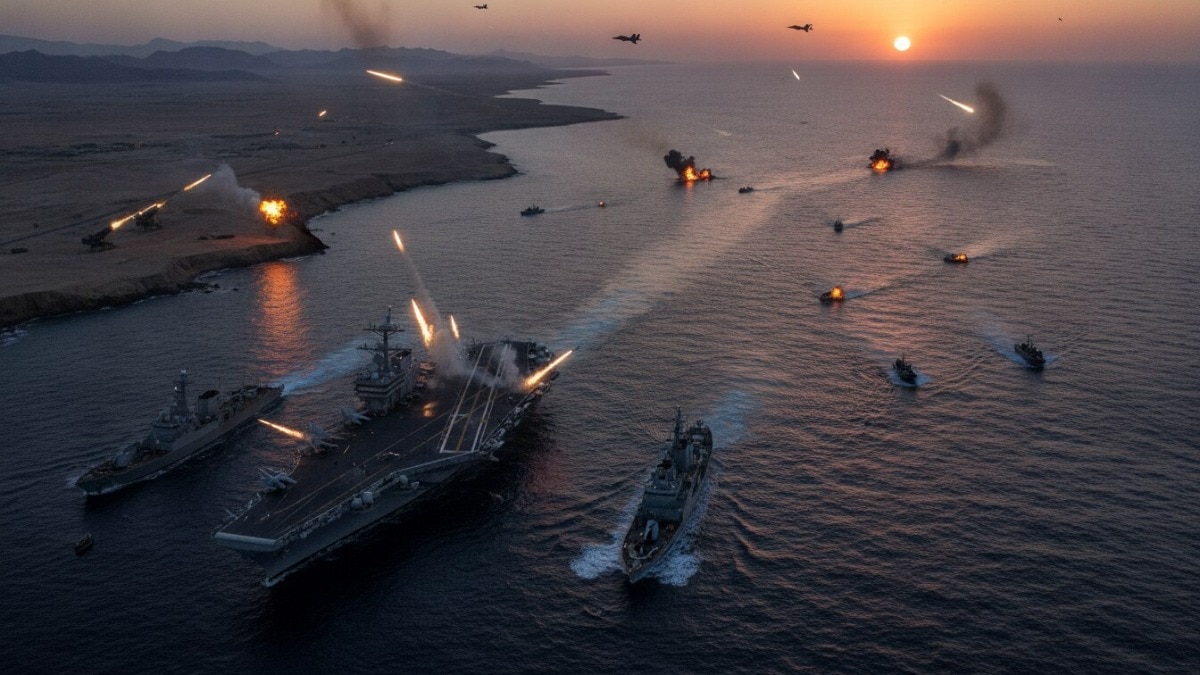
US President Donald Trump has announced complete US Navy control over the strategic Strait of Hormuz, enforcing an impenetrable blockade. Rejecting Tehran's demands for war damages, Trump directed negotiators to demand reparations from Iran for its hostile actions over the last 50 years.
Key Takeaways
- US Navy establishes 100% control over the Strait of Hormuz, blocking all Iran-bound vessels.
- President Trump rejects Iran's war compensation demands and counters with a 50-year reparation claim.
- Demands cover historic events like the USS Cole bombing, actions of Qasem Soleimani, and human rights violations.
In a major escalation of geopolitical tensions, US President Donald Trump announced that the United States Navy has established total control over the Strait of Hormuz. Speaking from the Oval Office, Trump described the naval blockade as an "iron wall" that is completely impenetrable. Under this strict blockade, no vessels bound for Iran are being permitted entry, effectively cutting off one of the world's most critical maritime choke points for Iranian trade.
The aggressive naval maneuver comes alongside a sharp diplomatic counter-strategy. Trump categorically rejected Iran's demands for war reparations stemming from recent military clashes. Instead, he instructed American negotiators to include a mandatory condition in all future diplomatic talks: Tehran must pay the United States for damages accumulated over the past 50 years. This includes compensation for state-sponsored terrorism, regional instability, and the suppression of domestic protests.
Why This Matters
A BozokMedia analysis shows that Trump's total blockade of the Strait of Hormuz represents a paradigm shift in global energy security. By controlling a choke point through which 20% of the world's petroleum passes, the US is not just squeezing Iran economically but also signaling to global markets its absolute naval dominance. This high-stakes leverage could force Tehran into a corner, but it also risks triggering an asymmetrical military response in the Persian Gulf.
"Trump's counter-claim for 50 years of reparations completely flips the diplomatic script, turning a defensive naval blockade into an offensive financial and strategic siege against Tehran." — Global Security Analyst
The Historical Weight of US-Iran Grievances
To justify the 50-year reparation demand, Trump cited several historical grievances. He highlighted the 2000 bombing of the USS Cole, regional destabilization orchestrated by the late Iranian military commander Qasem Soleimani, and decades of human rights abuses against Iranian citizens. Trump claimed that the Iranian regime's suppression of its own people has led to thousands of deaths, including an estimated 52,000 casualties over the last five months of intensified conflict following Iran's refusal to abandon its nuclear ambitions.
| Feature | Iran's Demands | United States' Demands |
|---|---|---|
| Hormuz Access | Immediate reopening and lifting of blockade | Strict blockade; only approved non-Iranian ships allowed |
| Reparations | Compensation for damages from recent US military actions | Compensation for 50 years of hostile acts, including USS Cole & Soleimani's actions |
| Nuclear Program | Right to peaceful nuclear development without sanctions | Complete abandonment of nuclear weapons ambitions |
Frequently Asked Questions
Q1: Why is the Strait of Hormuz so critical?
A1: It is the primary maritime route for oil exports from the Persian Gulf, carrying approximately one-fifth of the world's total oil consumption daily.
Q2: What triggered the latest escalation between the US and Iran?
A2: Tensions flared after Iran refused to halt its nuclear weapons program, leading to a five-month military standoff and the subsequent US naval blockade.