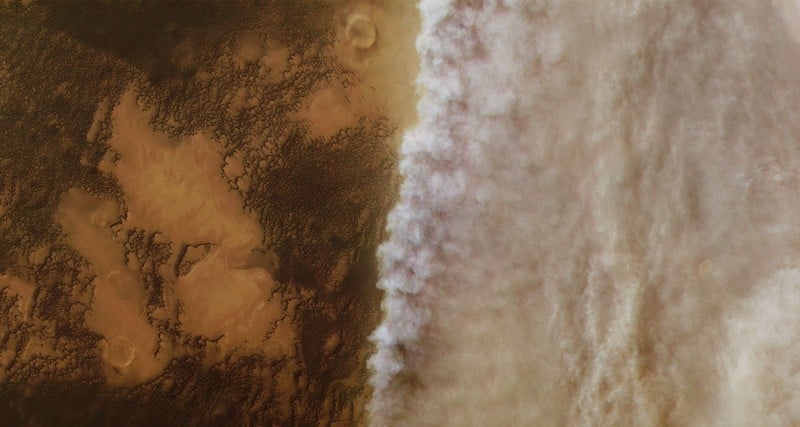
New research reveals that Martian dust storms do more than just block sunlight; they can create electrically charged environments in the lower atmosphere, threatening future space missions.
Key Takeaways
- Martian dust storms can create electrically charged conditions in the lower atmosphere.
- This poses a potential risk to communication systems, electronics, and future human habitats.
- The study analyzed data from the massive global dust storm of Martian Year 34.
The Red Planet, Mars, has always been a place of extreme weather, but a new study suggests the dangers are more complex than previously understood. While scientists have long known that massive dust storms can blanket the entire planet and block sunlight, researchers from the University of Alabama in Huntsville (UAH) and NASA Marshall Space Flight Center have uncovered a much more sinister possibility.
According to a study published in The Planetary Science Journal, Martian dust storms can cause the lower atmosphere to become electrically charged. By analyzing high-resolution weather data from Martian Year 34, the team found that these storms create 'breakdown-favorable' conditions, meaning localized regions where charge separation can persist, creating a structured electrostatic environment.
Why This Matters
BozokMedia analysis shows that this discovery shifts the paradigm of planetary protection. It is no longer just about visibility or solar power; it is about electrical integrity. For future astronauts and robotic explorers, an electrically charged atmosphere could lead to catastrophic failures in communication arrays, sensitive scientific instruments, and even the power systems of future Martian colonies.
For future Mars exploration, major dust storms should be evaluated not only as atmospheric, thermal, and visibility hazards, but also as structured electrostatic environments.
The historical impact of such storms is already evident. The mid-2018 global dust storm was responsible for ending the mission of NASA's legendary Opportunity (Oppy) rover. While 'Oppy' had survived far longer than expected, the sheer density of the dust prevented its solar panels from recharging, effectively silencing one of humanity's most successful robotic explorers.
Historical Context: The Power of Martian Storms
Unlike Earth, where storms are often localized, a Martian global dust storm can envelop the entire planet. This phenomenon makes the surface completely unobservable and can last for months, creating a hostile environment for any technology relying on solar energy or clear atmospheric conditions.
Frequently Asked Questions
1. How do these electric fields affect spacecraft?
They can interfere with electronic components and disrupt radio communication between the surface and orbiting spacecraft.
2. Has this happened before?
While the electrical aspect is new, the 2018 storm proved how deadly dust storms are by ending the Opportunity rover mission.