In a massive move to enhance road safety, India plans to mandate Vehicle-to-Vehicle (V2V) communication technology in new vehicles starting October 2028. This will allow cars to alert drivers of hazards even before they are visible.
Key Takeaways
- Mandatory V2V technology proposed for new vehicles from Oct 1, 2028.
- Uses AIS-230 standard via C-V2X technology.
- Covers two-wheelers, passenger cars, and commercial trucks.
- Aims to prevent collisions through real-time data sharing.
India is on the verge of a technological revolution on its highways. The Ministry of Road Transport and Highways (MoRTH) has proposed a draft amendment to the Central Motor Vehicles Rules (CMVR), 1989, making Vehicle-to-Vehicle (V2V) communication mandatory for new vehicles starting October 1, 2028. This initiative is designed to drastically reduce road accidents by enabling real-time intelligence sharing between moving vehicles.
Understanding V2V Communication
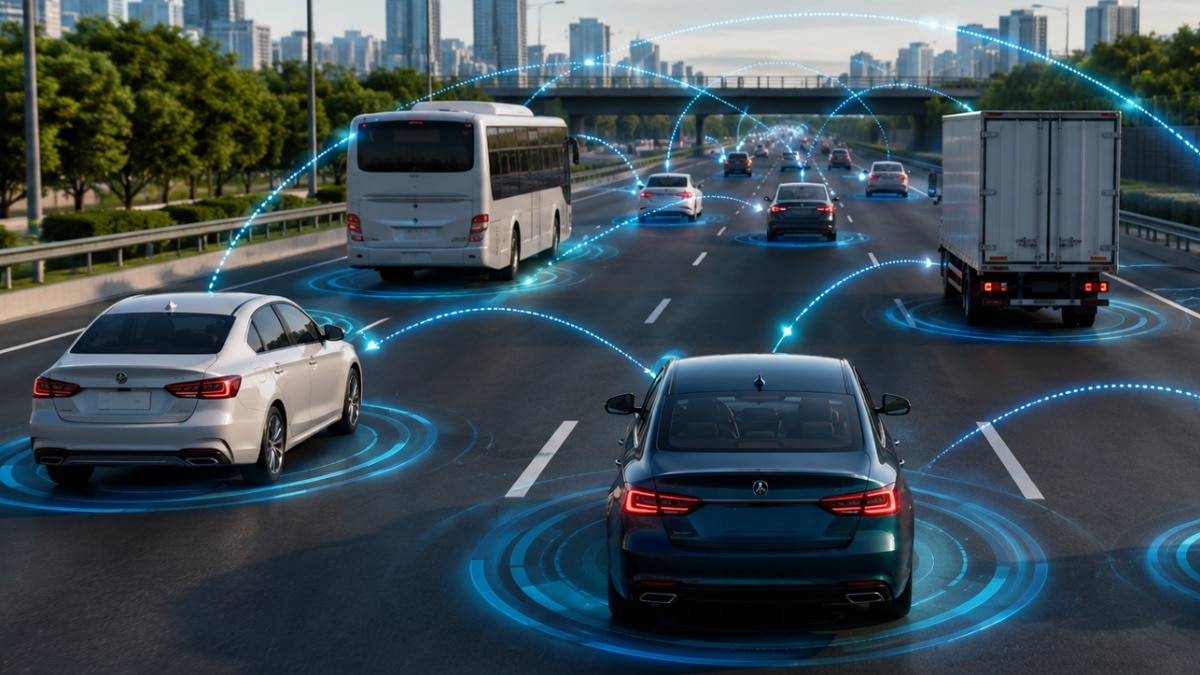
V2V technology allows vehicles to wirelessly exchange critical data such as speed, position, direction, and acceleration. Unlike traditional safety systems like cameras or radar, which are limited by the driver's line of sight, V2V can 'see' through obstacles. It can alert a driver if a vehicle several cars ahead brakes suddenly or if an emergency vehicle is approaching from a blind spot.
Why This Matters
BozokMedia analysis shows that in high-density traffic environments like India, situational awareness is often compromised by heavy congestion and poor visibility. By integrating V2V, the vehicle becomes part of a larger, intelligent network, providing a safety buffer that human reflexes alone cannot match.
V2V technology is the cornerstone of the transition from passive safety to active, predictive collision avoidance.
The Phased Rollout Plan
The government has outlined a strategic two-stage implementation to allow manufacturers to adapt:
| Implementation Date | Requirement Status | Vehicle Categories |
|---|---|---|
| Oct 1, 2027 | AIS-230 Compliance (Optional) | L, M, and N |
| Oct 1, 2028 | Mandatory V2V Integration | L, M, and N |
These categories include Category L (Two/Three-wheelers), Category M (Passenger cars/Buses), and Category N (Goods vehicles/Trucks).
Frequently Asked Questions
1. What safety features will V2V provide?
It will provide Emergency Brake Alerts, Forward Collision Warnings, Wrong-way Driving Alerts, and Emergency Vehicle Alerts.
2. What is the AIS-230 standard?
It is the technical framework that ensures all V2V systems in India meet specific cybersecurity, performance, and radio transmission standards.