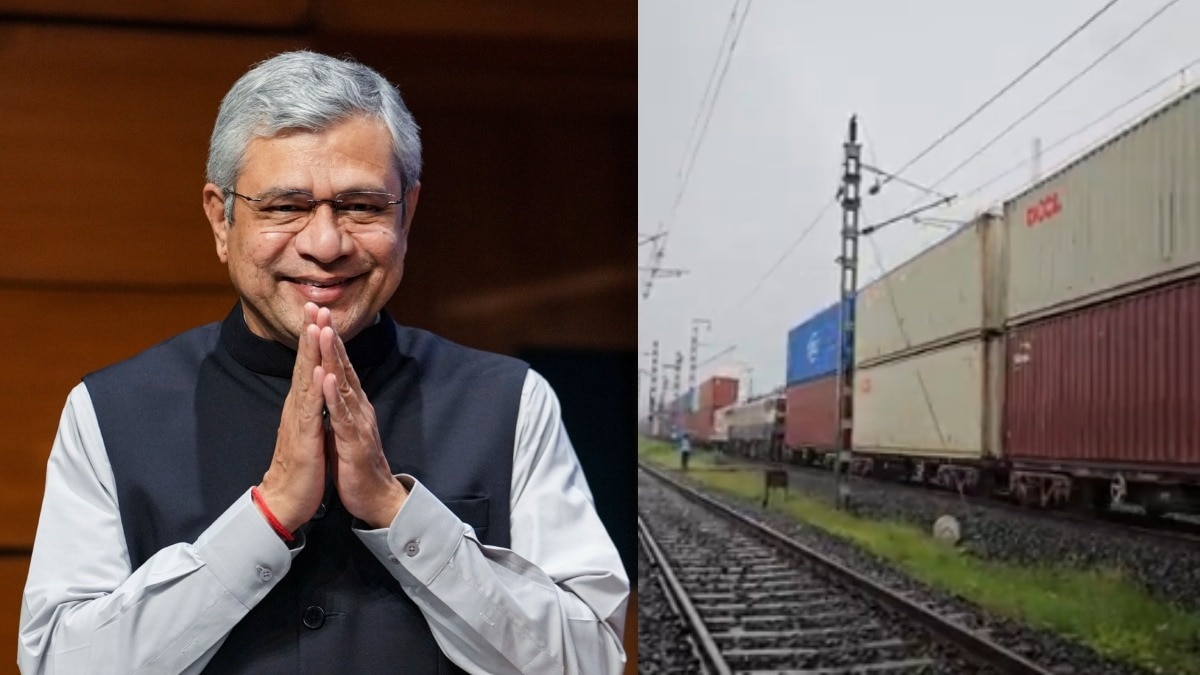
Union Minister Ashwini Vaishnaw showcased India's first long-haul double-stack container train. Spanning 1.3 km and carrying 3,922 tonnes, the train marks a new era in Indian logistics.
Indian Railways has marked a historic milestone in freight transportation. Union Minister Ashwini Vaishnaw shared a video showcasing the successful run of India's first long-distance double-stack container train. This gargantuan train is making headlines not just for its impressive 1.3 km length, but also for its massive payload capacity.
Technical Specifications and Operational Details
The train operated on the Western Dedicated Freight Corridor (WDFC), running from the Jawaharlal Nehru Port Trust (JNPT) in Mumbai to the CONCOR Cargo Terminal in Varnama, Vadodara division, Gujarat. The operation involved two powerful locomotives pulling two distinct rakes. The leading rake, powered by locomotive number 60311, carried 1,817 tonnes, while the trailing rake, powered by locomotive number 24690, carried 2,105 tonnes. In total, the train hauled a staggering 3,922 tonnes of cargo.
This feat involved the transportation of 360 TEUs (Twenty-foot Equivalent Units), demonstrating the immense capacity of the Indian rail network to handle large-scale bulk logistics in a single trip.
Why This Matters
BozokMedia analysis shows that this technological leap will fundamentally reshape India's logistics landscape. By utilizing double-stacking, the railways can move significantly more volume per trip, optimizing track usage and drastically reducing the number of required train movements. This efficiency is expected to alleviate congestion at major ports like JNPT.
The deployment of double-stack container trains is a strategic masterstroke to reduce logistics costs and boost India's export competitiveness.
Furthermore, the environmental implications are profound. As an electric-powered operation, this shift from diesel-dependent road transport to high-capacity rail will significantly lower carbon emissions, reduce road congestion, and decrease the overall environmental footprint of the supply chain.
Frequently Asked Questions
1. What is the significance of this train?
It is the first long-distance double-stack container train in India, capable of carrying massive loads over long distances efficiently.
2. Where did this train run?
The train traveled from JNPT, Mumbai, to Vadodara, Gujarat, via the Western Dedicated Freight Corridor.