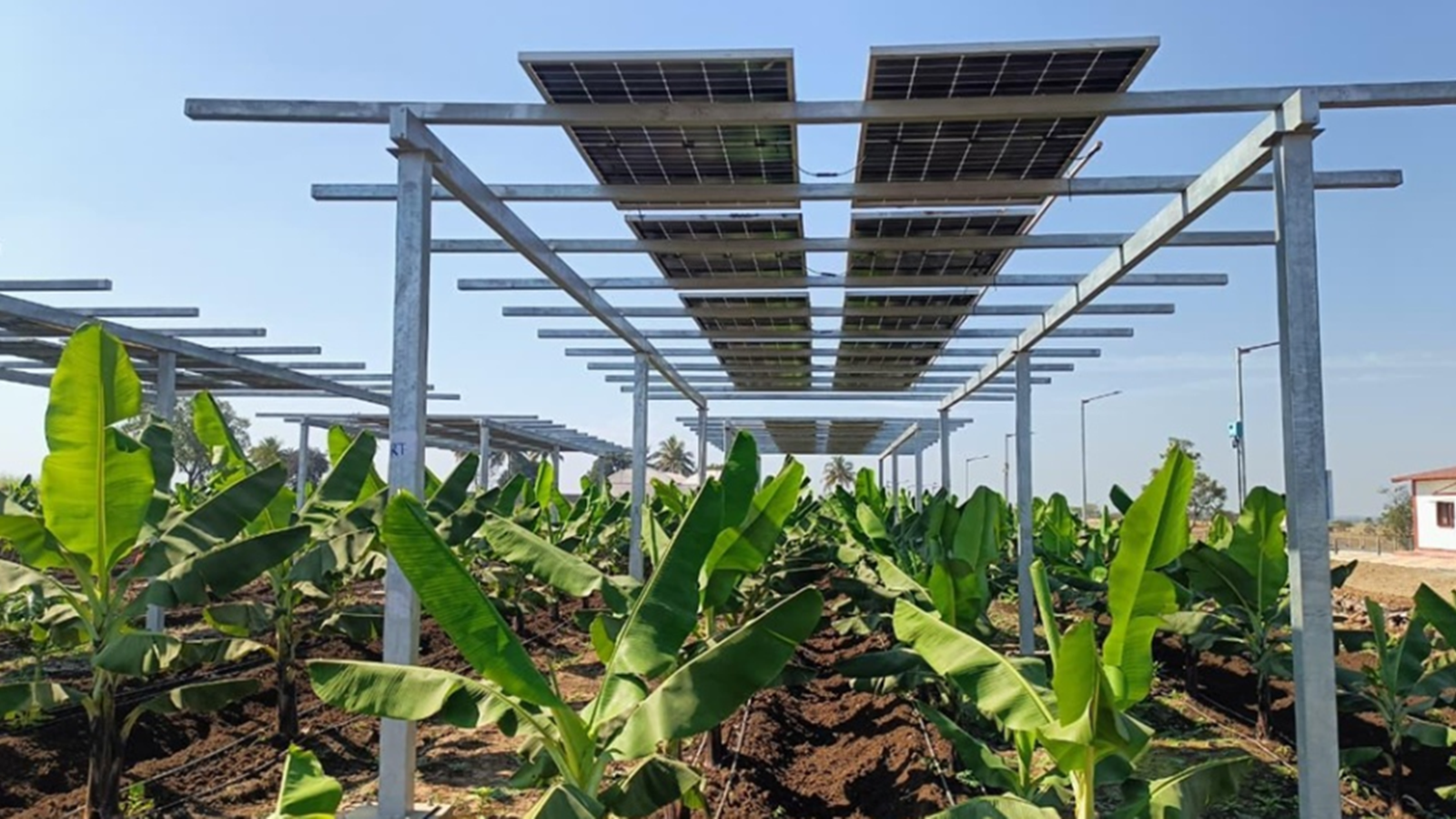
Researchers at BAIF in Pune are testing agrivoltaics, a method that combines solar power generation with crop cultivation to boost agricultural productivity and revenue.
- Agrivoltaics tests 17 solar configurations with 30 different crop types.
- Elevated panels up to 4 meters allow farm machinery to operate underneath.
- Crops like spinach and coriander saw a 100% yield increase under panels.
- The goal is to provide dual income streams from land and electricity.
In the heart of Pune, at the BAIF Rural Innovation Centre in Uruli Kanchan, a groundbreaking experiment is unfolding. Researchers are tackling a fundamental question of modern sustainability: Can the same piece of farmland be used effectively for both food production and solar energy generation? This concept, known as Agrivoltaics, is being rigorously tested through a project involving 17 types of solar-panel installations and 30 different crops.
Unlike traditional ground-mounted solar farms that occupy vast tracts of land exclusively for energy, this project explores vertical and elevated structures. Some solar panels are raised up to four meters, creating enough clearance for tractors and other essential farm machinery to pass underneath. The integration extends even further, with solar panels being combined with polyhouses, cattle sheds, and even floating installations on farm ponds.
Why This Matters
BozokMedia analysis shows that as climate volatility increases, agrivoltaics offers a dual-benefit strategy. The panels act as a protective shield against extreme summer heat and erratic rainfall, while simultaneously providing a consistent source of renewable energy that can be sold or used locally, stabilizing rural economies.
"The objective is to study how agricultural land can be used for both cultivation and solar power generation," stated Vitthal Kauthale, chief thematic programme executive at BAIF.
The preliminary findings are a mixed bag of success, proving that crop selection is critical. During the Kharif season, shade-loving crops like spinach, lettuce, and coriander showed a staggering 100% increase in yield compared to open-field control plots. Conversely, crops like brinjal recorded only about 80% of the standard yield, highlighting that the synergy depends heavily on the specific plant's light requirements.
| Crop Type | Solar Structure | Observed Outcome |
|---|---|---|
| Radish & Beans | Vertical Panels | Highly Suitable |
| Banana & Papaya | Elevated Panels | Optimal for tall crops |
| Spinach & Coriander | Shaded Panels | 100% Yield Increase |
| Brinjal | Shaded Panels | 80% Yield (Decrease) |
Historically, solar initiatives in India, such as the PM-KUSUM scheme, have largely focused on conventional, land-intensive installations. The BAIF study aims to bridge this gap by providing data-driven recommendations to the Government of India and NITI Aayog. By identifying the most profitable combinations of crops and solar structures, the project seeks to turn farmers into energy producers.
Founded in 1967 by social activist Manibhai Desai, BAIF is now entering its 60th year of service. With a vision to reach one crore families by 2030, the organization is looking to transform the economic landscape of rural India, aiming to raise the annual income of struggling families from ₹1.65 lakh to potentially ₹10 lakh by 2047 through integrated technologies like these.
Frequently Asked Questions
1. What is the main advantage of agrivoltaics?
It allows for dual land use, generating both food and renewable energy from the same plot, thereby maximizing economic returns.
2. Can all crops grow under solar panels?
No, it depends on the crop's light requirements. Shade-tolerant crops thrive, while sun-loving crops may see reduced yields.