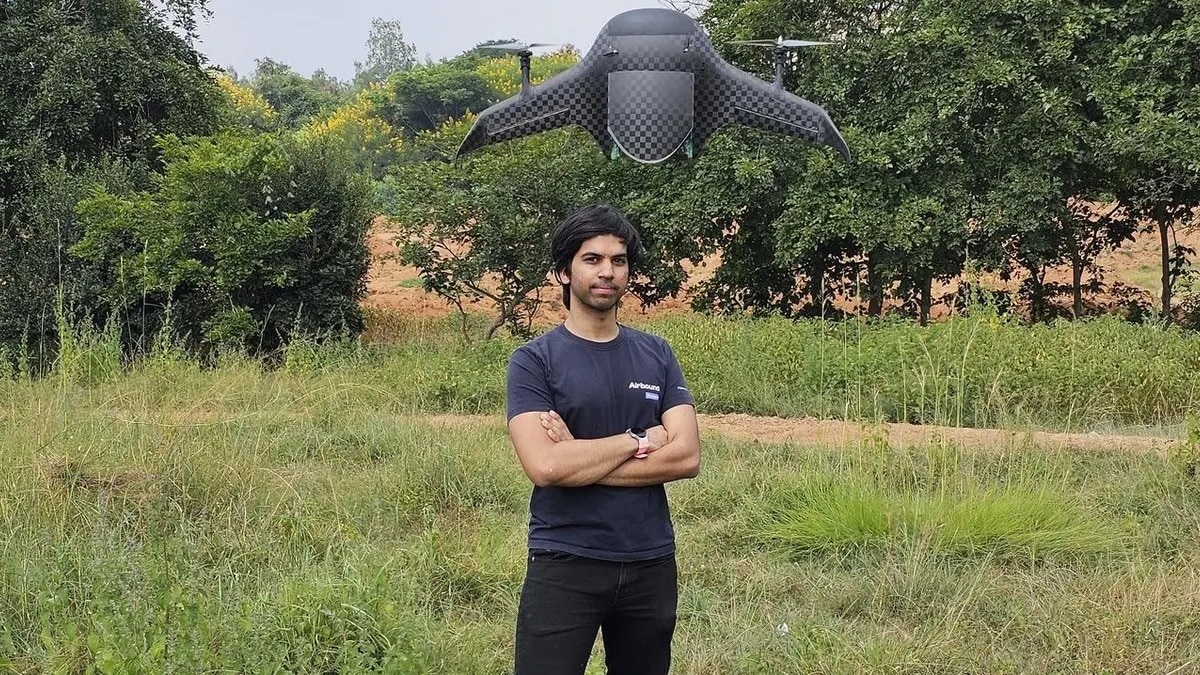
Bengaluru-based Airbound, founded by 21-year-old Naman Pushp, has raised $37 million to revolutionize drone logistics. What started as a pandemic-era boredom project is now transforming medical transport across India.
- Airbound raised $37 million in Series A funding led by Greenoaks.
- Founder Naman Pushp started building drones at age 15 during the COVID-19 lockdown.
- The startup specializes in high-payload, lightweight aircraft for medical and logistics transport.
- Airbound has completed over 13,000 autonomous flights, including critical blood sample transport for Narayana Health.
The story of Naman Pushp is a quintessential example of the modern entrepreneurial spirit. At just 21 years old, the CEO of Airbound has successfully transitioned from a curious teenager tinkering with robots in his bedroom to the leader of a high-growth aerospace startup. Based in Bengaluru, Airbound recently secured $37 million in a Series A funding round led by Greenoaks, bringing the company's total funding to nearly $50 million.
The genesis of Airbound dates back to 2020. While the world was grappling with the pandemic and schools were closed, Pushp, then 15, spent his time building a project called 'Open Drone'. This venture began not with a business plan, but with a desire to create. A win at a hackathon provided a $500 prize, which Pushp immediately reinvested into his first serious prototype—a drone that still serves as a reminder of his beginnings in the Airbound office today.
The Engineering Breakthrough
Pushp's approach to drone logistics addresses a fundamental flaw in conventional aircraft: the energy-to-weight ratio. Most drones spend more energy carrying their own frame than the actual payload, making them expensive compared to road transport. Airbound's TRT aircraft flips this script. Weighing only 1.5 kg, it can carry a 1 kg payload, transitioning from vertical takeoff to efficient horizontal flight. The company is currently developing a model capable of transporting 5 kg payloads to achieve cost parity with traditional trucking.
"The transition from a prototype to a scalable logistics network requires a fundamental shift from engineering curiosity to industrial precision."
Why This Matters
BozokMedia analysis shows that Airbound is not just building hardware; they are building a new infrastructure for urban logistics. By integrating with healthcare providers like Narayana Health, Airbound has proven that drones can replace ground transport for time-critical medical samples. The fact that a new hospital in Bengaluru was designed without a diagnostic lab—relying instead on Airbound's autonomous flights—signals a paradigm shift in how urban healthcare facilities will be planned in the future.
Beyond healthcare, Pushp is eyeing massive scaling in Andhra Pradesh. By connecting Amaravati, Vijayawada, and Guntur, Airbound aims for a staggering 10,000 flights per day. This expansion is supported by the state government's initiative to create ground observer networks, ensuring safety and regulatory compliance while scaling operations.
| Feature | Conventional Drones | Airbound TRT Aircraft |
|---|---|---|
| Weight-to-Payload Ratio | High Frame Weight | Ultra-Lightweight (1.5kg frame / 1kg load) |
| Flight Mode | Mostly Multirotor | VTOL (Vertical Takeoff + Horizontal Flight) |
| Primary Use Case | Photography/Surveillance | Industrial Logistics/Medical Transport |
Frequently Asked Questions
Q: Who is the founder of Airbound?
A: Airbound was founded by Naman Pushp, who started the project at age 15 during the pandemic lockdown.
Q: How is Airbound being used in healthcare?
A: Airbound transports blood samples between clinics and hospitals for Narayana Health, eliminating the need for ground transport on specific routes.