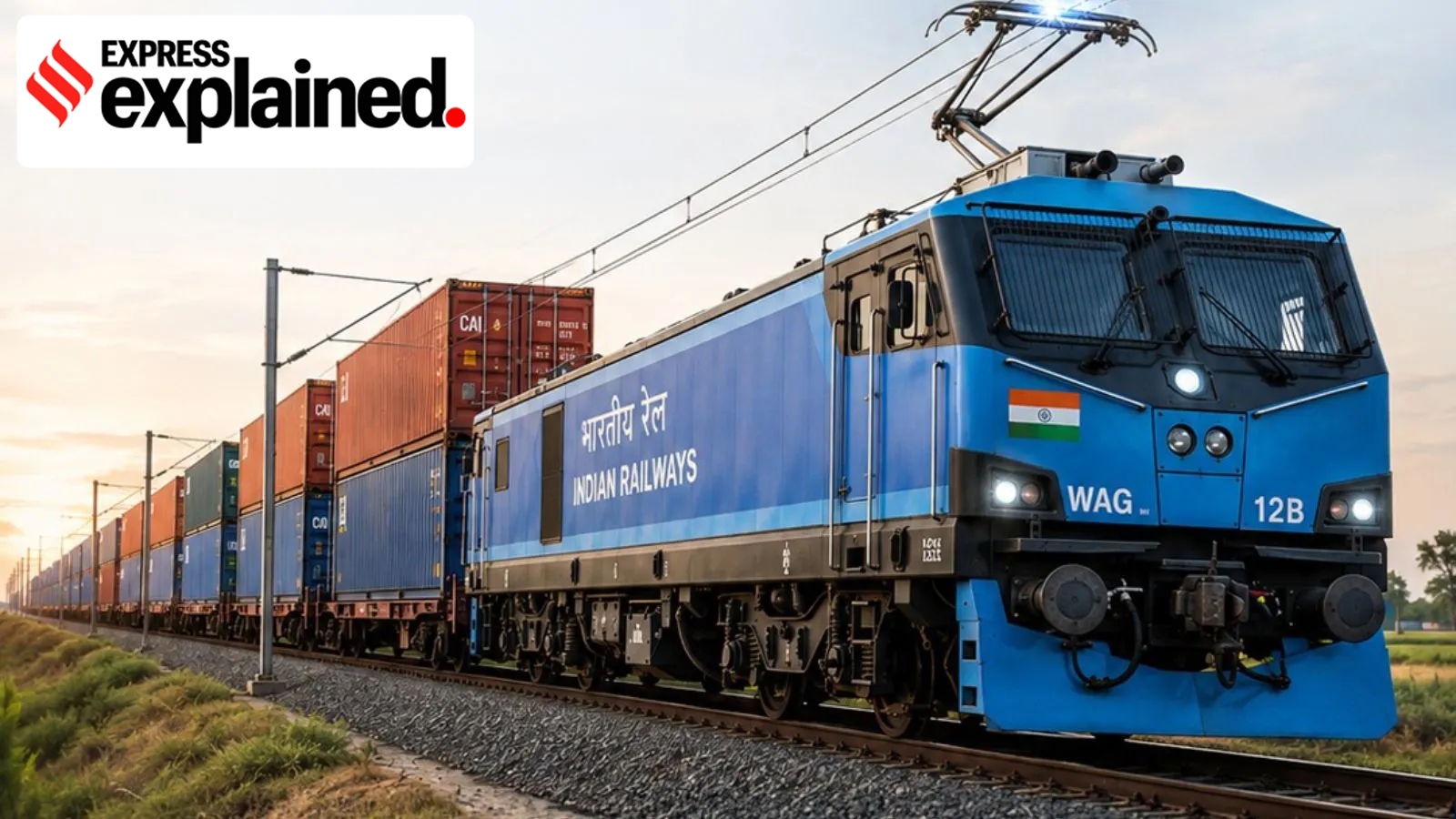
Prime Minister Narendra Modi has inaugurated the final three sections of the Western Dedicated Freight Corridor (WDFC), completing the 1,506-km stretch from JNPT to Dadri. This milestone marks a paradigm shift in India's freight movement, doubling train speeds and optimizing supply chains.
- Final 326 km sections of WDFC inaugurated, completing the 1,506 km route from JNPT to Dadri.
- Average freight speeds on DFCs have doubled to over 50 kmph compared to conventional tracks.
- Project funded by World Bank (₹14,900 cr) and JICA (₹38,722 cr) to boost rail freight share to 45% by 2030.
In a significant boost to India's logistics infrastructure, Prime Minister Narendra Modi inaugurated the final three sections of the Western Dedicated Freight Corridor (WDFC) in Vadodara. These segments—New Sanand (N)-New Makarpura, New Umbergaon-New Saphale, and New Saphale-New Jawaharlal Nehru Port Trust (JNPT)—spanning 326 kilometers, were developed at a cost exceeding ₹20,700 crore. This completion closes the loop on the 1,506-km corridor connecting Navi Mumbai's JNPT to Dadri in Uttar Pradesh.
The WDFC is strategically designed to handle ISO containers from major ports including JNPT, Mumbai Port, Pipavav, Mundra, and Kandla, directing them toward Inland Container Depots (ICDs) in North India, specifically Tughlakabad (Delhi), Dadri (UP), Dhandari Kalan (Punjab), and Khatuwas (Rajasthan). Beyond containers, the corridor will facilitate the movement of essential commodities such as fertilizers, foodgrains, coal, iron, steel, and cement.
Why This Matters
BozokMedia analysis shows that the separation of freight from passenger traffic is the single most critical upgrade for Indian Railways in decades. By eliminating the 'congestion bottleneck' of shared tracks, the DFCs allow for higher axle loads and consistent speeds. This reduces the 'last-mile' friction and significantly lowers the cost of doing business in India, making exports more competitive globally.
The DFCs represent a transition from a legacy railway system to a precision-driven logistics network capable of supporting a $5 trillion economy.
Parallel to the WDFC, the 1,337-km Eastern Dedicated Freight Corridor (EDFC), running from Ludhiana (Punjab) to Sonnagar (Bihar), was fully commissioned in October 2023. While the WDFC focuses on port-led container traffic, the EDFC primarily caters to the heavy coal and mineral traffic from India's eastern industrial belt.
Historical Background & Financing
The conceptualization of the DFC began in April 2005 during a Japan-India bilateral meeting. To ensure professional execution, the Dedicated Freight Corridor Corporation of India Limited (DFCCIL) was established as a Special Purpose Vehicle. The financial architecture of the project relied heavily on international debt funding, with the World Bank contributing ₹14,900 crore and the Japan International Cooperation Agency (JICA) providing ₹38,722 crore, supplemented by Indian government budgetary support.
| Feature | WDFC (Western) | EDFC (Eastern) |
|---|---|---|
| Total Length | 1,506 km | 1,337 km |
| Key Route | JNPT (Mumbai) to Dadri (UP) | Ludhiana (Punjab) to Sonnagar (Bihar) |
| Primary Cargo | Containers, Port Traffic, Fertilizers | Coal and Minerals |
Looking ahead, the Indian government has announced plans for a third corridor connecting Dankuni in West Bengal to Surat in Gujarat. The Detailed Project Report (DPR) for this new link is currently under preparation, signaling a long-term vision for a nationwide dedicated freight grid.
Frequently Asked Questions
Q1: How do DFCs improve efficiency over traditional lines?
A: By removing passenger train interference, DFCs allow freight trains to run at double the average speed (50+ kmph) and carry heavier loads.
Q2: What is the target for rail freight share by 2030?
A: The National Rail Plan aims to increase the share of freight traffic by rail from the current 27% to 45% by 2030.