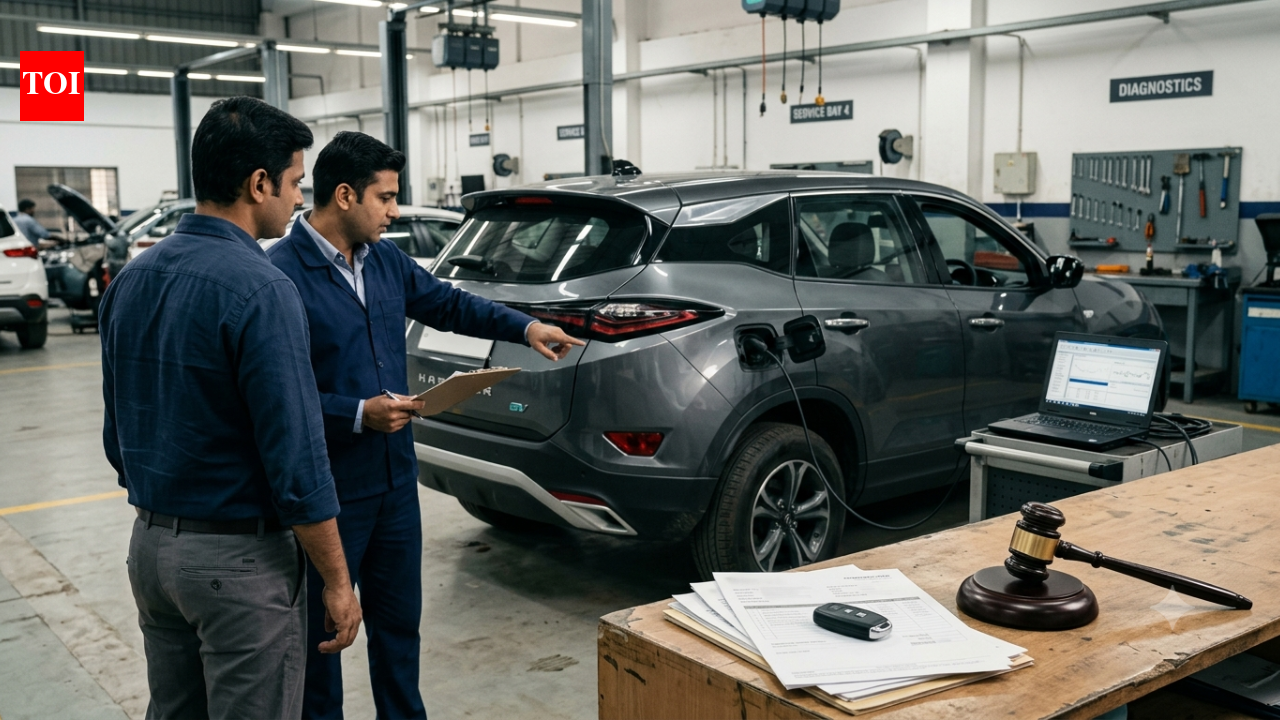
The Hyderabad District Consumer Commission has ordered Tata Select Motors to refund a customer for a defective Tata Harrier EV following repeated technical malfunctions.
- Tata Harrier EV experienced repeated smart-key and central-locking failures.
- Commission ordered a refund after 10% depreciation.
- Customer awarded ₹50,000 for mental agony and ₹15,000 in costs.
In a significant ruling for the automotive sector, the Hyderabad District Consumer Commission has directed Tata Select Motors to take back a Tata Harrier EV and refund the purchase price to the buyer. The decision follows a series of persistent technical failures that rendered the premium electric vehicle unreliable shortly after purchase.
Background of the Dispute
The complainant, a partnership firm represented by Pawan Bagrecha, purchased a Tata Harrier EV Empowered + 75 APC on August 1, 2025, for ₹27.98 lakh. Within days of delivery, the vehicle began exhibiting critical issues, including smart-key connectivity failures and central-locking malfunctions. According to the complaint, the vehicle stalled mid-way on multiple occasions, occurring four times within just one month of ownership.
While the dealer initially attributed these issues to a mere software glitch and attempted repairs, the problems persisted. The complainant subsequently sought a full refund and compensation for the mental harassment and financial strain caused by the defective product.
Why This Matters: BozokMedia Analysis
BozokMedia analysis shows that this verdict sets a critical precedent for the burgeoning Electric Vehicle (EV) market in India. As manufacturers transition to software-defined vehicles, the boundary between 'software glitches' and 'manufacturing defects' is becoming blurred. This case highlights that software updates are not a universal panacea for hardware-software integration failures, and dealers cannot evade liability by blaming the manufacturer if the service provided is deficient.
Frequent mechanical or electronic failures in a new vehicle constitute a clear deficiency in service, regardless of whether the manufacturer is a direct party to the suit.
The commission scrutinized the service history and job cards, noting that the repeated nature of the complaints—even after multiple repair attempts—established a clear pattern of deficiency. The bench, led by President B Uma Venkata Subba Lakshmi, observed that the dealer failed to provide a valid explanation for why the issues continued to plague the vehicle.
The Commission's Verdict
The commission declined to award the massive ₹10 lakh punitive damages sought by the complainant, stating that compensation should be fair and equitable rather than a source of profit. However, it ordered the dealer to refund the vehicle's price after a 10% depreciation deduction. Additionally, the buyer was awarded ₹50,000 for mental agony and ₹15,000 for legal costs.
The dealer has been given 45 days to comply with the order. Failure to do so will result in an additional 9% annual interest on the refund amount from the date of the order.
Frequently Asked Questions
1. Why was depreciation deducted from the refund?
The commission applied a standard 10% depreciation rule to account for the usage of the vehicle during the period it was with the owner.
2. Can a dealer avoid liability by saying they are just a service center?
No, the commission ruled that the dealer who executes the sale is liable for delivering a defective vehicle to the customer.