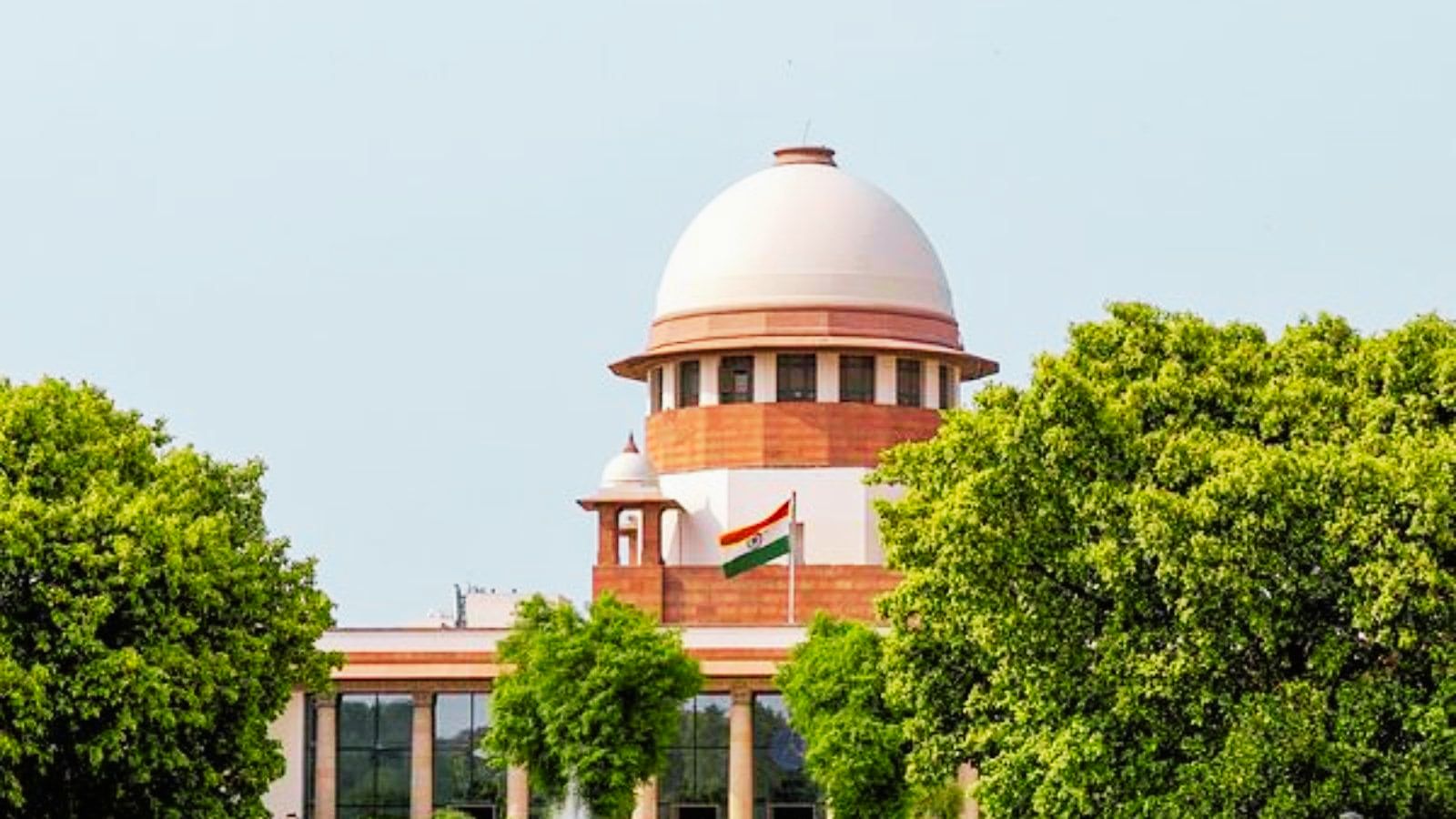
The Supreme Court is set to examine whether classifying English as a 'non-indigenous' language under the CBSE's three-language formula is constitutionally valid. The bench raised concerns over the practical implementation of the NEP 2026-27 policy.
- The Supreme Court will probe the constitutionality of treating English as a 'non-indigenous' language.
- The CBSE's three-language formula under NEP requires students to learn three languages, including two native Indian languages.
- Concerns were raised regarding the lack of infrastructure and trained teachers for the 2026-27 rollout.
New Delhi: In a significant legal development, the Supreme Court of India has questioned the classification of English as a 'non-indigenous' language under the Central Board of Secondary Education's (CBSE) proposed three-language policy. The court remarked that the constitutionality of this classification must be examined, given the deep-rooted presence of English within Indian society.
The Constitutional Debate
The observations were made during a hearing involving petitions challenging the CBSE's decision to implement the three-language formula under the National Education Policy (NEP) starting from the 2026-27 academic year. A three-judge bench, led by Chief Justice of India Surya Kant, deliberated on whether the term 'non-native' accurately reflects the linguistic landscape of modern India.
Additional Solicitor General Aishwarya Bhati, representing the CBSE, argued that while English is an official language under the Constitution, it cannot be treated as a 'native' language because language serves as a vehicle for specific cultures. However, Justice Bagchi expressed reservations about the terminology, suggesting that 'non-indigenous' carries a colonial undertone and that the term 'indigenous' would be more appropriate.
The historical perspective of English in India suggests its roots are far deeper than a mere colonial legacy.
Implementation and Infrastructure Hurdles
Beyond the linguistic debate, the court expressed serious concerns regarding the practical feasibility of the policy. Petitioners argued that categorizing English as non-native places an undue burden on students. The bench specifically questioned whether the current batch of Class 6 students could be granted a reprieve due to the lack of adequate school infrastructure.
BozokMedia analysis shows a massive disparity in the education sector: while CBSE governs only about 4% of schools, a staggering 96% fall under State Boards. This asymmetry poses a significant challenge for the standardized implementation of the NEP. Furthermore, the shortage of B.Ed-qualified teachers for regional languages like Sanskrit highlights a critical gap in the educational ecosystem.
Historical Context of Language Policy
Language politics in India has been a cornerstone of constitutional discourse since independence. The struggle to balance regional identities with a national link language has led to various iterations of language policies. The current NEP attempts to prioritize mother tongues, but the global and administrative dominance of English continues to challenge these frameworks.
Frequently Asked Questions
1. What is the CBSE three-language formula?
It is a policy requiring students to study three languages, with at least two being native Indian languages.
2. Why is the Supreme Court involved?
The court is reviewing the constitutionality of classifying English as 'non-indigenous' and the readiness of schools to implement the NEP.