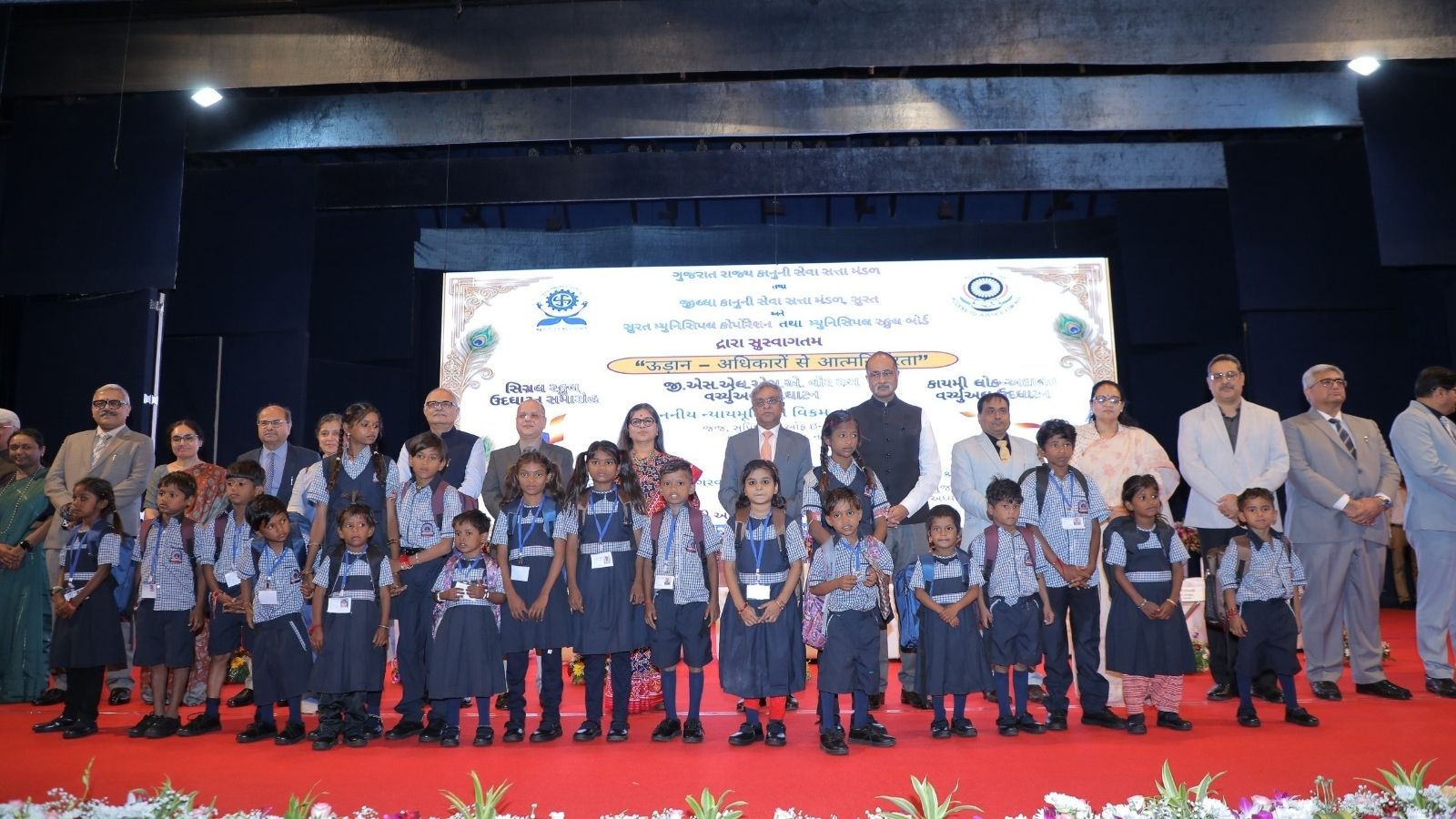
Supreme Court Judge Justice Vikram Nath launched the 'Signal School Bus' initiative in Surat, aimed at bringing education and social integration to children living at traffic signals.
- The 'Signal School Bus' initiative seeks to integrate children at traffic signals into the mainstream education system.
- Justice Vikram Nath described the bus as a 'strong bridge' rather than just a vehicle.
- The project follows successful implementation in Ahmedabad and is now expanding to Surat.
- Three major legal-tech projects, including the GSLSA War Room and E-PLA, were also launched.
Surat, Gujarat: In a profound move to uplift the most vulnerable sections of society, Supreme Court Judge and NALSA Executive Chairman Justice Vikram Nath officially flagged off the 'Signal School Bus' initiative in Surat on Saturday. The project is designed to transform the lives of children often seen at traffic signals, turning them from invisible bystanders into active participants in society.
Addressing the gathering, Justice Nath shared a poignant observation: when a traffic light turns green, drivers move forward, but the child at the signal remains stuck. He emphasized that these children should not be viewed merely as individuals seeking help, but as children with the inherent potential to study, play, and dream of a bright future.
Bringing Education to Their Doorsteps
Unlike traditional models that wait for children to find their way to a classroom, this initiative proactively "takes education to the child's home." Justice Nath elaborated that the process involves reaching out to families, providing foundational education and cultural values, and eventually facilitating formal admission into regular government schools.
The Signal School Bus is not just a vehicle, but a strong bridge connecting the child to the mainstream of society.
The initiative marks a significant expansion of a successful model previously implemented in Ahmedabad. By targeting the root causes of educational disparity, the project aims to ensure that socioeconomic status does not dictate a child's destiny.
Technological Advancement in Legal Services
The event was not limited to the school bus launch; it also marked a digital revolution in the Gujarat legal landscape. BozokMedia analysis shows that the integration of real-time monitoring and paperless systems is set to redefine legal accessibility in the state. The following projects were unveiled:
| Project Name | Primary Function | Scope/Impact |
|---|---|---|
| Signal School Bus | Mobile Education & Hygiene | Mainstreaming signal children |
| GSLSA War Room | Real-time Monitoring | 32 Districts & 4,200+ PLVs |
| E-Permanent Lok Adalat | Paperless Dispute Resolution | Surat, Ahmedabad, Rajkot, Vadodara |
Chief Justice Sunita Agarwal of the Gujarat High Court highlighted the critical challenge of student retention. While enrolling children is a start, preventing them from dropping out is the ultimate goal. She noted that the Gujarat State Legal Service Authority (GSLSA) is working tirelessly to monitor and support these students through various community-level interventions.
Historically, the education of street children has been a fragmented effort. This structured approach, combining social welfare with legal oversight, offers a holistic solution to systemic poverty and illiteracy.
Frequently Asked Questions
1. What makes the Signal School Bus unique?
It is a proactive mobile unit that brings education and hygiene training directly to children at traffic signals, facilitating their transition to formal schools.
2. How does the GSLSA War Room function?
It is an in-house digital monitoring center at the Gujarat High Court that tracks legal service activities across 32 districts to ensure efficiency and transparency.